


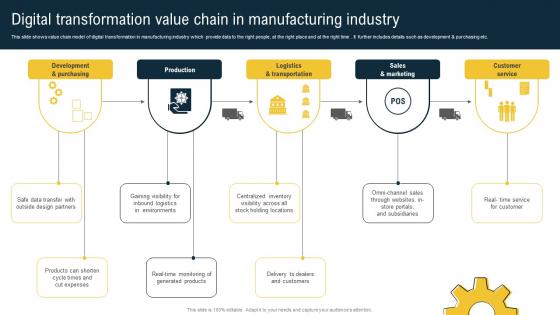
Digital Transformation Value Chain In Manufacturing Industry




Try Before you Buy Download Free Sample Product
 Impress Your
 Audience
 100%
100% Editable
 Save Hours
 of Time


This slide shows value chain model of digital transformation in manufacturing industry which provide data to the right people, at the right place and at the right time. It further includes details such as development and purchasing etc.
People who downloaded this PowerPoint presentation also viewed the following :
Digital Transformation Value Chain In Manufacturing Industry with all 9 slides:
Use our Digital Transformation Value Chain In Manufacturing Industry to effectively help you save your valuable time. They are readymade to fit into any presentation structure.








FAQs for Digital Transformation Value Chain
**INPUT**: What are the key components of a successful digital transformation strategy? **OUTPUT**: Key components include cloud infrastructure, data analytics capabilities, process automation, employee training programs, and customer experience enhancement technologies. These elements work together by streamlining operations, enabling data-driven decisions, and improving service delivery, with many organizations finding that strategic integration of these components delivers competitive advantage and measurable efficiency gains. [Word count: 54 words]
Organizations measure digital transformation ROI through key performance indicators like operational efficiency gains, cost reduction percentages, customer satisfaction scores, revenue growth metrics, and employee productivity improvements. Many companies track these across departments, comparing pre-transformation baselines with post-implementation results, while financial services and retail sectors increasingly find that customer acquisition costs and processing times deliver the clearest ROI evidence.
Leadership drives digital transformation by establishing clear vision, allocating resources strategically, fostering innovation culture, and championing change management initiatives across all organizational levels. Effective leaders in manufacturing, healthcare, and financial services enable seamless technology adoption, employee upskilling, and process optimization, ultimately delivering competitive advantage and operational efficiency in an increasingly digital business landscape.
Businesses can identify the right technologies by assessing current operational gaps, defining clear transformation objectives, evaluating scalability requirements, and conducting thorough cost-benefit analyses. Through strategic audits and pilot programs, organizations in manufacturing, healthcare, and financial services streamline processes, enhance customer experiences, and improve data analytics capabilities, ultimately delivering competitive advantages and measurable ROI that align with long-term business goals.
Common digital transformation pitfalls include inadequate change management, insufficient employee training, unrealistic timelines, poor data integration strategies, and lack of executive alignment. Organizations often underestimate cultural resistance and technical complexities, with many finding that successful transformations require gradual implementation, comprehensive staff development, and continuous stakeholder engagement to ensure sustainable adoption and measurable business outcomes.
Employee training and culture shift support digital transformation by building digital literacy, encouraging innovation mindsets, and fostering change acceptance throughout organizations. Through comprehensive upskilling programs and leadership modeling, companies streamline adoption processes, minimize resistance, and accelerate technology integration, with many finding that engaged, digitally-fluent workforces ultimately deliver faster implementation and sustained competitive advantage.
Data analytics accelerates digital transformation by enabling data-driven decision making, predictive insights, operational optimization, and customer behavior understanding. Through advanced analytics platforms, organizations streamline processes, reduce costs, and enhance customer experiences, with many financial institutions and retail companies finding that analytics-powered transformation delivers competitive advantage and measurable ROI improvements.
Small and medium-sized enterprises can leverage digital transformation through cloud-based solutions, automation tools, data analytics platforms, social media marketing, and e-commerce capabilities. These technologies enable SMEs to streamline operations, reduce costs, and enhance customer experiences while maintaining agility advantages over larger competitors, ultimately delivering faster decision-making and personalized services.
Customer feedback can be integrated into digital transformation strategies through real-time analytics platforms, automated survey systems, social media monitoring tools, and AI-powered sentiment analysis. These technologies enable organizations to continuously capture, analyze, and respond to customer insights, with many retail and financial services companies finding that this feedback-driven approach streamlines product development, enhances user experiences, and ultimately delivers more targeted digital solutions.
Cybersecurity best practices during digital transformation include implementing zero-trust architecture, conducting regular security audits, encrypting data at all stages, training employees on cyber threats, and establishing incident response protocols. These measures work by creating layered protection, minimizing vulnerabilities, and ensuring compliance, with many organizations finding that proactive security integration ultimately delivers operational confidence and competitive advantage.
Digital transformation revolutionizes supply chain management through real-time tracking, predictive analytics, IoT sensors, automated inventory systems, and AI-powered demand forecasting. These technologies enable manufacturers and retailers to minimize stockouts, reduce transportation costs, and enhance delivery speed, while providing complete visibility across global operations, ultimately delivering faster customer fulfillment and competitive advantage.
Digital transformation ethical considerations include data privacy protection, algorithmic bias prevention, employee displacement management, cybersecurity responsibilities, and transparent AI decision-making processes. Organizations increasingly find that addressing these concerns proactively through comprehensive governance frameworks, stakeholder engagement, and ethical technology policies ultimately delivers stronger customer trust, regulatory compliance, and sustainable competitive advantage in digital markets.
Organizations maintain customer trust during digital transformation by prioritizing transparent communication, ensuring robust data security, maintaining service continuity, and providing comprehensive support throughout transitions. By implementing gradual rollouts, offering multiple communication channels, and demonstrating clear value propositions, companies enable smoother customer adaptation while building confidence, ultimately delivering enhanced experiences and stronger long-term relationships.
The future of work involves remote collaboration, AI-augmented decision-making, automated routine tasks, continuous digital upskilling, and flexible hybrid models that enhance productivity. Through cloud technologies and intelligent systems, organizations streamline operations, reduce overhead costs, and deliver faster customer experiences, with many companies finding that strategic workforce digitization ultimately creates competitive advantage in an increasingly dynamic business landscape.
Partnerships and collaborations enhance digital transformation by providing specialized expertise, shared resources, and accelerated innovation that organizations may lack internally. Through strategic alliances with technology vendors, consulting firms, and industry peers, companies streamline implementation timelines, reduce costs, and access cutting-edge solutions, ultimately delivering faster market entry and competitive advantage.
-
A beautiful, professional design paired with high-quality images and content that is sure to impress. It is a must-use PPT template in my opinion.
-
SlideTeam is very efficient when it comes to saving time. I am happy that I chose them for my presentation.