


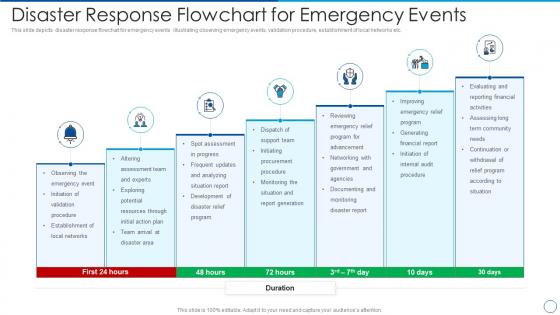
Disaster response flowchart for emergency events




Try Before you Buy Download Free Sample Product
 Impress Your
 Audience
 100%
100% Editable
 Save Hours
 of Time


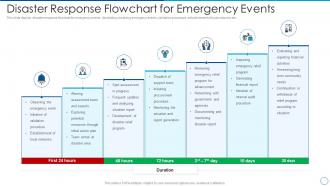
This slide depicts disaster response flowchart for emergency events illustrating observing emergency events, validation procedure, establishment of local networks etc.
People who downloaded this PowerPoint presentation also viewed the following :
Disaster response flowchart for emergency events with all 6 slides:
Use our Disaster Response Flowchart For Emergency Events to effectively help you save your valuable time. They are readymade to fit into any presentation structure.





FAQs for Disaster response flowchart
Okay so you need four main things. Communication protocols first - like who calls who when shit hits the fan. Then figure out your command structure so people aren't just running around confused. Resource management comes next - supplies, evacuation routes, shelter spots, that whole deal. Recovery planning too for getting back to normal afterward. Most places totally mess up the communication part though, people just panic and forget who they're supposed to call. I'd honestly start there - map out who contacts whom and actually practice it. Those tabletop exercises sound boring but they work.
Oh man, you really need backup systems in place *before* things go sideways. Satellite comms and mesh networks are lifesavers when cell towers get knocked out. Those offline apps? Total game-changers for coordinating your team. Social media actually becomes super valuable too - people post updates faster than news outlets sometimes. I'd honestly set up multiple communication channels now and train everyone on them. Mesh networks are kinda cool actually, they create their own little internet bubble. Point is, don't wait until disaster hits to figure this stuff out because redundancy is everything.
Honestly, your neighbors are gonna be way more helpful than FEMA in those first few hours. They already know who's elderly, which streets flood first, where the good escape routes are. My neighborhood actually did a practice run last year - sounds dorky but we figured out who has medical skills, generators, all that stuff. When disaster hits, outside help takes forever to show up. Communities that talk beforehand do so much better. Start small though - just chat with people on your block, maybe join a local group. That's really where it begins.
Honestly, your mental state makes a huge difference in how you handle disasters. Past trauma and stress levels totally affect whether you'll freeze up or actually help people. There's this weird "disaster brain fog" that happens too - like your brain just can't process stuff normally when everything's chaos. Recovery is where it gets really interesting though. People with good social support and decent mental health bounce back way faster. Others end up with PTSD or depression that lasts months. The whole thing convinced me that psychological help should be part of disaster planning from the start, not something you add later.
You've gotta map out where vulnerable people live *before* anything happens - that's huge. Partner with community leaders who already have trust built up, especially in underserved areas. They know exactly who needs help. Mobile units work great for folks who can't get around, and door-to-door checks are honestly amazing even though they eat up resources. Oh, and make sure you're communicating in different languages and formats. The biggest thing though? Build those relationships with local organizations now. Trust me, trying to earn people's trust while everything's falling apart just doesn't work.
Hey! So training sims are honestly a game-changer for first responders. You get to mess up without anyone actually dying, which is pretty valuable when you think about it. Building collapses, hazmat situations - practice it all safely while your muscle memory kicks in. The feedback happens instantly too, so you can run scenarios over and over until it's automatic. Your team learns to talk under pressure, coordinate when things get chaotic. Oh and the stress feels real, which I didn't expect at first. Start with whatever emergencies happen most in your area, then build up to those crazy multi-agency situations later.
Honestly, it's mostly communication chaos and nobody knowing who's actually running things. Different agencies roll up with incompatible radio systems and conflicting protocols - total mess. Plus you've got jurisdictional pissing contests because apparently even during disasters, people get territorial about their turf. Resources become this whole nightmare too when everyone's fighting over the same limited supplies. The smart move? Figure out your command structure and communication beforehand, not when everything's already going sideways. Way easier said than done though.
Social media's honestly your best bet for getting info out fast during emergencies. Twitter works great for quick alerts, Facebook's better for longer posts with maps attached, and Instagram's perfect for showing actual damage with photos. The speed is insane - you'll reach thousands instantly instead of waiting on traditional media. Just make sure you're posting from verified official accounts and keep messaging consistent across platforms. Oh, and definitely have someone monitoring comments and DMs because that's where people go first with questions. I'd probably assign that to someone specific so nothing gets missed.
Honestly, the real-time stuff is a game changer for emergency response. You can track traffic patterns to figure out the fastest evacuation routes, plus predict where you'll need the most resources. The flood and fire modeling tech has gotten insanely good - almost creepy how accurate it is now. Supply distribution becomes way easier to monitor, and you can spot vulnerable populations who need extra support. My cousin works in emergency management and swears by having all your data systems ready beforehand. Don't wait until disaster strikes to set up dashboards - that's when people actually need help.
Registration and screening first - you can't just let random people show up. Get team leaders for groups of 8-10 max, trust me on this one. Without proper coordination, volunteers honestly make things worse sometimes. Everyone needs a quick orientation covering safety rules, who's in charge, and their actual job for the day. Oh and keep records of who worked when for insurance stuff - learned that the hard way. Set up one central check-in spot where people report before they do anything else. Don't skip the briefing even if you're swamped.
Honestly, climate change is making disasters way more intense and frequent than before. Your old emergency plans? They're probably based on weather patterns that don't exist anymore. We're getting stronger hurricanes, crazy flooding in places that never flooded, droughts lasting forever. It's wild when you see the actual numbers. Better early warning systems are a must now. Also need to check if your evacuation routes even work with the new flood zones - some roads might be underwater when you need them most. The whole approach has to shift from just reacting after disasters hit to actually preparing for what's coming.
Ugh, disaster response ethics are such a nightmare to navigate. You're trying to help people fast but can't just bulldoze over their rights and dignity. Consent gets super tricky when folks are traumatized. Then there's making sure resources get distributed fairly - easier said than done. Cultural stuff matters too, which everyone kinda forgets about in the chaos. Plus you've got liability issues with volunteers and privacy concerns when collecting people's info. It's always this tension between what's good for everyone versus individual choice. Honestly? Figure out your protocols way ahead of time so you're not scrambling to make these calls when everything's falling apart.
Dude, you can't just tack health stuff onto disaster plans at the last minute - it never works. First thing? Figure out where your vulnerable people are living (elderly folks, anyone with chronic conditions, low-income areas). Map that out. Get tight with your local health department beforehand and stash medical supplies strategically. Set up communication systems for health alerts too. Trust me, once chaos hits, medication shortages and shelter outbreaks happen crazy fast. Oh, and those temporary clinic locations? Nail those down now. Having solid relationships and protocols ready makes all the difference when everything goes sideways.
Post-disaster assessments are honestly a game-changer for learning what went wrong. There's always stuff that worked great on paper but fell apart in reality - communication breakdowns, resource gaps, coordination nightmares. You'll spot community vulnerabilities you totally missed during planning too. The trick is getting everything documented while people still remember the details (memories fade fast after crisis mode). Then you can actually fix your emergency plans instead of making the same mistakes twice. It's like a reality check for your whole response strategy, which sounds boring but really isn't.
Dude, cultural stuff is huge in disaster response - like way bigger than people realize. Language barriers will mess you up fast, and religious practices can completely change how people react to help. I've seen entire operations tank because responders didn't get the local dynamics. Some communities won't trust outsiders, others have strict dietary needs you can't ignore. Traditional leaders? Work with them from day one, not when disaster hits. Building those relationships beforehand is everything - you don't want to be figuring out community politics while people need rescuing. Trust me on this one.
-
Much better than the original! Thanks for the quick turnaround.
-
Great product with effective design. Helped a lot in our corporate presentations. Easy to edit and stunning visuals.