


E Banking Management And Services Powerpoint Presentation Slides





Try Before you Buy Download Free Sample Product
 Impress Your
 Audience
 100%
100% Editable
 Save Hours
 of Time


E-banking is a form of banking in which transactions are completed electronically or through the internet. It lets banks digitally record customer details and account information, reducing operational costs and time. Grab our competently designed E Banking Management and Services template highlighting e banking trends, gap analysis, and process flow for the online banking system. It includes types of e banking such as internet banking, mobile banking, automated teller machine, plastic money, direct deposits, pays by phone systems, and point of sales transfer terminals. This PPT presents e banking services such as telephone banking, electronic clearing system, electronic fund transfer, insurance payment, and bill payments. It covers the e governance model, principles, e banking security threats and measures, and process flow for the cheque truncation system and its impact. Lastly, these PowerPoint slides depict the e-banking team, training plan, budget plan, and financial statements, including income statement, balance sheet and cash flow, and metric dashboards. Download our 100 percent editable and customizable template, which is also compatible with Google Slides. Get access now.
People who downloaded this PowerPoint presentation also viewed the following :
Content of this Powerpoint Presentation
Slide 1: This slide displays title i.e. 'E-banking management and services' and Your Company Name.
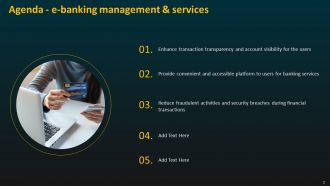
Slide 2: This slide presents agenda.
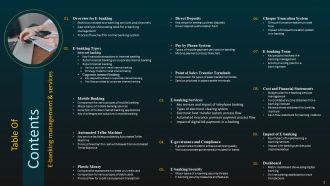
Slide 3: This slide exhibits table of contents.
Slide 4: This slide depicts title for three topics that are to be covered next in the template.
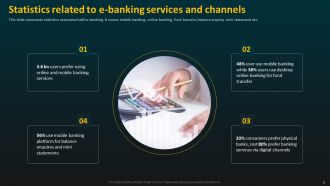
Slide 5: This slide represents statistics associated with e-banking.
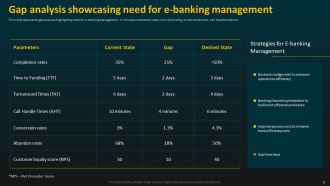
Slide 6: This slide represents gap analysis highlighting need for e-banking management.
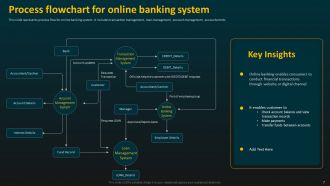
Slide 7: This slide represents process flow for online banking system.
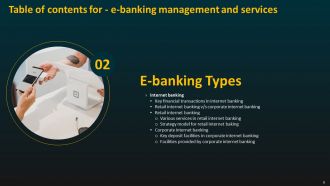
Slide 8: This slide depicts title for seven topics that are to be covered next in the template.
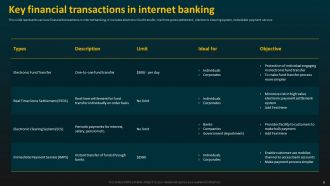
Slide 9: This slide represents various financial transactions in internet banking.
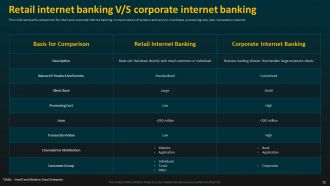
Slide 10: This slide represents comparison for retail and corporate internet banking.
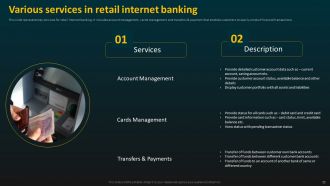
Slide 11: This slide represents key services for retail internet banking.
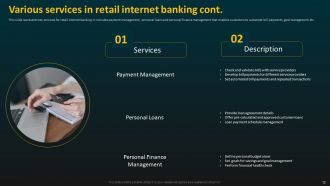
Slide 12: This slide represents key services for retail internet banking.
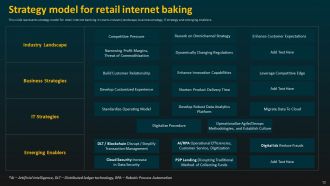
Slide 13: This slide represents strategy model for retail internet banking.
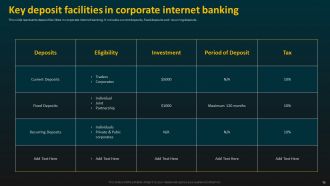
Slide 14: This slide represents deposit facilities in corporate internet banking.
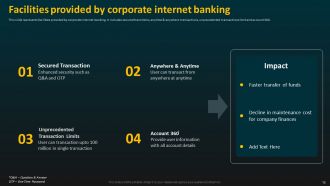
Slide 15: This slide represents facilities provided by corporate internet banking.
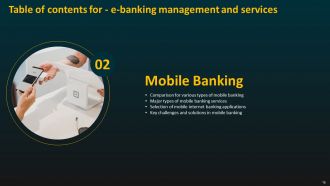
Slide 16: This slide depicts title for four topics that are to be covered next in the template.
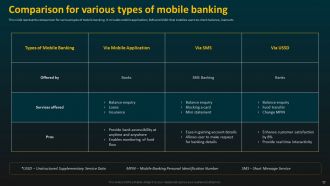
Slide 17: This slide represents comparison for various types of mobile banking.
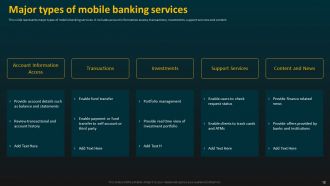
Slide 18: This slide represents major types of mobile banking services.
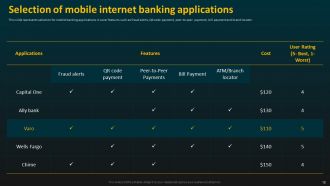
Slide 19: This slide represents selection for mobile banking applications.
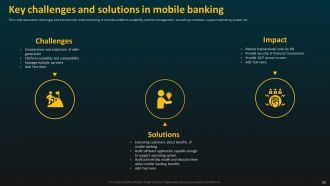
Slide 20: This slide represents challenges and solutions for mobile banking.
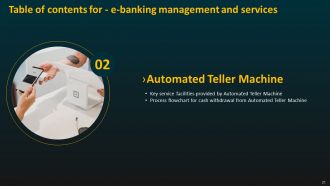
Slide 21: This slide depicts title for two topics that are to be covered next in the template.
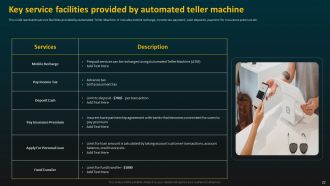
Slide 22: This slide represents service facilities provided by Automated Teller Machine.
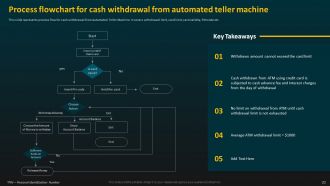
Slide 23: This slide represents process flow for cash withdrawal from Automated Teller Machine.
Slide 24: This slide depicts title for three topics that are to be covered next in the template.
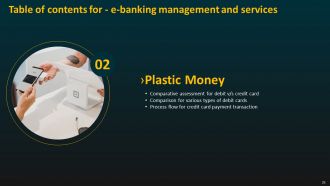
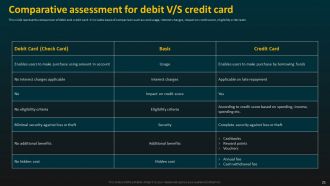
Slide 25: This slide represents comparison of debit and credit card.
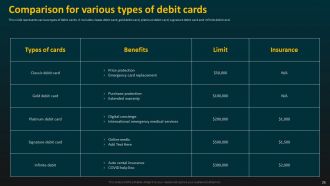
Slide 26: This slide represents various types of debit cards.
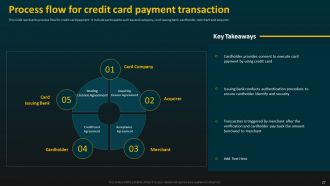
Slide 27: This slide represents process flow for credit card payment.
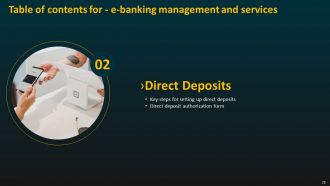
Slide 28: This slide depicts title for two topics that are to be covered next in the template.
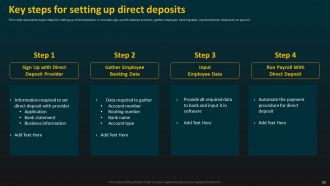
Slide 29: This slide represents major steps for setting up direct deposits.
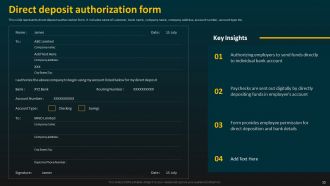
Slide 30: This slide represents direct deposit authorization form.
Slide 31: This slide depicts title for two topics that are to be covered next in the template.
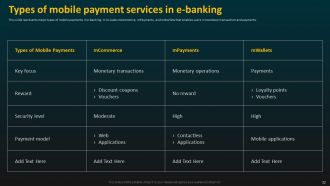
Slide 32: This slide represents major types of mobile payments in e-banking.
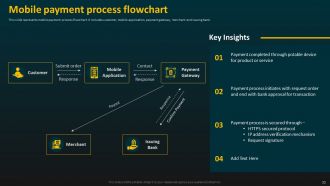
Slide 33: This slide represents mobile payment process flowchart.
Slide 34: This slide depicts title for two topics that are to be covered next in the template.
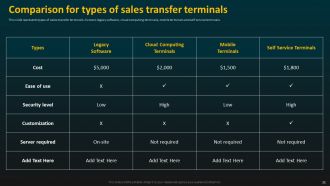
Slide 35: This slide represents types of sales transfer terminals.
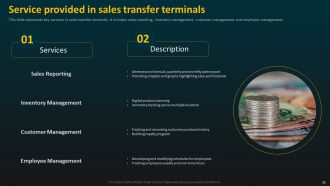
Slide 36: This slide represents key services in sales transfer terminals.
Slide 37: This slide depicts title for five topics that are to be covered next in the template.
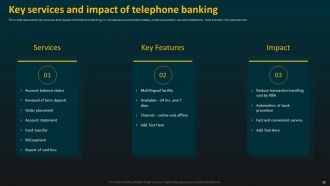
Slide 38: This slide represents key services and impact of telephone banking.
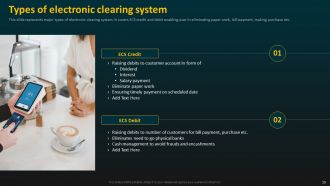
Slide 39: This slide represents major types of electronic clearing system.
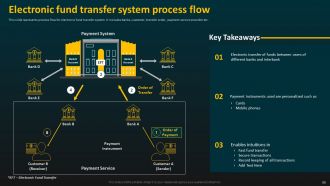
Slide 40: This slide represents process flow for electronic fund transfer system.
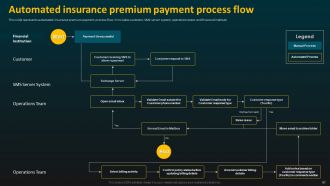
Slide 41: This slide represents automated insurance premium payment process flow.
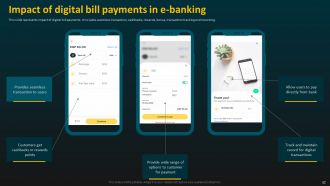
Slide 42: This slide represents impact of digital bill payments.
Slide 43: This slide depicts title for two topics that are to be covered next in the template.
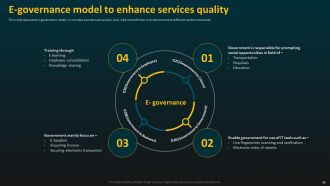
Slide 44: This slide represents e-governance model.
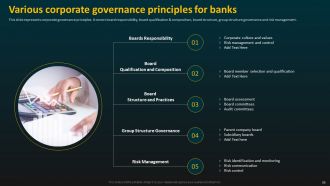
Slide 45: This slide represents corporate governance principles.
Slide 46: This slide depicts title for two topics that are to be covered next in the template.
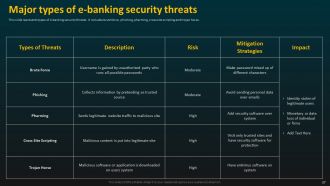
Slide 47: This slide represents types of e-banking security threats.
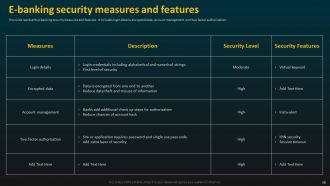
Slide 48: This slide represents e-banking security measures and features.
Slide 49: This slide depicts title for two topics that are to be covered next in the template.
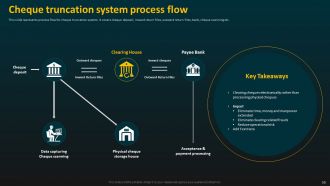
Slide 50: This slide represents process flow for cheque truncation system.
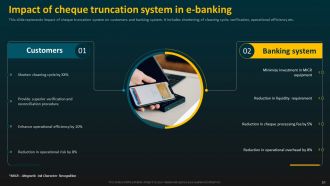
Slide 51: This slide represents impact of cheque truncation system on customers and banking system.
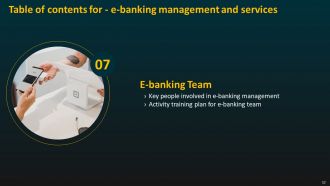
Slide 52: This slide depicts title for two topics that are to be covered next in the template.
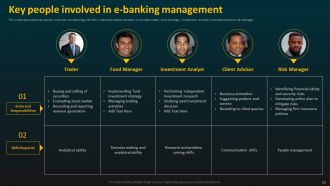
Slide 53: This slide represents key people involved in e-banking with their roles and responsibilities.
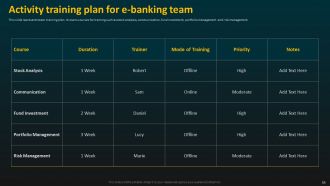
Slide 54: This slide represents team training plan.
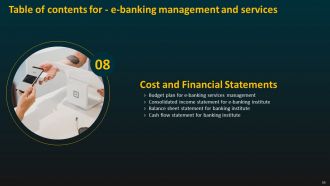
Slide 55: This slide depicts title for four topics that are to be covered next in the template.
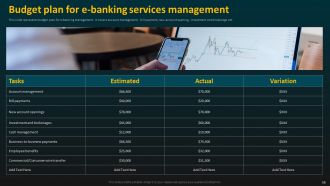
Slide 56: This slide represents budget plan for e-banking management.
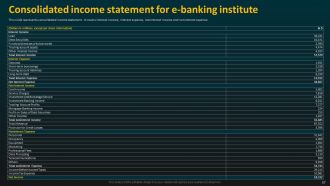
Slide 57: This slide represents consolidated income statement.
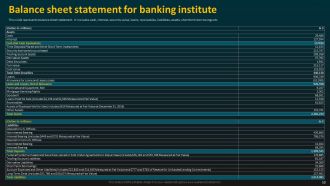
Slide 58: This slide represents balance sheet statement.
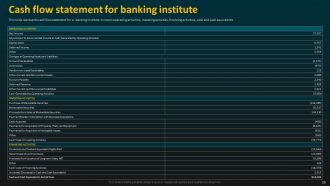
Slide 59: This slide represents cash flow statement for e- banking institute.
Slide 60: This slide depicts title for two topics that are to be covered next in the template.
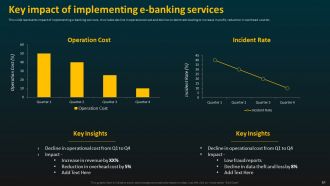
Slide 61: This slide represents impact of implementing e-banking services.
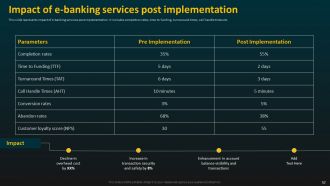
Slide 62: This slide represents impact of e-banking services post implementation.
Slide 63: This slide depicts title for two topics that are to be covered next in the template.
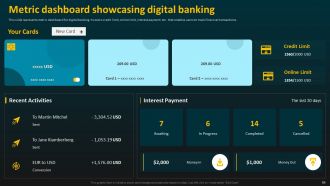
Slide 64: This slide represents metric dashboard for digital banking.
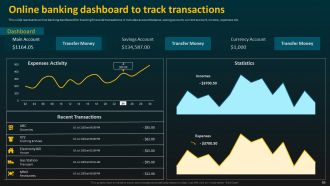
Slide 65: This slide represents online banking dashboard for tracking financial transactions.
Slide 66: This slide presents title for additional slides.
Slide 67: This slide depicts 30-60-90 days plan for projects.
Slide 68: This slide shows details of team members like name, designation, etc.
Slide 69: This slide presents your company's vision, mission and goals.
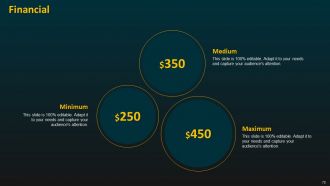
Slide 70: This slide showcases financials.
Slide 71: This slide depicts posts for past experiences of clients.
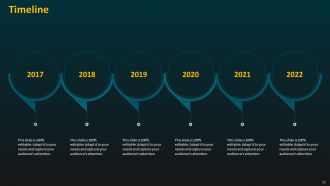
Slide 72: This slide exhibits yearly timeline.
Slide 73: This slide displays puzzle.
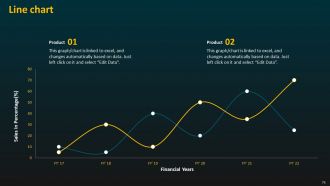
Slide 74: This slide exhibits yearly sales line charts for different products. The charts are linked to Excel.
Slide 75: This is thank you slide & contains contact details of company like office address, phone no., etc.
E Banking Management And Services Powerpoint Presentation Slides with all 80 slides:
Use our E Banking Management And Services Powerpoint Presentation Slides to effectively help you save your valuable time. They are readymade to fit into any presentation structure.











FAQs for E Banking Management And Services
Key components include secure authentication protocols, real-time transaction processing, comprehensive account management, mobile banking integration, and robust fraud detection systems. These technologies streamline banking operations by automating routine processes, enhancing customer experiences, and minimizing security risks, with many financial institutions finding that strategic integration ultimately delivers faster services and significant operational cost reductions.
E-banking enhances customer engagement and satisfaction by providing 24/7 accessibility, personalized financial insights, streamlined transaction processes, and instant service delivery across multiple digital channels. Through mobile apps and online platforms, banks enable customers to manage accounts seamlessly, access real-time support, and receive tailored recommendations, ultimately delivering convenience and improved banking experiences that build long-term loyalty.
Essential e-banking security measures include multi-factor authentication, end-to-end encryption, real-time fraud monitoring, secure socket layer protocols, and biometric verification systems. These technologies streamline protection by detecting suspicious activities, encrypting sensitive transactions, and verifying user identities, with many financial institutions finding that layered security approaches ultimately deliver enhanced customer trust while maintaining seamless banking experiences.
Banks leverage artificial intelligence in e-banking management through automated customer service chatbots, fraud detection algorithms, personalized financial recommendations, risk assessment automation, and predictive analytics for loan approvals. These AI technologies streamline operations by reducing processing times, enhancing security protocols, and improving customer experiences, with many financial institutions finding that strategic AI integration delivers significant cost reductions and competitive advantage.
Mobile banking serves as the primary customer touchpoint in e-banking, enabling account management, payments, transfers, and financial services through smartphones and tablets. It revolutionizes banking accessibility by delivering 24/7 convenience, real-time transactions, and personalized experiences, with many financial institutions finding that mobile platforms significantly reduce operational costs while enhancing customer engagement and competitive positioning.
Regulatory compliance requirements significantly shape e-banking management by mandating robust security protocols, data protection measures, transaction monitoring systems, and comprehensive audit trails. These frameworks, while requiring substantial investment in compliance infrastructure, ultimately enhance customer trust, reduce operational risks, and create competitive advantages for banks that seamlessly integrate regulatory standards into their digital service delivery.
Banks face implementation challenges including cybersecurity threats, regulatory compliance complexities, legacy system integration difficulties, customer adoption resistance, and substantial infrastructure costs. While these obstacles require strategic planning and significant investment, many financial institutions find that phased implementation approaches, robust security frameworks, and comprehensive staff training ultimately deliver enhanced operational efficiency, reduced transaction costs, and improved customer experiences in an increasingly digital banking landscape.
Banks can measure e-banking success through key performance indicators including user adoption rates, transaction volumes, customer satisfaction scores, digital channel usage, and cost-per-transaction metrics. Through advanced analytics platforms, financial institutions track service uptime, mobile app engagement, and customer retention rates, while monitoring operational efficiency improvements and reduced branch overhead costs, ultimately delivering enhanced customer experiences and competitive advantage.
Blockchain integration in e-banking delivers enhanced security, reduced transaction costs, faster cross-border payments, improved transparency, and streamlined regulatory compliance. Through distributed ledger technology, financial institutions can minimize fraud risks, accelerate settlement processes, and eliminate intermediaries, with many banks finding that blockchain ultimately provides competitive advantages in an increasingly digital banking landscape.
User experience design significantly impacts e-banking adoption by creating intuitive interfaces, streamlining navigation, and building user trust through seamless interactions. Banks with superior UX design see higher customer acquisition and retention rates, as simplified account management, faster transaction processing, and accessible mobile features ultimately deliver enhanced customer satisfaction and competitive advantage in the digital banking landscape.
Strategies to enhance e-banking customer loyalty include personalized services, seamless omnichannel experiences, proactive customer support, robust security measures, and competitive rewards programs. These approaches streamline customer interactions by delivering tailored financial solutions, reducing transaction friction, and building trust through transparent communication, with many banks finding that combining digital convenience with human touchpoints ultimately drives retention and increases customer lifetime value.
Data analytics transforms e-banking management by enabling predictive fraud detection, personalized customer experiences, and real-time risk assessment across all banking operations. Through machine learning algorithms, banks streamline loan approvals, optimize resource allocation, and enhance regulatory compliance, while delivering faster services and reduced operational costs, ultimately providing significant competitive advantages in increasingly digital financial markets.
Potential threats to e-banking systems include phishing attacks, malware infections, data breaches, identity theft, and transaction fraud targeting customer accounts and financial data. These vulnerabilities can be mitigated through multi-factor authentication, encryption protocols, real-time fraud monitoring, and regular security audits, with many financial institutions finding that comprehensive cybersecurity frameworks ultimately deliver enhanced customer trust and operational resilience.
Global trends in digital finance significantly influence e-banking strategies by driving adoption of mobile-first platforms, AI-powered personalization, and open banking APIs. These developments enable financial institutions to streamline customer onboarding, enhance fraud detection, and deliver seamless cross-border payments, with many banks finding that strategic integration of fintech partnerships ultimately delivers competitive advantage in an increasingly digital marketplace.
Future advancements in e-banking management systems include AI-driven personalization, blockchain-based security protocols, voice-activated banking interfaces, predictive analytics for risk assessment, and seamless omnichannel integration. These technologies streamline customer experiences by enabling real-time fraud detection, automated financial planning, and instant cross-platform transactions, with many financial institutions finding that enhanced digital capabilities ultimately deliver faster services and stronger competitive positioning.
-
Out of the box and creative design.
-
Easy to use and customize templates. Helped me give a last minute presentation.