


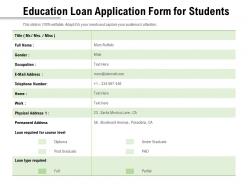
Education loan application form for students





Try Before you Buy Download Free Sample Product
 Impress Your
 Audience
 100%
100% Editable
 Save Hours
 of Time


Our Education Loan Application Form For Students are topically designed to provide an attractive backdrop to any subject. Use them to look like a presentation pro.
People who downloaded this PowerPoint presentation also viewed the following :
Education loan application form for students with all 2 slides:
Use our Education Loan Application Form For Students to effectively help you save your valuable time. They are readymade to fit into any presentation structure.
FAQs for Education loan application
Key eligibility criteria for education loans include admission confirmation to recognized institutions, co-applicant requirements, minimum academic scores, age limits, and income documentation from guarantors. These requirements streamline approval processes by ensuring repayment capacity, academic merit, and institutional credibility, with many banks finding that students meeting comprehensive criteria, especially for professional courses, ultimately secure favorable terms and competitive interest rates.
Students determine appropriate education loan amounts by calculating total academic costs including tuition, fees, living expenses, books, and miscellaneous costs, then subtracting available family contributions, scholarships, and grants. This strategic approach enables students to minimize debt burden while ensuring adequate funding, with many finding that borrowing conservatively and exploring additional aid sources ultimately delivers better financial outcomes upon graduation.
Education loans include federal subsidized and unsubsidized loans, private loans, parent PLUS loans, graduate PLUS loans, and institutional loans from colleges directly. These financing options differ by interest rates, repayment terms, credit requirements, and borrowing limits, with federal loans typically offering more flexible repayment options and borrower protections, while private loans often require credit checks but may provide higher borrowing amounts for students pursuing advanced degrees.
Education loan applications typically require academic transcripts, admission letters from educational institutions, income certificates, bank statements, tax returns, identity proof, and collateral documents if applicable. These requirements enable lenders to assess creditworthiness, verify educational plans, and streamline approval processes, with many financial institutions finding that comprehensive documentation accelerates loan processing and delivers faster access to educational funding.
Credit history significantly impacts education loan approval by determining interest rates, loan amounts, required collateral, and co-signer requirements. Strong credit scores enable students to secure lower rates and higher loan limits, while limited credit histories often require co-signers or parental guarantees, with many financial institutions finding that established credit relationships streamline approval processes and deliver more favorable terms.
Education loan interest rates are calculated based on factors including credit score, loan amount, repayment term, borrower's income profile, and institutional partnerships with lenders. Financial institutions typically use base lending rates plus risk premiums, with many banks offering preferential rates for premier educational institutions, co-signer arrangements, and strong academic performance, ultimately enabling students to secure competitive financing for their educational investments.
Yes, several government schemes support education loans, including interest subsidies under the Central Sector Interest Subsidy Scheme, tax deductions under Section 80E, and state-specific programs for economically weaker sections. These initiatives streamline access to higher education by reducing financial burden, offering collateral-free loans up to specific limits, and enabling students from diverse backgrounds to pursue quality education, ultimately enhancing skilled workforce development.
Applicants can improve education loan approval chances by maintaining strong credit scores, providing comprehensive financial documentation, securing co-signers with stable income, and choosing accredited institutions with favorable employment outcomes. Banks increasingly favor applications demonstrating clear repayment capacity through family income stability, academic performance records, and career prospects in high-demand fields, ultimately delivering better loan terms and faster approval processes.
Co-signers provide additional financial backing and creditworthiness to education loan applications, particularly when students lack established credit history or sufficient income. They assume joint responsibility for loan repayment, which significantly enhances approval odds and often secures better interest rates, with many lenders requiring co-signers for private student loans to minimize default risk.
Lenders assess repayment capacity through income verification, credit scores, employment stability, debt-to-income ratios, and academic program evaluation. Financial institutions like banks and credit unions analyze salary prospects, co-signer creditworthiness, and collateral value, while educational loan specialists increasingly use predictive analytics to evaluate career outcomes, ultimately delivering more accurate risk assessment and competitive interest rates.
Education loan processing typically takes 15-30 days, depending on documentation completeness, loan amount, and lender requirements, with some institutions offering expedited processing for pre-approved applicants. Banks and financial institutions streamline approval through digital verification systems, automated credit assessments, and dedicated education loan teams, ultimately delivering faster disbursements for students with complete documentation and strong co-signer profiles.
Student loan repayment options significantly impact financial planning, career flexibility, and long-term debt management through income-driven plans, standard repayment schedules, and deferment possibilities. These options enable graduates to align payments with earning capacity, pursue public service careers with forgiveness programs, and manage financial stress during career transitions, ultimately delivering greater educational accessibility and strategic career planning flexibility.
Students can leverage scholarships through merit-based applications, need-based grants, employer tuition assistance, and work-study programs to significantly reduce borrowing requirements. These financial aid strategies enable students to minimize loan amounts, reduce future interest payments, and accelerate debt-free graduation timelines, with many finding that combining multiple funding sources delivers substantial long-term financial advantages.
Common pitfalls include inadequate research on interest rates and terms, insufficient documentation preparation, poor credit score management, overlooking co-signer requirements, and failing to compare multiple lenders. These mistakes can result in loan rejections, unfavorable terms, or delayed approvals, with many students finding that thorough preparation and early application significantly improve their chances of securing optimal financing.
International students navigate education loan applications by researching lender requirements, gathering comprehensive documentation including transcripts and financial statements, securing co-signers when required, and comparing interest rates across multiple institutions. Many find success through specialized international student lenders, university partnerships, and government-backed programs in their home countries, ultimately securing funding that enables access to global educational opportunities while building credit history.
No Reviews