


Effective Decision Making With Risk Governance Framework




Try Before you Buy Download Free Sample Product
 Impress Your
 Audience
 100%
100% Editable
 Save Hours
 of Time


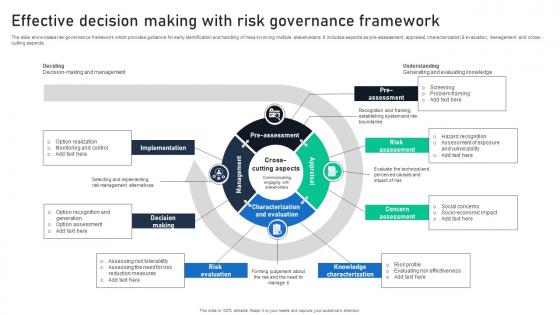
The slide showcases risk governance framework which provides guidance for early identification and handling of risks involving multiple stakeholders. It includes aspects as pre-assessment, appraisal, characterization and evaluation, management and cross-cutting aspects.
People who downloaded this PowerPoint presentation also viewed the following :
Effective Decision Making With Risk Governance Framework with all 6 slides:
Use our Effective Decision Making With Risk Governance Framework to effectively help you save your valuable time. They are readymade to fit into any presentation structure.





FAQs for Effective Decision Making With
Honestly, start by figuring out who's actually responsible for what risks right now - that'll expose all the messy gaps. Three things matter most: risk appetite that people genuinely get (not corporate speak), governance with real accountability, and assessment processes that actually influence decisions. Your board can't just nod along to everything either. Also need reporting systems so risks don't get stuck in silos. Oh, and create a culture where folks won't get thrown under the bus for flagging problems. I've seen too many places where people stay quiet because they're scared.
Start with getting your board to actually grasp what risks could torpedo your strategy - I know it sounds basic but so many companies blow this off. Map your big strategic goals against your biggest risks first. Then build your governance around those connections. Risk committees should constantly check if your risk appetite matches strategic priorities, and honestly? This conversation has to happen every time you make major strategic moves. Don't treat it like some quarterly checkbox - weave risk talks right into your strategy meetings from the start. Makes all the difference.
Culture's what really matters - it shapes how people act around risk, not some fancy policy document. When leadership only cares about hitting numbers, your team will absolutely cut corners and hide problems. Seen it happen way too many times. The real test? Watch how your senior leaders react when someone brings them bad news about risk. That reaction ripples down through everything. You'll know your culture's working when people actually speak up about concerns instead of just sweeping things under the rug. Daily decisions tell the whole story, honestly.
Honestly, tech can totally transform how you handle risk stuff. Automated data collection is huge - no more manual spreadsheets driving everyone crazy. Real-time dashboards give you the full picture, and AI catches patterns humans usually miss. Predictive analytics will flag problems before they explode (which is pretty sweet). Having everything centralized with decent visualization makes executive presentations way less painful. Workflow automation stops things from getting lost in approval hell too. My advice? Don't go overboard initially. Pick one annoying thing like manual reports and fix that first.
Honestly, the worst thing companies do is turn risk management into some bureaucratic checklist that nobody actually uses. Leadership still makes decisions based on hunches while these fancy risk registers just sit around doing nothing. Don't let your risk people work in a bubble either - I've seen way too many teams completely disconnected from what's actually happening operationally. Your board needs the real story, not some watered-down version that makes everything sound fine. The whole point is making risk part of how you actually run things daily, not just another meeting to endure.
Honestly, you'll want to track both hard numbers and softer stuff. Incident rates, response times, whether you're hitting risk targets - that's your baseline data. But here's what I've learned: sometimes the realest indicator is just asking people if they actually feel safe flagging problems. Survey your team, check what auditors are saying, see how you stack up against competitors. Oh, and definitely stress-test everything through scenario planning. Board reporting quality matters too. If your frameworks don't fall apart when things get messy, you're probably doing something right.
So risk governance is like the big-picture strategy stuff - your board deciding how much risk they're comfortable with and setting the overall direction. Compliance is more the nuts and bolts of actually following rules and regulations. Governance answers "who decides what" and "how much risk do we want." Compliance handles the day-to-day execution and reporting. Honestly, most companies are way better at compliance than governance because it's easier to just follow a checklist. You can't really do one without the other though. Great strategy means nothing if you can't execute it, and following rules blindly without understanding the bigger picture is pretty pointless.
Look, cybersecurity threats move insanely fast compared to normal business risks, so you can't stick with those old annual review processes. Hackers don't wait for your quarterly meetings, you know? Your governance has to get way more flexible - real-time monitoring, teams that actually communicate across departments, board members who get tech stuff. I mean, my company's CISO literally has nightmares about this. Short version: build systems that can shift gears quickly when new threats pop up. Don't wait around for the next scheduled risk assessment because by then you're already behind.
Dude, you'll get way better information when you actually talk to people first. Different groups spot problems you'd totally miss on your own. Plus they won't fight your decisions later if they helped make them - which honestly saves so much drama down the road. Trust builds up naturally when stakeholders feel heard instead of ignored. The trick is figuring out who actually matters for each situation (not just the obvious people) and having real conversations with them. Short cuts here always backfire. Two-way dialogue beats those fake consultation meetings every time.
Look, the main thing is keeping risk communication simple and regular - don't wait for disasters to start talking. Set up consistent reporting formats so everyone knows what's coming. I've watched way too many leadership teams get completely caught off guard because someone buried critical info in technical mumbo-jumbo. Translate everything into business terms that executives can actually understand and act on. You'll want clear escalation rules too - when does something need immediate attention vs routine check-ins? Honestly, most companies suck at this because they only think about communication channels after things blow up. Get your structure ready now.
Look, good risk governance is like having smoke detectors and a fire escape plan. You'll spot trouble early instead of running around screaming when everything's already burning. Set up clear ownership - who watches what, who decides what when shit hits the fan. Test your decision-making process beforehand too, because committees that take three weeks to approve lunch orders aren't gonna save you in a real crisis. Short version: build your early warning system now. Make sure people actually know their jobs when things get messy. Trust me, panic mode is not where you want to figure out who's supposed to do what.
For your risk dashboard, mix leading and lagging indicators - stuff like risk identification rates, how fast you're closing mitigation actions, incident frequency, and compliance scores. I'd definitely add risk culture survey results too. People think those are fluffy but they actually reveal what's really going down in the trenches. Track your risk appetite utilization and incident severity metrics. The trick is getting both backward-looking data and predictive stuff that tells you what's coming. Oh, and start small - maybe 5-7 key metrics instead of cramming everything onto one screen. Nobody wants to stare at a wall of charts.
So finance deals with crazy stuff like market crashes and regulatory nightmares - they're stuck with Basel III rules and constant stress testing. Healthcare's totally different though. Their boards obsess over patient safety and HIPAA compliance instead of market volatility. Banks have these risk committees meeting practically daily to freak out over market exposure. Meanwhile hospitals track patient incidents and quality metrics through clinical committees. Both are super intense, just worried about completely different disasters. Honestly? Just match your risk setup to whatever regulatory mess your industry throws at you. Way more effective than some generic approach.
Your board basically sets the risk limits and keeps management honest about following them. Think of them as the final backstop - they approve big risk policies, review those enterprise reports, and ask hard questions when stuff looks weird. This isn't where you want yes-men, honestly. Good board members will push back on management's assumptions and stay on top of everything from cyber risks to financial stuff. Just make sure they get clear, regular risk updates that aren't total snooze-fests, otherwise they can't really help you out.
Honestly, you've gotta bake flexibility into your risk stuff right from day one. Quarterly reviews are non-negotiable, but also set up those automatic triggers for when shit hits the fan. Here's what kills me though - most companies only loop in finance and compliance people for these conversations. Big mistake. You need different perspectives or you'll miss obvious blindspots. Keep scanning what's happening outside your bubble, and actually update your risk appetite when business reality changes. Oh, and make it stupidly easy for teams to flag new risks fast. Start by asking what could completely wreck your current assumptions in the next three months.
-
“You have the structure in place that are easy to explore new opportunities.I will be recommending your services to other people.”
-
“Easy to use. I always wanted to have a quick search for products and SlideTeam has helped me have it.”