


Effective Quality Assurance Strategy Implementation For Continuous Improvement Complete Deck




Try Before you Buy Download Free Sample Product
 Impress Your
 Audience
 100%
100% Editable
 Save Hours
 of Time


Get our Insightfully developed PowerPoint Presentation titled, Effective quality assurance strategy implementation for continuous improvement to assist your organization in developing a robust quality assurance plan. Additionally, our Quality assurance PPT ensures that products and services meet the highest standards and customer expectations. Within this Benchmarking deck, we also cover essential strategies that are fundamental to effective quality assurance. Moreover, this Standard Operating Procedures template provides your team with a comprehensive understanding of various approaches, such as developing well-rounded Quality Assurance Strategies to maintain product and service excellence. The presentation further delves into the power of Benchmarking, enabling you to analyze industry best practices and apply them to your organization to gain a competitive edge. Lastly, with our Quality assurance strategies PowerPoint template, your organization will experience significant benefits. Get access now.
People who downloaded this PowerPoint presentation also viewed the following :
Content of this Powerpoint Presentation
Slide 1: This slide introduces Effective Quality Assurance Strategy Implementation For Continuous Improvement. State Your Company Name and begin.
Slide 2: This slide is an Agenda slide. State your agendas here.
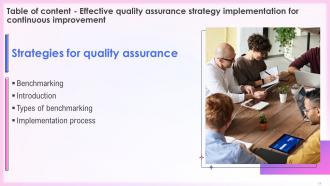
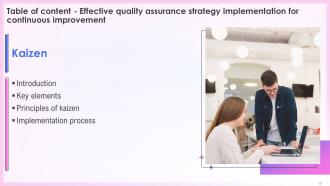
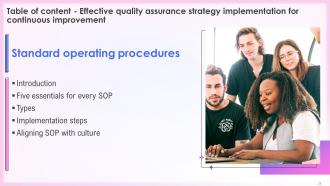
Slide 3: This slide shows a Table of Contents for the presentation.
Slide 4: This slide is an introductory slide.
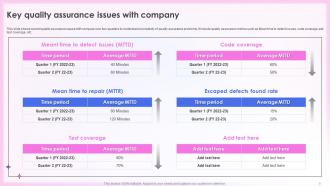
Slide 5: This slide shows current quality assurance issues with company over two quarters to understand complexity of quality assurance problems.
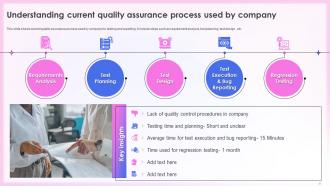
Slide 6: This slide showcases current quality assurance process used by company for testing and reporting.
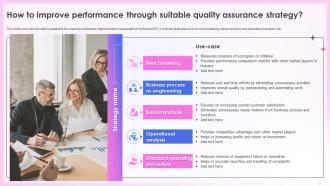
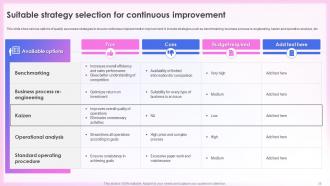
Slide 7: This slide entails various options available for ensuring continuous improvement in organization to enhance ROI.
Slide 8: This slide is an introductory slide.
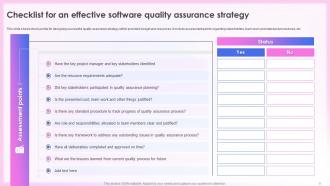
Slide 9: This slide presents check points for designing successful quality assurance strategy within provided budget and resources.
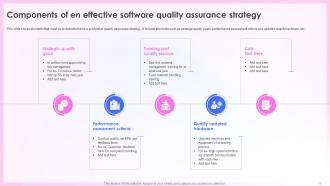
Slide 10: This slide highlights elements that must be included to frame a productive quality assurance strategy.
Slide 11: This slide is an introductory slide.
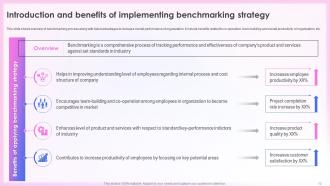
Slide 12: This slide outlines an overview of benchmarking process along with listed advantages to increase overall performance of organization.
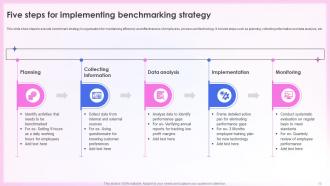
Slide 13: This slide represents steps to execute benchmark strategy in organization for maintaining efficiency and effectiveness of employees, process and technology.
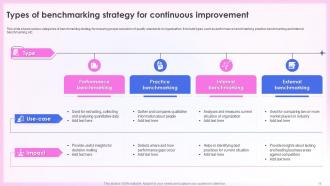
Slide 14: This slide offers various categories of benchmarking strategy for ensuring proper execution of quality standards in organization.
Slide 15: This slide is an introductory slide.
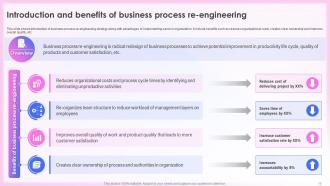
Slide 16: This slide compasses introduction of business process re-engineering strategy along with advantages of implementing same in organization.
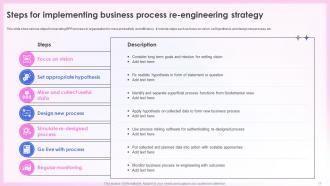
Slide 17: This slide outlines various steps for executing BPR process in organization for more productivity and efficiency.
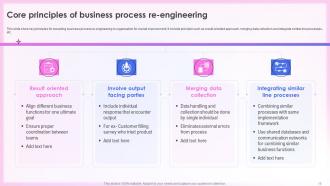
Slide 18: This slide caters to key principles for executing business process re-engineering in organization for overall improvement.
Slide 19: This slide is an introductory slide.
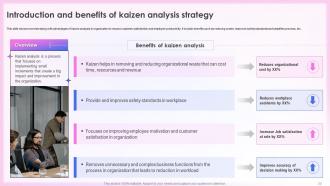
Slide 20: This slide contains overview along with advantages of kaizen analysis in organization to ensure customer satisfaction and employee productivity.
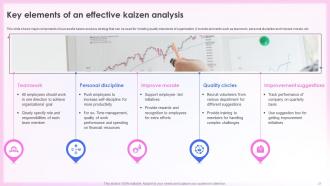
Slide 21: This slide illustrates major components of successful kaizen analysis strategy that can be used for meeting quality standards of organization.
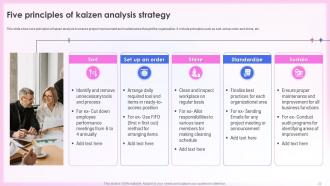
Slide 22: This slide shows core principles of kaizen analysis to ensure proper improvement and maintenance thought the organization.
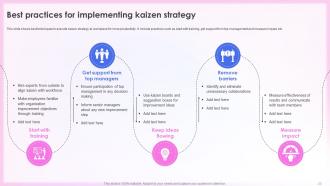
Slide 23: This slide showcases best techniques to execute kaizen strategy at workplace for more productivity.
Slide 24: This slide is an introductory slide.
Slide 25: This slide depicts overview of operational analysis strategy for analysing current situation of organization.
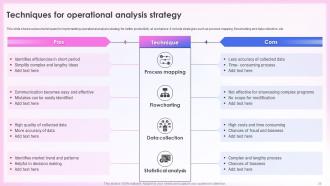
Slide 26: This slide describes various techniques for implementing operational analysis strategy for better productivity at workplace.
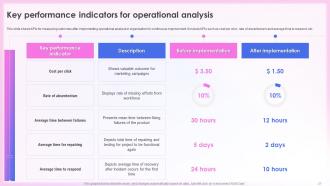
Slide 27: This slide shows KPIs for measuring outcomes after implementing operational analysis in organization for continuous improvement.
Slide 28: This slide is an introductory slide.
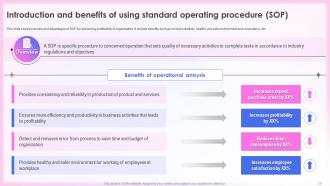
Slide 29: This slide demonstrates overview and advantages of SOP for enhancing profitability of organization.
Slide 30: This slide portrays five essential check-pints for every standard operating procedure for better improvement in organization.
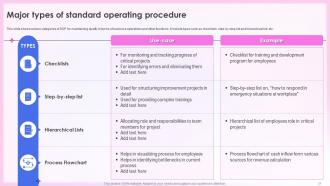
Slide 31: This slide puts various categories of SOP for maintaining quality in terms of business operations and other functions.
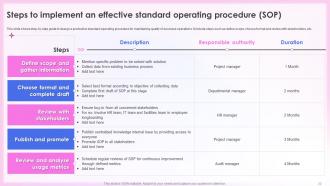
Slide 32: This slide shows step-by-step guide to design a productive standard operating procedure for maintaining quality of business operations.
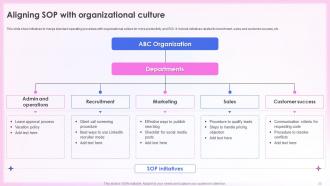
Slide 33: This slide showcases initiatives to merge standard operating procedure with organizational culture for more productivity and ROI.
Slide 34: This slide is an introductory slide.
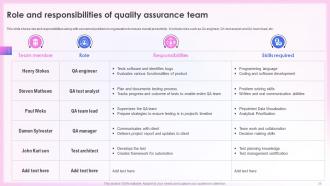
Slide 35: This slide puts role and responsibilities along-with concerned positions in organization to ensure overall productivity.
Slide 36: This slide entails organizational structure of quality control team in company to ensure smooth flow of work and authority.
Slide 37: This slide is an introductory slide.
Slide 38: This slide puts various options of quality assurance strategies to ensure continuous improvement in improvement.
Slide 39: This slide is an introductory slide.
Slide 40: This slide showcases improvements made in quality assurance process to correct defaults and enhance productivity.
Slide 41: This slide is an introductory slide.
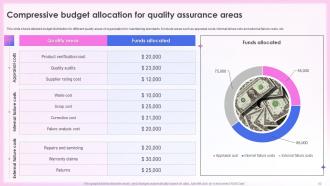
Slide 42: This slide outlines detailed budget distribution for different quality areas of organization for maintaining standards.
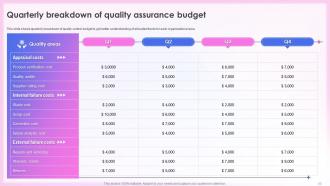
Slide 43: This slide possess quarterly breakdown of quality control budget to get better understanding of allocated funds for each organizational area.
Slide 44: This slide is an introductory slide.
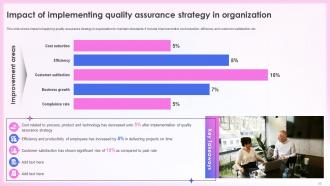
Slide 45: This side shows impact of applying quality assurance strategy in organization to maintain standards.
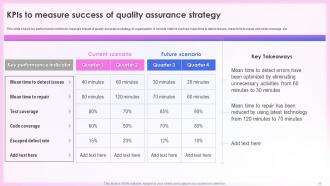
Slide 46: This slide outlines key performance metrics to measure impact of quality assurance strategy in organization.
Slide 47: This slide is an introductory slide.
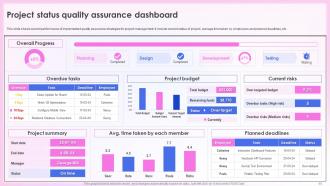
Slide 48: This slide shows current performance of implemented quality assurance strategies for project management.
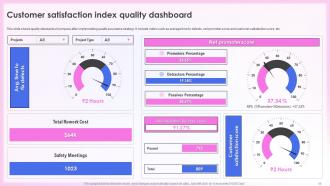
Slide 49: This slide showcases quality standards of company after implementing quality assurance strategy.
Slide 50: This slide shows all the icons included in the presentation.
Slide 51: This slide is titled Additional Slides for moving forward.
Slide 52: This slide is a financial slide. Show your finance-related stuff here.
Slide 53: This slide presents a Roadmap with additional text boxes.
Slide 54: This slide is one of our additional slides.
Slide 55: This slide is one of our additional slides.
Slide 56: This slide is a Timeline slide. Show data related to time intervals here.
Slide 57: This slide is Our Goal slide. State your Goals here.
Slide 58: This slide is Our Team slide with names and designations.
Slide 59: This is one of our additional slides.
Slide 60: This is one of our additional slides.
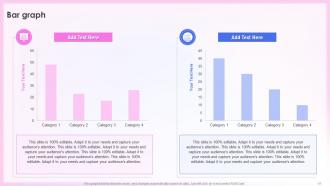
Slide 61: This slide shows information with the help of Bar Graph.
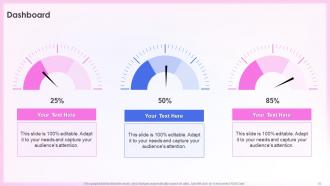
Slide 62: This slide shows information with the help charts.
Slide 63: This slide is a thank-you slide with address, contact numbers, and email address.
Effective Quality Assurance Strategy Implementation For Continuous Improvement Complete Deck with all 71 slides:
Use our Effective Quality Assurance Strategy Implementation For Continuous Improvement Complete Deck to effectively help you save your valuable time. They are readymade to fit into any presentation structure.


















FAQs for Effective Quality Assurance Strategy Implementation For Continuous
Effective quality assurance strategies include comprehensive testing protocols, automated testing tools, continuous integration processes, risk assessment frameworks, and performance monitoring systems. These components work together by identifying defects early, streamlining development cycles, and ensuring consistent product quality, with many organizations finding that strategic QA implementation reduces costs while accelerating time-to-market and enhancing customer satisfaction.
Automation enhances quality assurance by enabling continuous testing, reducing manual errors, and accelerating feedback cycles throughout development. Through automated testing frameworks, development teams streamline regression testing, perform comprehensive code analysis, and execute thousands of test cases simultaneously, ultimately delivering faster releases and more reliable software while minimizing resource allocation costs.
Continuous integration maintains quality standards by automatically testing code changes, detecting defects early, and ensuring consistent builds across development environments. Through automated testing pipelines, development teams streamline bug identification, reduce integration conflicts, and accelerate release cycles, with many software organizations finding that CI practices ultimately deliver faster deployment times and enhanced product reliability.
Organizations should measure QA success through defect reduction rates, customer satisfaction scores, time-to-market improvements, cost of quality metrics, and process efficiency indicators. These measurements enable companies to track operational performance, identify improvement opportunities, and demonstrate ROI, with many finding that comprehensive QA metrics ultimately deliver enhanced product reliability and competitive advantage.
Common challenges in implementing quality assurance strategies include inadequate resource allocation, resistance to process changes, lack of standardized procedures, insufficient training programs, and poor communication across departments. Organizations often struggle with balancing quality requirements against tight deadlines and budget constraints, while many companies find that integrating QA protocols into existing workflows requires significant cultural shifts, ultimately demanding strategic commitment and cross-functional collaboration.
Team collaboration within quality assurance frameworks improves through cross-functional communication protocols, shared testing environments, standardized documentation processes, regular feedback loops, and integrated project management tools. These collaborative approaches streamline quality workflows by reducing miscommunication, accelerating defect resolution, and ensuring consistent testing standards, with many organizations finding that enhanced team coordination ultimately delivers faster product releases and improved overall quality outcomes.
A quality assurance strategy significantly enhances customer satisfaction by ensuring consistent product quality, reducing defects, and minimizing service disruptions across all touchpoints. Through systematic testing and continuous monitoring, organizations deliver more reliable experiences, faster issue resolution, and improved product performance, with many companies finding that proactive quality measures ultimately reduce customer complaints while building stronger brand loyalty and trust.
Industries tailor quality assurance strategies by adapting methodologies, compliance requirements, testing protocols, and risk assessment frameworks to their unique operational demands. Healthcare organizations emphasize regulatory compliance and patient safety validation, while financial services prioritize security testing and transaction integrity, and manufacturing focuses on product specifications and supply chain quality, ultimately delivering industry-specific outcomes that enhance customer trust and competitive positioning.
Essential QA tools include automated testing frameworks, continuous integration platforms, defect tracking systems, performance monitoring solutions, and code analysis tools. These technologies streamline testing processes by enabling faster bug detection, comprehensive test coverage, and real-time quality metrics, with many software organizations finding that strategic tool integration ultimately delivers reduced development cycles and enhanced product reliability.
Risk management integrates into quality assurance through systematic risk assessment during planning phases, implementing preventive controls at critical checkpoints, and establishing continuous monitoring protocols throughout development cycles. This strategic combination enables organizations to proactively identify potential failures, reduce costly defects, and streamline remediation processes, ultimately delivering higher-quality products while minimizing operational disruptions and resource allocation inefficiencies.
Quality assurance professionals require technical testing skills, analytical thinking, attention to detail, communication abilities, and knowledge of testing methodologies like automation and manual testing. With industries from healthcare to financial services increasingly prioritizing quality, these professionals also need domain expertise, project management capabilities, and adaptability to emerging technologies, ultimately delivering enhanced product reliability and customer satisfaction.
Regulatory requirements fundamentally shape quality assurance strategies by mandating specific compliance frameworks, documentation standards, audit protocols, and risk management procedures across industries. Organizations in sectors like pharmaceuticals, financial services, and healthcare must integrate these regulations into their QA processes, ensuring systematic monitoring, traceability, and reporting capabilities that ultimately deliver regulatory compliance while maintaining operational efficiency.
Quality assurance focuses on preventing defects through systematic processes and standards, while quality control identifies and corrects defects through testing and inspection activities. QA establishes the framework for quality throughout development cycles, and QC validates deliverables against requirements, with organizations finding that this strategic combination streamlines operations, reduces costs, and ultimately delivers superior products while enhancing customer satisfaction.
Feedback loops can be established through regular stakeholder reviews, automated testing reports, customer satisfaction surveys, cross-functional retrospectives, and performance metrics tracking. These mechanisms enable organizations to identify process gaps, refine testing protocols, and enhance product reliability, with many software development teams finding that continuous feedback cycles reduce defect rates and accelerate delivery timelines.
QA documentation best practices include maintaining comprehensive test plans, detailed test cases with clear acceptance criteria, real-time defect tracking, and standardized reporting templates. These practices streamline communication between development and testing teams, enhance traceability across project lifecycles, and ensure regulatory compliance, with many organizations finding that structured documentation ultimately reduces testing cycles while improving product reliability and team accountability.
-
These stunning templates can help you create a presentation like a pro.
-
Design layout is very impressive.