


Emerging Business Model Of A Pharmaceutical Company Case Competition Complete Deck




Try Before you Buy Download Free Sample Product
 Impress Your
 Audience
 100%
100% Editable
 Save Hours
 of Time


Today, how will the global pharmaceutical firms cope with rising productions environmental impacts. What policies and approaches do pharmaceutical companies follow as they grow internationally to handle the ecological implications of their operations. Here is an efficiently designed template on Emerging Business Model of a Pharmaceutical Company Case Competition with operational challenges in the production. This will help the companies identify the new strategies, recommendations, and solutions to overcome the difficulties related to production, distribution, transportation, and patients. The strategy might help the company bring back its patients and boost the declining financials soon. The main objective of this template is to identify the effective strategies for environmental and operational challenges in a pharmaceutical company. This presentation includes various slides such as company details, company financials, facts and figures, problems faced by the company with their effective solutions, potential partners, key achievements, new business model, customer journey map, SWOT analysis, etc. In the end, this module covers the financial forecast of the pharmaceutical company for the next five years. It also covers profitability analysis after the implementation of strategies, etc. Get access to it now.
People who downloaded this PowerPoint presentation also viewed the following :
Content of this Powerpoint Presentation
Slide 1: This slide introduces Emerging Business Model of a Pharmaceutical Company. State Your Company Name and begin.
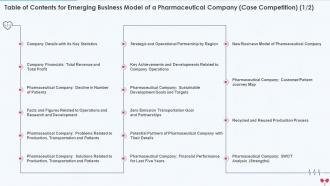
Slide 2: This slide presents Table of Content for the presentation.
Slide 3: This is another slide continuing Table of Content for the presentation.
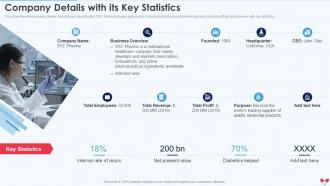
Slide 4: This slide shows the company details with key statitics.
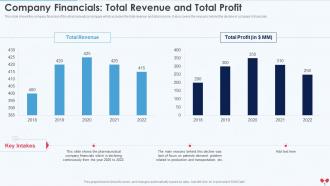
Slide 5: This slide shows the company financial of the pharmaceutical company including the total revenue and total income.
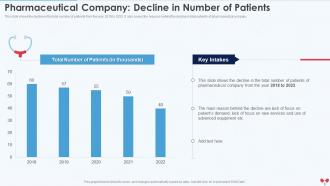
Slide 6: This slide shows the decline in the total number of patients from the year 2017 to 2021.
Slide 7: This slide shows the facts and figures related to the pharmaceutical company.
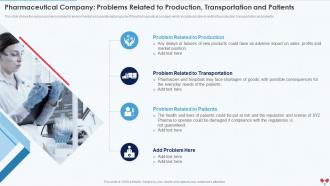
Slide 8: This slide shows the various problems related to environmental and operational programs of the pharmaceutical company.
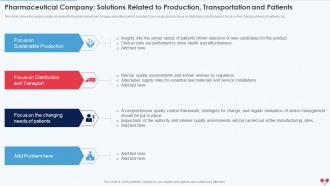
Slide 9: This slide shows the various solutions related to the pharmaceutical company operations.
Slide 10: This slide shows the financial performance of the pharmaceutical company from last five years from 2017 to 2021.
Slide 11: This slide shows the potential partners of pharmaceutical company.
Slide 12: This slide shows the goals and partnerships for zero emission of the pharmaceutical company.
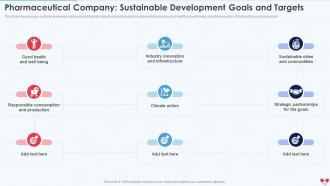
Slide 13: This slide shows various sustainable development goals and targets related to pharmaceutical company.
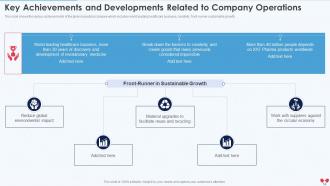
Slide 14: This slide shows the various achievements of the pharmaceutical company.
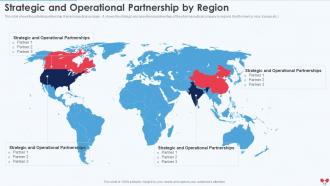
Slide 15: This slide shows the potential partnerships of pharmaceutical company .
Slide 16: This slide shows the new business model of pharmaceutical company.
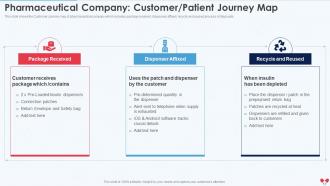
Slide 17: This slide shows the Customer Journey map of pharmaceutical company which includes package received etc.
Slide 18: This slide shows the process of recycling and refuse production of pharmaceutical company.
Slide 19: This slide shows the key strengths related to pharmaceutical company.
Slide 20: This slide shows the various Weakness related to pharmaceutical company such as less investment in research and development etc.
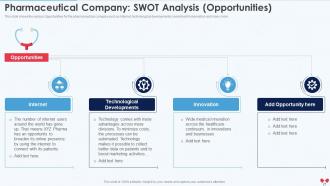
Slide 21: This slide shows the various Opportunities for the pharmaceutical company such as Internet, technological developments etc.
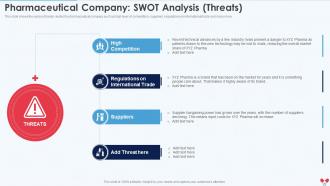
Slide 22: This slide shows the various threats related to pharmaceutical company such as high level of competition etc.
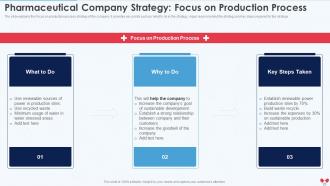
Slide 23: The slide explains the Focus on production process strategy of the company.
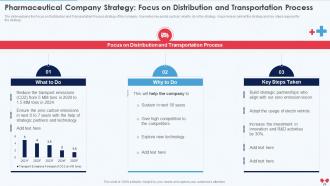
Slide 24: The slide explains the Focus on Distribution and Transportation Process strategy of the company.
Slide 25: The slide explains the Focus on Patient’s Needs and Demands strategy of the company.
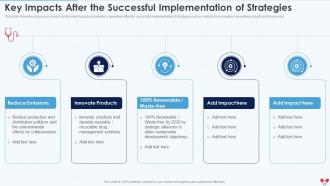
Slide 26: This slide shows the various key impacts on the pharmaceutical company’s operations after the successful implementation of certain strategies.
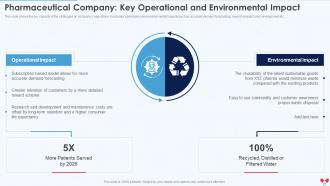
Slide 27: This slide shows the key impacts of the strategies on company’s operations incuding operational and environmental impacts.
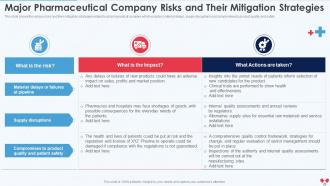
Slide 28: This slide shows the various risks and their mitigation strategies related to pharmaceutical company.
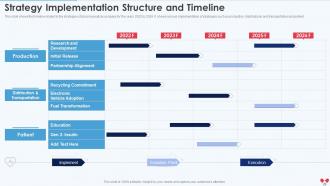
Slide 29: This slide shows the timeline related to the strategies of pharmaceutical company for the years 2021 to 2025.
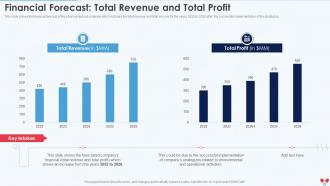
Slide 30: This slide shows the financial forecast of the pharmaceutical company which includes the total revenue and total income for the years 2021 to 2025.
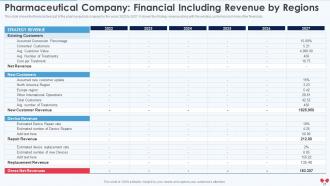
Slide 31: This slide shows the financial forecast of the pharmaceutical company for the years 2021 to 2026.
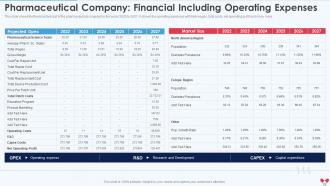
Slide 32: This slide again shows the financial forecast of the pharmaceutical company for the years 2021 to 2026.
Slide 33: The slide shows the profitability of the company (after implementing the strategy).
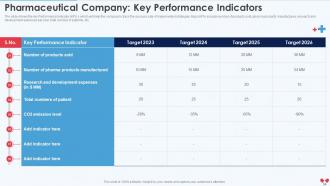
Slide 34: The slide shows the key Performance Indicator (KPI)s.
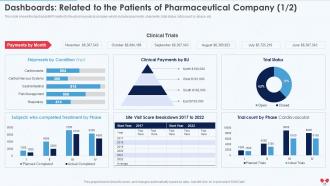
Slide 35: This slide shows the dashboard/KPI related to the pharmaceutical company which includes payments etc.
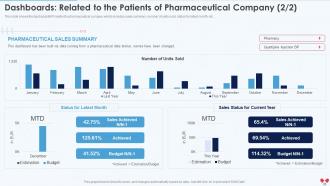
Slide 36: This slide shows the dashboard/KPI related to pharmaceutical company which includes sales summary, number of units sold etc.
Slide 37: This slide displays Icons for Emerging Business Model of a Pharmaceutical Company (Case Competition).
Slide 38: This slide is titled as Additional Slides for moving forward.
Slide 39: This is About Us slide to show company specifications etc.
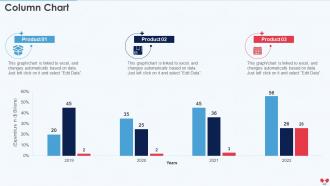
Slide 40: This slide displays Column chart with two products comparison.
Slide 41: This slide presents Bar chart with two products comparison.
Slide 42: This slide depicts Venn diagram with text boxes.
Slide 43: This is an Idea Generation slide to state a new idea or highlight information, specifications etc.
Slide 44: This is Our Goal slide. State your firm's goals here.
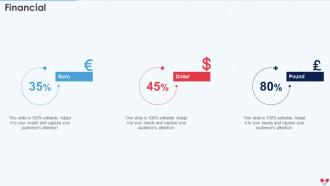
Slide 45: This is a Financial slide. Show your finance related stuff here.
Slide 46: This slide shows Post It Notes. Post your important notes here.
Slide 47: This slide presents Roadmap with additional textboxes.
Slide 48: This slide provides 30 60 90 Days Plan with text boxes.
Slide 49: This slide contains Puzzle with related icons and text.
Slide 50: This is a Thank You slide with address, contact numbers and email address.
Emerging Business Model Of A Pharmaceutical Company Case Competition Complete Deck with all 55 slides:
Use our Emerging Business Model Of A Pharmaceutical Company Case Competition Complete Deck to effectively help you save your valuable time. They are readymade to fit into any presentation structure.





















FAQs for Emerging Business Model Of A Pharmaceutical Company Case
So personalized medicine is huge right now - like treatments based on your actual genes. AI's speeding up drug discovery too, which is pretty wild. Companies are finally making money on rare diseases, so that's blowing up. Digital health stuff is everywhere now - they're literally building apps into treatment plans. Even sustainability matters for R&D decisions (not just PR anymore). Oh, and regulators are fast-tracking breakthrough drugs, so companies are reshuffling what they work on. If you're looking at pharma investments, check out their AI game and rare disease stuff. That's honestly where the momentum is.
Dude, drug discovery is insane now with AI. Machine learning can predict if compounds will work before you blow millions testing them. Companies like Atomwise and Recursion have these crazy platforms that simulate drug-protein interactions way faster than old methods. What used to take 10-15 years might be down to 5-7 years now. AI also finds drug targets in diseases we couldn't touch before - honestly kind of mind-blowing when you think about it. The whole timeline compression thing is probably the biggest game-changer. Worth checking out if you're curious about this stuff.
So patents are kind of a double-edged sword in pharma. Companies get 20 years of exclusivity, which is huge because they're dropping billions into R&D and need time to make that money back. Without patents, honestly nobody would bother developing new drugs. But during those 20 years, other companies can't build on or improve the original drug, so innovation gets stuck. Then when patents expire - yikes. Generic companies swoop in and prices crash overnight. My advice? Always check patent dates before investing. And watch out for companies that just make tiny tweaks to extend their patents - that's usually a red flag.
Pharma companies have the money and regulatory expertise, but startups bring the cool AI and data stuff that actually speeds things up. Perfect combo when it clicks. You'll get better patient recruitment, predictive models, faster trials - all that good stuff traditional pharma can't pull off solo. Here's the thing though: skip the flashy demo companies. Find startups that get your compliance headaches, not just the ones with pretty presentations. Both sides need to nail down what winning looks like upfront, or you're just burning cash.
The uncertainty kills you - limited data on novel mechanisms makes regulators super cautious about safety. Expect way longer review times and tons more documentation than regular drugs. They'll probably ask for multiple additional studies too. Since you're first-in-class, there's no precedent to follow, which honestly sucks. Adaptive trials help a bit but not much. My take? Get into FDA's breakthrough program early - I know it seems like extra work upfront, but their guidance before you're deep in development is clutch. Trust me on this one.
So basically pharma companies are finally doing things backwards - in a good way. Instead of creating drugs and hoping patients want them, they're asking patients what they actually need first. Pretty wild concept, right? Companies involve patients in designing trials, picking which outcomes to measure, all that stuff. Way better than the old approach of "here's your medicine, deal with it." Patients stick to treatments more when they actually address real problems. The trick is getting patient input from day one, not as an afterthought when everything's already decided.
So real-world evidence is totally flipping how we figure out if drugs actually work. Instead of just relying on those super sterile clinical trials, companies are diving into messy data from patient records, insurance claims, stuff like that. Shows how meds perform when people are actually taking them at home with their other health issues. Pharma loves it because they can spot new uses for old drugs and catch problems faster. The FDA's getting way more cool with accepting this data for approvals too - which honestly makes sense since it's more realistic than lab conditions. You should definitely start looking at RWE opportunities in whatever areas you're working on.
So basically blockchain gives every medication this unfakeable digital trail from factory to pharmacy. You can see exactly who touched what and when - makes it super hard for fake drugs to sneak in. Each person in the chain adds their stamp, which is honestly pretty genius for transparency. Real-time tracking means you'll catch sketchy stuff before it reaches patients. I'd start by figuring out where your current system has the biggest gaps, then focus blockchain verification there first. Way more effective than trying to do everything at once.
Okay so the main things you'll want to nail down: informed consent (make sure people actually get what they're signing up for, not just legal BS), risk vs benefit analysis, and fair participant selection. Novel mechanisms make the risk thing trickier obviously. Diverse populations are good but don't prey on vulnerable groups - that's just gross. Placebo controls get weird when there's already proven treatments out there. Honestly? Loop in your ethics committee from day one. I learned that the hard way. Patient welfare should drive every decision you make.
So pharma companies are totally flipping their approach because of personalized medicine. Instead of making drugs for everyone, they're designing treatments based on your specific genes and biomarkers. Pretty crazy stuff honestly. Clinical trials are getting way more complicated since they're targeting smaller groups, but the results should be much better. Companies are throwing tons of money at genomics and AI to figure out which patients will actually respond to treatments. Oh, and you'll probably start seeing more of those combo packages where the drug comes with its own diagnostic test. Makes sense when you think about it.
Those targeted nanoparticles are insane - they literally deliver drugs straight to the cells that need them. Implantable devices are huge too since patients don't have to remember daily pills anymore. Transdermal patches can now handle way bigger molecules than before, which is wild. Oh, and inhalable biologics are replacing a ton of injections. My buddy works in pharma and says the compliance rates are through the roof with these new systems. ROI looks solid because you're cutting side effects and making treatment way easier. I'd watch companies teaming up with nanotech - that's where the money's moving.
So pharma companies literally just follow the money when it comes to R&D - they're looking at who's getting sick and where. Aging populations mean huge investments in Alzheimer's and cancer treatments because that's where patients are heading. The diabetes market blew up partly from demographics but also lifestyle stuff. Companies will pivot to younger markets too, focusing on things like infectious diseases there. I mean, it makes sense from a business standpoint - though sometimes I wonder if they're missing opportunities in rare diseases. But yeah, if you're trying to predict where the industry's going, just look at population data for different regions.
Honestly, crowd-sourcing is pretty brilliant for pharma stuff. Patients who actually deal with these conditions daily can spot things your internal team might miss completely. Plus you'll get random experts from totally different fields - like some programmer in Estonia who suddenly cracks a problem that's been driving everyone nuts for months. The speed thing is huge too. Way faster than those endless internal approval processes, and obviously way cheaper. Oh, and researchers love contributing to this stuff when they have spare time. Just don't go all-in immediately - test it on one specific challenge first to see how it works for your company.
Look, psychological safety has to come first - people won't innovate if they're scared of getting fired for failing. Get your R&D, clinical, and commercial folks talking to each other more. That's where the magic happens honestly. Set aside real time for exploratory stuff that isn't about hitting next quarter's numbers. Also, your reward systems probably suck right now - they need to celebrate smart risks, not just wins. Oh and here's a thought: actually ask your scientists what's slowing them down. Then fix those things one by one.
Honestly, open innovation is a game changer because you're getting way more brainpower than you'd ever have internally. Partner with universities, startups, even competitors sometimes - splits those insane drug development costs. Access to specialized stuff you don't have is huge too, like AI expertise or niche disease knowledge. When your pipeline's looking rough, this can really save you. The tricky part (and where most companies mess up) is figuring out what to keep proprietary vs. what you're cool collaborating on. I'd start by mapping out your actual competitive advantages first.
-
Easily Understandable slides.
-
The templates are the best in class. Very clear and innovative graphics! I am excited to explore and download more presentations.