


Employee Perks And Incentives Powerpoint Presentation Slides




Try Before you Buy Download Free Sample Product
 Impress Your
 Audience
 100%
100% Editable
 Save Hours
 of Time


Demonstrate effective ways to reward your employees with the help of our pre-made content ready Employee Perks and Incentives PowerPoint Presentation Slides. Discuss all perks and bonuses in detail using staff perks and benefits PowerPoint complete deck. The employee benefits plan presentation deck contains twenty-one ready to use PPT slides. These PowerPoint templates are completely customizable, users can edit the color, size, font style as per their needs. The staff benefits and perks PPT visuals are useful for HR managers. Effective benefits strategies can attract and retain top talent. List down the types of perks such as health insurance, paid vacations, meal breaks, social security, pay raise, achievement awards, perks, and bonuses, etc using ready to use benefits and perks presentation design. Download this professionally designed company employee benefits PPT slides to improve the performance of your employees. Express your ideas with great impact and capture the attention of your audience. Get creative with our Employee Perks And Incentives Powerpoint Presentation Slides. Give your talents a free run.
People who downloaded this PowerPoint presentation also viewed the following :
Content of this Powerpoint Presentation
Slide 1: This slide introduces Employee Perks & Incentives. State Your Company Name and begin.
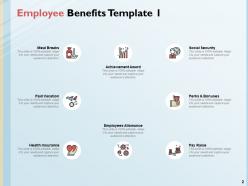
Slide 2: This slide shows Employee Benefits Template 1 describing- Social Security, Meal Breaks, Perks & Bonuses, Paid Vacation, Pay Raise, Health Insurance, Employees Allowance, Achievement Award.
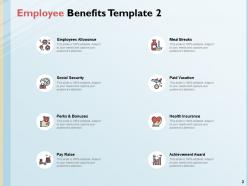
Slide 3: This slide presents Employee Benefits Template 2. You can add or edit data as per requirements.
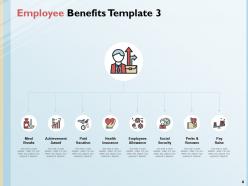
Slide 4: This slide represents Employee Benefits Template 3 with related imagery and text.
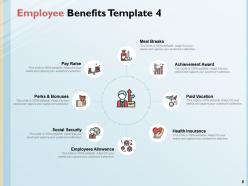
Slide 5: This slide displays Employee Benefits Template 4 with related icons and imagery. You can modify the template as per requirements.
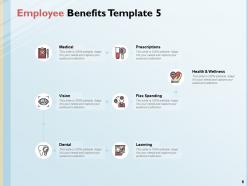
Slide 6: This slide showcases Employee Benefits Template 5 describing- Medical, Vision, Dental, Prescriptions, Health & Wellness, Flex Spending, Learning.
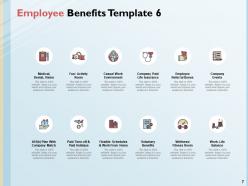
Slide 7: This slide shows Employee Benefits Template 6 describing- Fun/ Activity Room, Medical, Dental, Vision, Casual Work Environment, Company Paid, Life Insurance, Company Events, Employee Referral Bonus, 401(k) Plan With Company Match, Paid Time-off & Paid Holidays, Voluntary Benefits, Flexible Schedules & Work From Home, Wellness/ Fitness Room, Work- Life Balance.
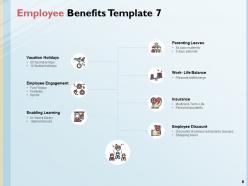
Slide 8: This slide presents Employee Benefits Template 7 describing- Employee Discount, Enabling Learning, Insurance, Employee Engagement, Vacation Holidays, Parenting Leaves, Work- Life Balance.
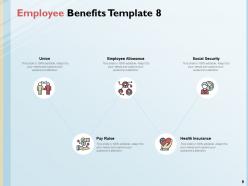
Slide 9: This slide displays Employee Benefits Template 8 describing- Union, Pay Raise, Employee Allowance, Health Insurance, Social Security.
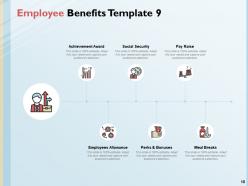
Slide 10: This slide represents Employee Benefits Template 9.
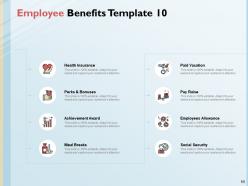
Slide 11: This slide showcases Employee Benefits Template 10 describing- Health Insurance, Perks & Bonuses, Achievement Award, Meal Breaks, Social Security, Employees Allowance, Pay Raise, Paid Vacation.
Slide 12: This slide displays Employee Benefits Icons.
Slide 13: This slide is titled as Additional Slides for moving forward.
Slide 14: This is About Us slide to show company specifications etc.
Slide 15: This is Our Team slide with names and designation.
Slide 16: This is an optional Our Team slide.
Slide 17: This is Our Mission slide with related imagery and text.
Slide 18: This slide is titled as Our Financial. Show your finance related stuff here.
Slide 19: This is an optional Our Financial slide.
Slide 20: This is Our Goal slide. Show your goals here.
Slide 21: This is a Thank you slide with address, contact numbers and email address.
Employee Perks And Incentives Powerpoint Presentation Slides with all 21 slides:
Install your ideas firmly in their heads with our Employee Perks And Incentives Powerpoint Presentation Slides. Guide the destiny of generations to come.

FAQs for Employee Perks And Incentives
The top three employee incentive types include monetary rewards like bonuses and raises, recognition programs such as awards and public acknowledgment, and professional development opportunities including training and career advancement. These incentives enhance workplace motivation by addressing financial security, personal fulfillment, and growth aspirations, with many organizations finding that strategic combinations deliver higher retention rates, improved productivity, and stronger competitive advantage in talent acquisition.
Monetary incentives deliver immediate satisfaction and financial security, while non-monetary incentives like recognition, flexible schedules, and professional development create lasting engagement and loyalty. Both approaches work synergistically, with many organizations finding that combining competitive compensation with meaningful recognition, career advancement opportunities, and work-life balance initiatives ultimately drives higher retention and performance than relying on salary alone.
Company culture significantly influences incentive program effectiveness by shaping how employees perceive, value, and respond to rewards and recognition initiatives. In cultures emphasizing collaboration, team-based incentives resonate more strongly, while competitive environments may find individual performance rewards more effective, with many organizations discovering that aligning incentive structures with cultural values ultimately delivers higher engagement and sustained motivation.
Organizations align employee incentives with business goals by establishing clear performance metrics, implementing outcome-based compensation structures, creating team-based rewards, and linking individual achievements to strategic objectives. Through balanced scorecards and goal-setting frameworks, companies enhance productivity, improve employee engagement, and drive revenue growth, with many finding that aligned incentives ultimately deliver stronger organizational performance and competitive advantage.
Creative non-cash incentives include flexible work arrangements, professional development opportunities, recognition programs, wellness initiatives, and career advancement pathways. These approaches enhance engagement by addressing work-life balance, skill building, and personal growth, with many organizations finding that strategic combinations of learning stipends, remote work options, and public recognition ultimately deliver higher retention rates and improved performance.
Employee feedback can be incorporated through surveys, focus groups, one-on-one discussions, and performance review conversations to understand what motivates different team members. Organizations increasingly use pulse surveys and feedback platforms to gather real-time insights, with many companies finding that employee-driven incentive design significantly improves program participation rates and overall workplace satisfaction.
Key metrics include employee retention rates, productivity measurements, engagement survey scores, goal achievement percentages, and participation rates in incentive programs. These indicators help organizations assess whether their initiatives are driving desired behaviors, reducing turnover costs, and enhancing overall performance, with many companies finding that balanced scorecards combining quantitative and qualitative measures deliver the most comprehensive insights.
Employee incentives can be tailored through flexible benefits for millennials, recognition programs for Gen X, career advancement opportunities for Gen Z, and stability-focused rewards for baby boomers. Organizations increasingly find success by combining technology-driven platforms with personalized approaches, ultimately delivering higher engagement across diverse workforce segments while enhancing retention and productivity.
Organizations ensure fairness and transparency by establishing clear performance metrics, implementing consistent evaluation processes, and maintaining open communication about incentive criteria and outcomes. Through regular audits, standardized assessment frameworks, and accessible feedback mechanisms, companies create equitable systems that build trust, reduce bias, and ultimately enhance employee engagement while delivering sustainable performance improvements across all organizational levels.
Poorly structured incentive programs can create unintended consequences including decreased team collaboration, short-term thinking over strategic goals, gaming of metrics, and employee resentment from perceived unfairness. These issues often lead to reduced overall productivity, higher turnover rates, and damaged workplace culture, with many organizations finding that misaligned incentives ultimately undermine the very behaviors they intended to encourage.
Technology enhances employee incentive implementation and tracking through automated reward systems, real-time performance dashboards, personalized recognition platforms, and comprehensive analytics tools. These digital solutions streamline reward distribution, provide transparent progress tracking, and enable data-driven program optimization, with many organizations finding that automated systems deliver faster recognition, improved employee engagement, and significantly reduced administrative overhead.
Recognizing employee achievements significantly enhances team performance by boosting morale, increasing motivation, and fostering collaborative environments where success is celebrated collectively. Through strategic recognition programs, organizations experience improved productivity, reduced turnover, and stronger team cohesion, with many companies finding that acknowledged employees become advocates who inspire higher performance across departments.
Employee incentives can be aligned with well-being through flexible work arrangements, wellness program rewards, mental health days, fitness memberships, and family-friendly benefits. These strategic combinations enhance productivity, reduce burnout, and improve retention, with many organizations finding that employees who feel supported deliver higher performance, lower absenteeism, and ultimately stronger business outcomes.
Common mistakes include misaligning incentives with business goals, focusing solely on individual rewards rather than team outcomes, implementing one-size-fits-all programs, and failing to communicate program details clearly. Many organizations find that poorly designed incentive structures can inadvertently encourage counterproductive behaviors, reduce collaboration, and ultimately undermine employee engagement rather than enhancing performance and retention.
Organizations communicate incentive offerings effectively through clear program documentation, regular all-hands meetings, personalized digital dashboards, and dedicated HR communication channels. These approaches enhance transparency and engagement by providing accessible program details, celebrating achievement examples, and enabling real-time progress tracking, ultimately delivering improved employee satisfaction and higher participation rates across teams.
No Reviews