


Employee upskilling training program managing cyber risk in a digital age




Try Before you Buy Download Free Sample Product
 Impress Your
 Audience
 100%
100% Editable
 Save Hours
 of Time


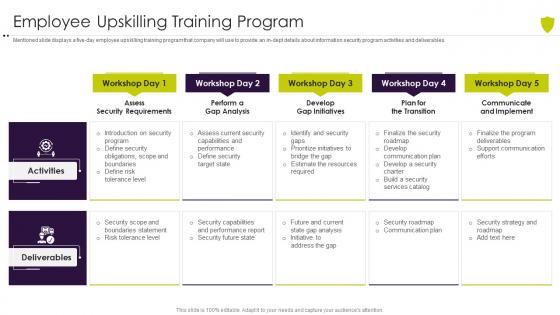
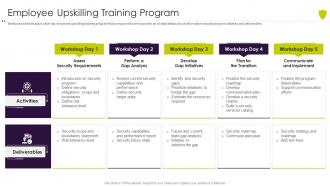
Mentioned slide displays a five-day employee upskilling training program that company will use to provide an in-dept details about information security program activities and deliverables.
People who downloaded this PowerPoint presentation also viewed the following :
Employee upskilling training program managing cyber risk in a digital age with all 6 slides:
Use our Employee Upskilling Training Program Managing Cyber Risk In A Digital Age to effectively help you save your valuable time. They are readymade to fit into any presentation structure.





FAQs for Employee upskilling training program managing cyber risk in
Key competencies include threat assessment and vulnerability analysis, incident response planning, regulatory compliance knowledge, risk quantification methodologies, and cross-functional communication skills. These capabilities enable organizations to proactively identify vulnerabilities, respond swiftly to breaches, and maintain operational continuity, with many financial institutions and healthcare systems finding that comprehensive competency development significantly reduces response times and enhances their overall security posture.
Organizations can identify cybersecurity skill gaps through comprehensive assessments including technical evaluations, simulated phishing tests, risk scenario exercises, peer reviews, and competency mapping against industry frameworks. These methods enable companies to pinpoint specific vulnerabilities in areas like threat detection, incident response, and compliance management, with many finding that regular skills audits ultimately enhance their overall security posture and workforce preparedness.
Continuous learning ensures cybersecurity teams stay ahead of rapidly evolving threats through regular training updates, threat intelligence briefings, simulated attack exercises, and certification programs. This proactive approach enables organizations to identify vulnerabilities faster, respond to incidents more effectively, and adapt security protocols continuously, with many financial institutions and healthcare providers finding that ongoing education significantly reduces breach risks while enhancing overall organizational resilience.
Employee upskilling in cyber risk management strengthens organizational security by enhancing threat detection capabilities, improving incident response times, and reducing human error vulnerabilities across all departments. These enhanced competencies enable staff to identify phishing attempts, implement secure protocols, and respond effectively to breaches, with many organizations finding that comprehensive training programs ultimately deliver reduced security incidents and stronger regulatory compliance.
The most effective training methods include interactive simulations, phishing awareness exercises, role-based scenario training, regular workshops, and gamified learning platforms. These approaches enhance employee engagement by providing hands-on experience with real-world threats, enabling organizations to build stronger security cultures while reducing human error risks, ultimately delivering improved incident response capabilities and organizational resilience.
Businesses can measure upskilling success through pre and post-training assessments, incident response times, security awareness scores, certification completion rates, and reduced security breach frequency. Organizations across sectors like banking and healthcare track metrics such as faster threat detection, improved compliance audit results, and decreased phishing susceptibility, ultimately delivering enhanced organizational resilience and measurable risk reduction.
Employee cyber risk training resources include interactive e-learning platforms, simulated phishing exercises, cybersecurity awareness videos, real-time threat intelligence feeds, and gamified security challenges. These tools enhance organizational security posture by delivering engaging content, testing employee responses to actual threats, and creating continuous learning environments, with many companies finding that comprehensive training programs significantly reduce human error incidents while strengthening overall cyber resilience.
Non-technical staff understanding cyber risk management principles is crucial since they often represent the largest attack surface through social engineering, phishing attempts, and inadvertent security breaches. This knowledge enables organizations to create comprehensive security cultures where employees across departments recognize threats, follow proper protocols, and respond appropriately to incidents, ultimately reducing human error vulnerabilities while strengthening overall organizational resilience.
**INPUT**: What are the common challenges organizations face when implementing upskilling programs in cyber risk? **OUTPUT**: Common challenges include budget constraints, time limitations for training, rapidly evolving cyber threats, skill gaps among existing staff, and resistance to change from employees. While financial services and healthcare organizations increasingly recognize upskilling's importance, many find that strategic investment in comprehensive programs ultimately delivers enhanced security posture, reduced incident response times, and stronger competitive advantage in an increasingly complex threat landscape. [Word count: 58 words]
Mentorship programs enhance cyber risk management learning by providing personalized guidance, real-world scenario training, and hands-on experience with incident response protocols. Through strategic pairing of experienced cybersecurity professionals with emerging talent, organizations streamline knowledge transfer, accelerate threat detection capabilities, and build stronger security cultures, ultimately delivering enhanced organizational resilience and competitive advantage.
Cybersecurity certifications enhance professional credibility, demonstrate specialized expertise in risk management, validate technical competencies, and provide structured learning pathways for career advancement. These credentials enable employees to command higher salaries, access senior security roles, and deliver greater organizational value, with many companies finding that certified professionals significantly strengthen their cybersecurity posture and regulatory compliance.
Gamification can be integrated through interactive simulations, point-based learning modules, team-based cybersecurity challenges, virtual reality phishing scenarios, and competitive leaderboards that track progress. These approaches enhance engagement by transforming complex security concepts into interactive experiences, with many organizations finding that gamified training significantly improves retention rates, accelerates skill development, and ultimately delivers stronger cyber risk awareness across all employee levels.
Leaders can foster continuous learning cultures through mentorship programs, dedicated training time, cross-departmental collaboration opportunities, and recognizing skill development achievements publicly. By implementing structured learning paths, providing access to cybersecurity certifications, and creating psychological safety for experimentation, organizations enable teams to stay current with evolving threats while building confidence, ultimately delivering enhanced security posture and competitive advantage.
Remote work significantly amplifies cyber risk exposure while creating both challenges and opportunities for employee upskilling, requiring organizations to adapt training methods, expand security awareness programs, and implement continuous education frameworks. Companies increasingly find that virtual training platforms, simulated phishing exercises, and real-time threat awareness programs deliver enhanced engagement and scalability, ultimately strengthening their distributed workforce's cybersecurity capabilities.
Organizations can tailor cybersecurity training by incorporating visual elements like infographics and simulations, hands-on workshops with real threat scenarios, audio-based modules, and interactive gamification approaches. This multi-modal strategy ensures comprehensive learning across different preferences, with many financial institutions and healthcare organizations finding that personalized training paths significantly improve threat detection capabilities and reduce security incidents.
-
Really like the color and design of the presentation.
-
Easy to edit slides with easy to understand instructions.