

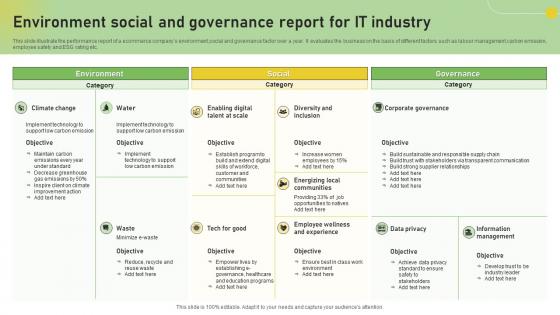
Environment Social And Governance Report For It Industry




Try Before you Buy Download Free Sample Product
 Impress Your
 Audience
 100%
100% Editable
 Save Hours
 of Time


This slide illustrate the performance report of a ecommerce companys environment, social and governance factor over a year. It evaluates the business on the basis of different factors such as labour management, carbon emission, employee safety and ESG rating etc.
People who downloaded this PowerPoint presentation also viewed the following :
Environment Social And Governance Report For It Industry with all 6 slides:
Use our Environment Social And Governance Report For It Industry to effectively help you save your valuable time. They are readymade to fit into any presentation structure.





FAQs for Environment Social And Governance Report
The IT industry advances sustainable business practices by developing ESG reporting platforms, automating data collection and analysis, enhancing transparency through blockchain technology, and creating AI-driven sustainability metrics. These technologies streamline environmental monitoring, social impact assessment, and governance tracking across organizations, with many financial services and manufacturing companies finding that digital ESG solutions deliver faster compliance, reduced reporting costs, and improved stakeholder trust in an increasingly sustainability-focused business environment.
IT companies can effectively measure their environmental impact through carbon footprint assessments, energy consumption tracking, waste management audits, water usage monitoring, and supply chain sustainability evaluations. These measurement frameworks enable organizations to establish baseline metrics, set reduction targets, and demonstrate progress through standardized reporting protocols like GRI or SASB, ultimately delivering transparency to stakeholders while identifying cost-saving opportunities.
Key components include environmental impact metrics, data governance frameworks, cybersecurity measures, diversity and inclusion statistics, and ethical AI practices. These elements enable technology firms to demonstrate sustainability through energy-efficient operations, responsible data handling, and inclusive workplace cultures, with many organizations finding that comprehensive ESG reporting ultimately enhances investor confidence and competitive positioning.
Data privacy directly impacts the social pillar of ESG by demonstrating how IT companies protect customer information, ensure ethical data handling, and maintain stakeholder trust through transparent governance practices. Through robust privacy frameworks, IT organizations enhance customer confidence, reduce regulatory risks, and strengthen community relationships, while ultimately delivering competitive advantage in an increasingly privacy-conscious marketplace where social responsibility drives business value.
IT companies can leverage automation platforms, blockchain technology, real-time data analytics, AI-powered monitoring systems, and cloud-based reporting tools to enhance transparency in their ESG reporting. These technologies streamline data collection, ensure accuracy, and provide stakeholders with accessible dashboards, while many organizations find that automated ESG platforms significantly reduce reporting errors and accelerate compliance timelines.
Investor expectations drive IT companies to prioritize comprehensive ESG metrics, including carbon footprint reduction, data privacy governance, supply chain transparency, and diversity initiatives. These demands push organizations to adopt standardized frameworks like GRI and SASB, ultimately delivering enhanced accountability and competitive positioning, with many tech firms finding that robust ESG reporting attracts sustainable investment capital.
Tech companies commonly use GRI Standards, SASB Technology & Communications framework, CDP Climate disclosures, TCFD recommendations, and UN Global Compact principles for ESG reporting. These frameworks enable organizations to standardize sustainability metrics, enhance transparency across operations, and demonstrate environmental stewardship, with many technology firms finding that comprehensive ESG reporting delivers improved stakeholder trust and competitive positioning in increasingly conscious markets.
Collaboration among tech companies improves ESG reporting through shared standards development, pooled resources for data collection systems, and unified measurement frameworks that ensure consistency across the industry. By working together, companies can establish comprehensive benchmarking protocols, reduce individual compliance costs, and create transparent reporting mechanisms that enhance investor confidence while accelerating sustainable innovation adoption.
IT businesses face challenges including data measurement complexities, supply chain transparency issues, talent retention pressures, regulatory compliance costs, and balancing rapid innovation with sustainable practices. While these obstacles initially require significant resource allocation and strategic restructuring, companies increasingly find that systematic ESG integration ultimately delivers enhanced stakeholder trust, operational efficiency, and competitive positioning in an increasingly sustainability-focused market landscape.
Strong ESG performance enhances IT companies' competitive advantage by attracting sustainability-focused clients, reducing operational costs through energy efficiency, and improving talent acquisition in competitive markets. Companies with robust environmental practices, ethical data governance, and diverse workforces increasingly win enterprise contracts, access lower-cost capital, and achieve premium valuations, ultimately delivering market differentiation.
Consumers increasingly prioritize data privacy, ethical AI practices, and environmental responsibility when choosing tech products and services, demanding transparency in corporate sustainability efforts. This shift particularly affects younger demographics and enterprise customers, with many organizations requiring ESG compliance from their technology vendors, ultimately driving competitive advantage for transparent firms in an increasingly conscious marketplace.
Small and medium-sized IT enterprises can navigate ESG reporting by leveraging automated software solutions, partnering with specialized consultancies, focusing on material impacts like energy efficiency and data privacy, and utilizing industry frameworks designed for smaller organizations. These approaches enable streamlined data collection, cost-effective compliance, and strategic positioning, with many SMEs finding that targeted ESG initiatives ultimately enhance operational efficiency while attracting sustainability-conscious clients and investors.
Regulatory changes are driving tech companies toward mandatory ESG disclosures, standardized sustainability metrics, enhanced data privacy reporting, and stricter environmental impact assessments across global markets. These evolving requirements enable organizations to streamline compliance processes, reduce regulatory risks, and build competitive advantage through transparent stakeholder communication, with many technology firms finding that proactive ESG reporting ultimately delivers enhanced investor confidence and market positioning.
Essential ESG metrics for IT industry stakeholders include energy consumption and carbon footprint, data privacy and cybersecurity measures, employee diversity and inclusion statistics, e-waste management practices, and supply chain sustainability indicators. These metrics enable technology companies to demonstrate operational efficiency, regulatory compliance, and social responsibility, with many investors and clients increasingly prioritizing organizations that deliver transparent sustainability reporting alongside competitive digital solutions.
IT companies can address diversity and inclusion by reporting comprehensive workforce demographics, leadership representation metrics, pay equity analyses, inclusive hiring practices, and employee resource group participation rates. These transparency measures enhance credibility by demonstrating measurable progress, with many stakeholders finding that detailed D&I data, coupled with specific improvement targets and accountability frameworks, ultimately delivers stronger investor confidence and competitive advantage.
-
Informative design.
-
The best collection of PPT templates!! Totally worth the money.