


Equipment maintenance schedule status ppt powerpoint presentation inspiration




Try Before you Buy Download Free Sample Product
 Impress Your
 Audience
 100%
100% Editable
 Save Hours
 of Time


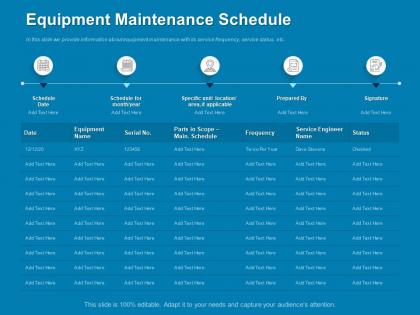
In this slide we provide information about equipment maintenance with its service frequency, service status, etc.
People who downloaded this PowerPoint presentation also viewed the following :
Equipment maintenance schedule status ppt powerpoint presentation inspiration with all 2 slides:
Give your audience a fulfilling experience. They will find our Equipment Maintenance Schedule Status Ppt Powerpoint Presentation Inspiration elevating.

FAQs for Equipment maintenance schedule status ppt
Key components include preventive maintenance intervals, asset prioritization matrices, resource allocation planning, performance tracking metrics, and compliance documentation requirements. These elements work together by minimizing unexpected downtime, optimizing maintenance costs, and extending equipment lifecycles, with many manufacturing and healthcare organizations finding that structured scheduling delivers improved operational efficiency and regulatory compliance.
Routine maintenance frequency varies by equipment type, with critical machinery requiring weekly inspections, HVAC systems needing quarterly servicing, vehicles demanding monthly checks, and IT infrastructure requiring daily monitoring and annual overhauls. Manufacturing facilities, hospitals, and logistics companies increasingly find that strategic maintenance scheduling reduces downtime by 30-40%, ultimately delivering cost savings and operational reliability.
Critical machinery maintenance schedules should consider equipment age, operating hours, manufacturer recommendations, environmental conditions, and regulatory compliance requirements. These factors enable organizations to balance preventive maintenance costs with downtime risks, with many manufacturing facilities and power plants finding that data-driven scheduling approaches ultimately deliver improved reliability and reduced operational expenses.
Technology streamlines equipment maintenance scheduling through IoT sensors, predictive analytics platforms, CMMS software, mobile applications, and automated workflow systems. These solutions enable organizations to monitor equipment health in real-time, predict failures before they occur, and optimize maintenance intervals, with manufacturing plants and healthcare facilities finding significantly reduced downtime and operational costs.
Equipment usage frequency directly determines maintenance intervals by accelerating wear patterns, increasing component stress, and requiring more frequent inspections and replacements. High-usage equipment in manufacturing plants, hospitals, and logistics centers typically needs shortened maintenance cycles, with many organizations finding that usage-based scheduling reduces unexpected breakdowns while optimizing maintenance costs and operational efficiency.
Organizations prioritize maintenance tasks by conducting criticality assessments that evaluate equipment impact on operations, safety requirements, replacement costs, and downtime consequences. Through risk-based maintenance strategies, companies in manufacturing, healthcare, and energy sectors can allocate resources to high-priority assets first, ultimately reducing unexpected failures while optimizing maintenance budgets and operational efficiency.
Best practices for documenting maintenance activities include creating standardized work orders, maintaining detailed equipment histories, recording part replacements, tracking labor hours, and using digital maintenance management systems. These approaches streamline operations by enabling predictive maintenance scheduling, reducing unexpected downtime, and improving resource allocation, with many manufacturing and healthcare facilities finding that comprehensive documentation ultimately delivers significant cost savings and enhanced equipment reliability.
Predictive maintenance uses real-time data, sensors, and analytics to forecast equipment failures before they occur, while preventive maintenance follows predetermined schedules regardless of actual equipment condition. Through IoT sensors and machine learning algorithms, manufacturers and utilities can reduce unplanned downtime by up to 50%, optimize resource allocation, and extend asset lifecycles, ultimately delivering significant cost savings compared to traditional time-based scheduling approaches.
A well-structured maintenance schedule can extend equipment lifespan by 20-40% through preventive interventions, optimized performance monitoring, and early issue detection before costly failures occur. Manufacturing plants, hospitals, and transportation companies consistently find that systematic scheduling reduces replacement costs, minimizes unexpected downtime, and delivers significant operational savings while enhancing overall equipment reliability.
Maintenance schedules should be adapted by increasing frequency during peak seasonal usage periods, adjusting lubricants and components for temperature variations, and implementing pre-season intensive inspections. Many manufacturing and agricultural operations find that proactive seasonal calibration, combined with weather-specific protective measures, ultimately reduces unexpected breakdowns while extending equipment lifespan and operational efficiency.
Neglecting regular equipment maintenance leads to increased breakdowns, higher repair costs, reduced operational efficiency, safety hazards, and shortened equipment lifespan. These consequences significantly impact businesses across manufacturing, healthcare, and logistics sectors, with many organizations finding that poor maintenance practices ultimately result in costly downtime, compromised product quality, and loss of competitive advantage.
Staff training improves adherence to equipment maintenance schedules by educating employees on proper procedures, safety protocols, and the critical importance of preventive maintenance. Well-trained staff understand maintenance requirements, can identify early warning signs of equipment issues, and recognize how consistent schedules reduce downtime and repair costs, ultimately delivering improved operational efficiency and equipment longevity.
Key metrics for evaluating maintenance schedule effectiveness include equipment uptime, mean time between failures, maintenance costs per asset, schedule compliance rates, and overall equipment effectiveness (OEE). These performance indicators enable organizations to optimize resource allocation, reduce unplanned downtime, and enhance operational efficiency, with many manufacturing and healthcare facilities finding that comprehensive tracking ultimately delivers significant cost savings and improved productivity.
Companies effectively communicate maintenance schedules through digital dashboards, automated notifications, mobile apps, shared calendars, and regular team meetings. These communication tools streamline operations by providing real-time updates, reducing equipment downtime, and ensuring accountability across departments, with many manufacturing and facilities management teams finding that centralized scheduling platforms ultimately enhance productivity and minimize costly maintenance oversights.
Common challenges in maintaining equipment maintenance schedules include resource constraints, unexpected breakdowns disrupting planned activities, poor communication between teams, inadequate tracking systems, and competing operational priorities. Organizations overcome these by implementing digital maintenance management systems, cross-training technicians across multiple equipment types, establishing clear communication protocols, and integrating predictive analytics, ultimately delivering improved equipment reliability, reduced downtime costs, and enhanced operational efficiency across manufacturing and industrial facilities.
No Reviews