


Evaluating Human Resource Management Performance In Okr Report





Try Before you Buy Download Free Sample Product
 Impress Your
 Audience
 100%
100% Editable
 Save Hours
 of Time


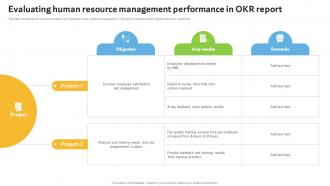
This slide represents okr report performance by evaluating human resource management. This further includes project, objective and key results etc.
People who downloaded this PowerPoint presentation also viewed the following :
Evaluating Human Resource Management Performance In Okr Report with all 9 slides:
Use our Evaluating Human Resource Management Performance In Okr Report to effectively help you save your valuable time. They are readymade to fit into any presentation structure.








FAQs for Evaluating Human Resource Management Performance
Key HR performance indicators include employee turnover rate, time-to-fill positions, employee engagement scores, training ROI, and absenteeism rates. These metrics enable organizations to streamline talent management, enhance workforce productivity, and reduce recruitment costs, with many companies finding that strategic KPI tracking ultimately delivers improved employee retention and competitive advantage.
HR analytics influences strategic decision-making by providing data-driven insights into workforce trends, performance metrics, and predictive modeling for talent management. These analytics enable organizations to optimize recruitment strategies, identify skill gaps, and forecast turnover risks, with companies in manufacturing and financial services finding that analytics-driven HR decisions ultimately deliver improved employee retention and competitive advantage.
Employee engagement significantly impacts HR performance by enhancing productivity, reducing turnover, improving talent retention, and strengthening organizational culture. Engaged employees deliver higher quality work, require less supervision, and contribute to better customer experiences, with many organizations finding that strategic engagement initiatives ultimately drive measurable improvements in recruitment success and operational efficiency.
HR management contributes to competitive advantage by attracting top talent, developing strategic workforce capabilities, fostering innovation cultures, and aligning employee performance with business objectives. Through data-driven recruitment, comprehensive training programs, and performance management systems, organizations streamline operations, enhance productivity, and retain critical talent, ultimately delivering sustainable growth and market differentiation in increasingly competitive landscapes.
HR can implement targeted recruitment strategies, competitive compensation packages, comprehensive onboarding programs, professional development opportunities, and flexible work arrangements to enhance talent acquisition and retention. These approaches streamline hiring processes while fostering employee engagement, with many organizations finding that strategic combinations of mentorship programs, career advancement pathways, and work-life balance initiatives ultimately deliver reduced turnover and stronger competitive advantage.
Performance appraisal significantly impacts employee productivity and morale by providing structured feedback, setting clear expectations, and identifying development opportunities. Through regular evaluation processes, organizations enhance employee engagement, streamline goal alignment, and deliver targeted training programs, with many companies finding that transparent appraisal systems ultimately boost retention rates and competitive performance.
**INPUT**: What are the best practices for creating a diverse and inclusive workplace? **OUTPUT**: Best practices include comprehensive recruitment strategies, inclusive leadership training, employee resource groups, bias-free performance evaluations, and transparent advancement pathways. These approaches streamline organizational culture by enhancing employee engagement, reducing turnover, and improving decision-making, with many companies finding that diverse teams deliver stronger innovation and competitive advantage in increasingly global markets.
Technology enhances HR performance through automated recruitment systems, AI-powered candidate screening, digital performance management platforms, cloud-based employee data systems, and integrated payroll solutions. These technologies streamline processes by reducing manual administrative tasks, accelerating hiring timelines, and enabling data-driven decision making, with many organizations finding that automated HR workflows ultimately deliver faster employee services and significantly improved operational efficiency.
Organizations face challenges including misaligned performance metrics, inadequate communication between HR and leadership teams, resource allocation conflicts, and difficulty measuring HR's strategic impact on business outcomes. These alignment gaps often result in reduced operational efficiency, inconsistent talent management strategies, and missed competitive advantages, with many companies finding that strategic HR-business integration requires ongoing collaboration and data-driven approaches.
HR performance in remote and hybrid environments can be measured through digital engagement metrics, virtual collaboration effectiveness, employee satisfaction surveys, retention rates, and goal achievement tracking. These approaches enable organizations to assess talent management, team productivity, and workplace culture across distributed teams, with many companies finding that data-driven performance indicators ultimately deliver better insights into employee engagement and organizational effectiveness.
Training and development significantly enhances HR outcomes by improving employee performance, increasing retention rates, boosting engagement levels, and accelerating career progression pathways. These strategic investments streamline talent management processes while reducing recruitment costs, with many organizations finding that comprehensive development programs ultimately deliver stronger competitive advantage and measurably higher productivity across all departments.
Organizations ensure effective communication within HR teams by establishing clear protocols, implementing collaborative technologies, conducting regular team meetings, creating transparent reporting structures, and fostering open feedback channels. These approaches streamline information flow, enhance coordination between recruitment and employee relations functions, and ultimately deliver faster response times to employee inquiries, with many companies finding that structured communication significantly improves overall HR service delivery.
Succession planning ensures organizational continuity by identifying and developing internal talent for key leadership positions, reducing recruitment costs, and minimizing disruption during transitions. Through strategic talent mapping and development programs, organizations enhance employee retention, accelerate leadership readiness, and maintain operational stability, with many companies finding that proactive succession planning delivers competitive advantage in increasingly dynamic markets.
Labor laws and regulations significantly shape HR practices by mandating compliance requirements for recruitment, compensation, workplace safety, employee rights, and termination procedures. While these frameworks require careful navigation and ongoing training, they ultimately enhance organizational credibility, reduce legal risks, and promote fair workplace standards, with many companies finding that robust compliance systems streamline operations and strengthen employee trust.
Organizational culture significantly impacts HR effectiveness by influencing employee engagement, talent retention, communication patterns, policy implementation, and overall strategic alignment. A positive, inclusive culture enhances HR's ability to attract top talent, reduce turnover costs, and streamline performance management, while misaligned cultures create resistance to initiatives, ultimately determining whether HR delivers competitive advantage or operational friction.
-
I can always count on your designs for my professional needs. I believe I found a one-stop-shop for PPTs.
-
The team is highly dedicated and professional. They deliver their work on time and with perfection.