


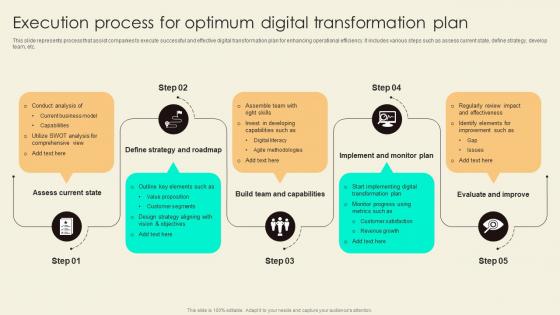
Execution Process For Optimum Digital Transformation Plan




Try Before you Buy Download Free Sample Product
 Impress Your
 Audience
 100%
100% Editable
 Save Hours
 of Time


This slide represents process that assist companies to execute successful and effective digital transformation plan for enhancing operational efficiency. It includes various steps such as assess current state, define strategy, develop team, etc.
People who downloaded this PowerPoint presentation also viewed the following :
Execution Process For Optimum Digital Transformation Plan with all 9 slides:
Use our Execution Process For Optimum Digital Transformation Plan to effectively help you save your valuable time. They are readymade to fit into any presentation structure.








FAQs for Execution Process For Optimum
Successful digital transformation execution strategies include comprehensive change management, robust technology integration, employee training programs, data-driven decision frameworks, and stakeholder alignment processes. These components work synergistically by ensuring organizational readiness, minimizing resistance, and accelerating adoption, with many enterprises finding that strategic coordination across these areas ultimately delivers enhanced operational efficiency and sustainable competitive advantage.
Organizations effectively align digital transformation goals with business objectives by establishing clear KPIs that directly support revenue growth, operational efficiency, and customer satisfaction metrics. Through strategic roadmapping and cross-functional leadership teams, companies integrate technology initiatives with core business priorities like market expansion and cost reduction, ultimately delivering measurable competitive advantages.
Leadership drives digital transformation execution by establishing clear vision, allocating strategic resources, fostering cultural change, and ensuring cross-functional alignment throughout the organization. Effective leaders champion technology adoption while managing resistance, with many executives finding that their commitment to upskilling teams and breaking down silos ultimately delivers faster implementation timelines and sustainable competitive advantage.
Companies can measure digital transformation effectiveness through key performance indicators like operational efficiency improvements, customer satisfaction scores, revenue growth metrics, cost reduction percentages, and employee productivity measures. These metrics enable organizations to track progress across departments, with many financial services and retail companies finding that combining quantitative data with qualitative feedback ultimately delivers comprehensive insights into transformation success and competitive positioning.
Common digital transformation challenges include resistance to change, legacy system integration complexities, skill gaps, budget overruns, and inadequate leadership alignment. Organizations overcome these through comprehensive change management programs, phased migration strategies, targeted upskilling initiatives, and strong executive sponsorship, with many finding that early wins and continuous communication ultimately deliver smoother transitions and sustainable competitive advantages.
Employee engagement and training significantly impact digital transformation success by reducing resistance to change, accelerating technology adoption, and ensuring seamless workflow integration across departments. Through comprehensive upskilling programs and change management initiatives, organizations enhance productivity, minimize implementation delays, and achieve higher ROI, with many companies finding that engaged employees become transformation advocates rather than obstacles.
Cloud computing, artificial intelligence, data analytics, automation platforms, and API integration tools are most critical for supporting digital transformation execution across industries. These technologies streamline operations by enabling scalable infrastructure, intelligent decision-making, and seamless system connectivity, with many organizations finding that strategic combinations deliver enhanced efficiency, faster innovation cycles, and sustainable competitive advantages.
Organizations ensure data security and privacy during digital transformation by implementing robust encryption protocols, establishing comprehensive access controls, conducting regular security audits, and maintaining compliance with data protection regulations. Through strategic cybersecurity frameworks, companies streamline risk management, enhance customer trust, and accelerate secure innovation, with many financial services and healthcare institutions finding that proactive security measures ultimately deliver competitive advantage while minimizing operational vulnerabilities.
Companies should focus on metrics including customer experience scores, operational efficiency improvements, revenue from digital channels, employee productivity gains, and time-to-market acceleration. These measurements enable organizations to track transformation across customer interactions, internal processes, and business outcomes, with many finding that combining leading indicators like adoption rates with lagging indicators like ROI delivers comprehensive visibility into digital progress.
Customer feedback can be integrated into digital transformation execution through real-time analytics platforms, continuous user testing, stakeholder surveys, feedback loops, and iterative development cycles. These mechanisms enable organizations to refine digital initiatives based on actual user experiences, with many companies finding that customer-driven adjustments ultimately deliver higher adoption rates, improved satisfaction scores, and sustainable competitive advantage.
Organizations can foster innovation culture through cross-functional collaboration, experimentation frameworks, employee upskilling programs, leadership commitment, and failure tolerance policies. These practices streamline creative processes by encouraging diverse perspectives, enabling rapid prototyping, and empowering teams to test new solutions, with many companies finding that strategic innovation programs ultimately deliver competitive advantage and accelerated transformation outcomes.
Digital transformation execution varies significantly by sector due to regulatory requirements, customer expectations, and operational complexities, with healthcare prioritizing patient data security and interoperability, finance focusing on compliance and fraud prevention, and retail emphasizing customer experience and supply chain optimization. These sector-specific approaches enable organizations to address unique challenges while leveraging digital technologies for competitive advantage, ultimately delivering improved services and operational efficiency.
Strategic partnerships enhance digital transformation execution by providing specialized expertise, shared resources, accelerated implementation timelines, and reduced financial risk through collaborative investment models. Through these alliances, organizations access cutting-edge technologies and proven methodologies while leveraging partner networks, with many companies finding that strategic partnerships deliver faster market entry, enhanced innovation capabilities, and ultimately stronger competitive positioning in increasingly digital business environments.
Agile methodology accelerates digital transformation by enabling iterative development, rapid feedback cycles, cross-functional collaboration, and adaptive planning throughout implementation phases. Through sprint-based approaches, organizations streamline project timelines, minimize risks, and respond quickly to changing requirements, with many enterprises finding that agile frameworks ultimately deliver faster time-to-market and enhanced stakeholder alignment.
Organizations leverage analytics by examining customer behavior patterns, operational bottlenecks, market trends, technology performance metrics, and competitive positioning data to identify transformation priorities. Through predictive analytics and real-time dashboards, companies streamline resource allocation, enhance customer experiences, and accelerate decision-making processes, with many enterprises finding that data-driven strategies deliver measurable ROI and sustainable competitive advantages.
-
I am a big fan of their newsletters because that is how I found my perfect requirement at the time of urgency. Thank God, I kept opening those.
-
Professionally designed slides with color coordinated themes and icons. Perfect for enhancing the style of the presentations.