


Explainable Ai In Judicial System Interpretable AI Ppt Powerpoint Presentation Show Professional




Try Before you Buy Download Free Sample Product
 Impress Your
 Audience
 100%
100% Editable
 Save Hours
 of Time


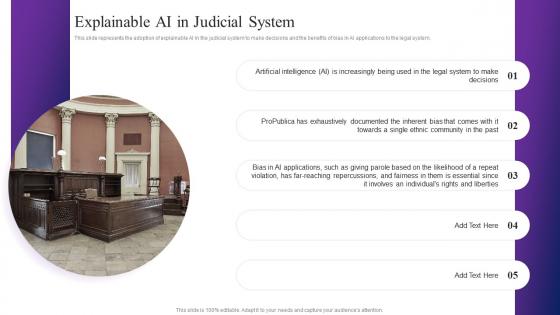
This slide represents the adoption of explainable AI in the judicial system to make decisions and the benefits of bias in AI applications to the legal system.
People who downloaded this PowerPoint presentation also viewed the following :
Explainable Ai In Judicial System Interpretable AI Ppt Powerpoint Presentation Show Professional with all 6 slides:
Use our Explainable Ai In Judicial System Interpretable AI Ppt Powerpoint Presentation Show Professional to effectively help you save your valuable time. They are readymade to fit into any presentation structure.





FAQs for Explainable Ai In Judicial System Interpretable AI Ppt Powerpoint
So explainable AI basically means you can actually see how these systems make decisions instead of just getting some mysterious output. Like when an algorithm suggests a sentence or does a risk assessment, you'd know what factors it weighed - was it prior convictions, age, whatever. That's huge for accountability honestly. Right now too many of these systems are total black boxes that nobody can challenge. Defendants and lawyers deserve to understand the reasoning, especially when it affects someone's freedom. You should definitely look into what standards your area has - or doesn't have, which is probably the case.
Look, explainable AI basically shows you the "why" behind court decisions instead of just spitting out random verdicts. You can see exactly which factors the system weighed - like prior offenses, flight risk, whatever - and how much each one mattered for bail or sentencing. Judges and lawyers can actually challenge the logic instead of just accepting some mysterious algorithm. Honestly, it's way better than the old boys' club where decisions happened behind closed doors anyway. The trick is building systems that explain themselves in normal language, not tech gibberish that nobody understands.
So basically, these AI systems pick up biases from old court records and arrest patterns - even from how people labeled the training data. Risk assessment tools end up flagging certain groups unfairly for repeat offenses. The worst part? These are total black boxes. Nobody can explain why they made specific decisions. What helps is using more diverse data and doing regular bias checks. Also, algorithms need to show their work somehow. Oh, and humans should always make the final call - never let the AI decide alone. Appeals processes are crucial too.
Explainable AI shows you exactly why it made certain predictions - super helpful for building cases. You can see which precedents or evidence it focused on most, then use those same factors in your arguments. Way better than getting some mysterious recommendation you can't explain. It'll also flag potential weak spots you might've missed (honestly saved me a few times). The real win? When you're in front of a judge, you can walk through concrete reasoning instead of just saying "trust me, this feels right." Makes everything way more convincing.
So basically explainable AI lets you see the "why" behind decisions, not just the answer. Like instead of some mystery algorithm telling you how a case might go, you can actually peek under the hood and see its reasoning. Pretty neat honestly. You're not just blindly following whatever it spits out - you can challenge stuff that seems off and still use your own judgment. The whole point is working together with the tech rather than getting steamrolled by it. You'll still make the final calls, but now you've got backup that actually shows its work.
Oh man, this is a minefield. Biggest issue? Bias gets baked right in - if the training data comes from historically biased court decisions, you're just automating discrimination. Then there's the black box mess where judges can't actually explain how they reached decisions because they don't understand the AI's logic either. That's pretty sketchy for due process, right? Someone's liberty is on the line here. Bottom line: any AI tools need to be completely transparent and auditable, with judges still making the final calls instead of just going along with whatever the algorithm spits out.
Honestly, these explainable AI tools are pretty cool for law school. They show you step-by-step how algorithms analyze evidence and interpret case law - basically like watching someone's brain work in slow motion. You can actually see where the AI might be getting things wrong too, which is huge since these systems will probably be everywhere soon. It's like having that one professor who's always willing to walk through their reasoning again (you know the type). The transparency part is what makes them actually useful for learning legal thinking patterns. I'd mess around with some of these platforms now if I were you - might as well get comfortable with this stuff early.
Honestly, your biggest headache will be making judges and lawyers actually understand *why* your AI decided something - not just the technical stuff. Legal language is super nuanced, and let's be real, even humans can't agree on interpretations half the time! Biased training data is another nightmare since it could just repeat all the unfair patterns from before. Different states have totally different legal frameworks too, which makes things messy. My advice? Work with actual lawyers from day one - they'll tell you what explanations actually matter instead of you guessing.
So explainable AI can churn through thousands of legal cases and pull out the key stuff that influenced similar decisions. Makes precedents way easier to digest for judges and juries. You don't have to manually dig through endless case law anymore (thank god, because that sounds awful). The AI surfaces relevant patterns and breaks down why certain precedents apply to your case. It turns complex legal reasoning into clear visual summaries showing how past rulings connect to current facts. Everyone gets the "why" behind decisions, not just the "what." Look for tools with case citation mapping - they're honestly game changers for legal research.
Honestly, there aren't many fully deployed systems yet - courts move super slowly with this stuff. COMPAS risk assessment tools added explanation features after that whole bias mess. Estonia's trying AI for small claims, which is kinda cool. Some US courts are testing explainable systems for bail and scheduling decisions. Oh, and the Netherlands piloted fraud detection AI in administrative courts with decent transparency. Most places are still in "let's not screw this up" mode though. You'll find more pilot programs than actual implementations right now.
So it's all over the place honestly. EU's going hard on transparency - if AI touches a legal decision, you gotta explain how it works. Here in the US? Total mess. Some states make you disclose it, others are like "we'll figure it out later" lol. Estonia and Singapore are testing transparency rules in their digital courts, which is pretty cool actually. Most places are heading toward requiring explanations though, especially for bail or sentencing stuff. I'd definitely check what your bar association says since this whole thing changes constantly.
Look, public trust basically makes or breaks these AI court tools. Citizens get suspicious when algorithms start affecting their lives - can't really blame them, right? The whole thing falls apart without buy-in, no matter how well the tech actually works. Transparency is huge here. Show people the data sources, explain how decisions get made, and make it crystal clear that humans have the final say. Oh, and don't wait around hoping people will just accept it. Get out there early, answer their questions directly, and actually listen to what's bugging them about it.
So basically explainable AI lets you see exactly how the system made its decision - no more black box nonsense. You can actually trace which factors it weighted most heavily when recommending a sentence or whatever. That's pretty crucial since people's lives are on the line here. If something seems off, you can challenge the reasoning or at least understand why it spit out that particular recommendation. Plus there's an audit trail if things go sideways later. Honestly, I'd always push for the explanation whenever AI gets involved in court stuff - you deserve to know how these decisions get made.
Courts are gonna start requiring "show your work" docs for any AI decisions - that's coming fast. The tech is getting crazy sophisticated too, like actually walking through reasoning chains instead of just basic feature importance. Some demos I've seen are honestly pretty insane. Real-time explanation tools are in development so judges can query systems during proceedings. Different jurisdictions will probably standardize frameworks soon. My advice? Track which courts are piloting this stuff now. Early adopters always end up setting the standards everyone else has to follow later.
Look, criminal cases need way tighter controls - we're talking about people's freedom here. Before any sentencing, humans must review AI recommendations. Also run bias audits every six months, no exceptions. Civil stuff can be more relaxed but you still need clear documentation showing how the AI decided things. The difference between "you're going to jail" and "pay this money" is huge, right? Your safeguards should match that reality. Get diverse legal experts involved in reviews and always keep audit trails. Oh, and definitely sort cases by risk level first - makes everything easier.
-
Their designing team is so expert in making tailored templates. They craft the exact thing I have in my mind…..really happy.
-
Designs have enough space to add content.