


Export Strategic Guide For Global Market Entry Powerpoint Presentation Slides Strategy MD




Try Before you Buy Download Free Sample Product
 Impress Your
 Audience
 100%
100% Editable
 Save Hours
 of Time


Our Export Strategic Guide For Global Market Entry Powerpoint Presentation Slides Strategy MD are topically designed to provide an attractive backdrop to any subject. Use them to look like a presentation pro.
People who downloaded this PowerPoint presentation also viewed the following :
Content of this Powerpoint Presentation
Slide 1: This slide introduces Export Strategic Guide for Global Market Entry. State your company name and begin.
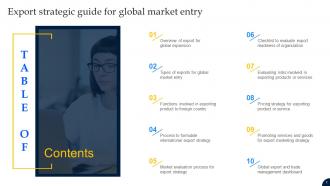
Slide 2: This slide shows Table of Content for the presentation.
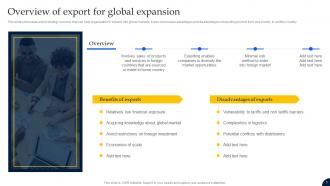
Slide 3: This slide shows Overview of export for global expansion.
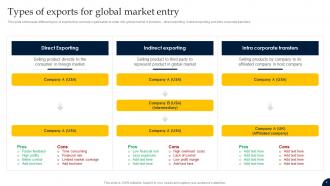
Slide 4: This slide presents Types of exports for global market entry.
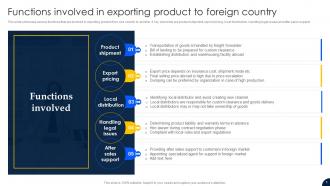
Slide 5: This slide displays Functions involved in exporting product to foreign country.
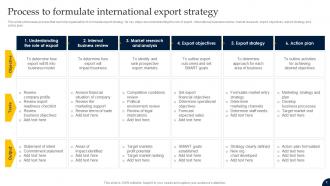
Slide 6: This slide represents Process to formulate international export strategy.
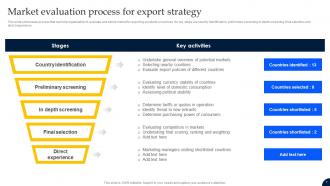
Slide 7: This slide displays Market evaluation process for export strategy.
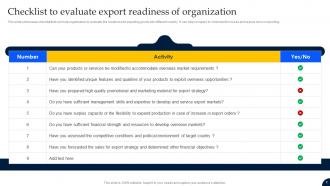
Slide 8: This slide represents Checklist to evaluate export readiness of organization.
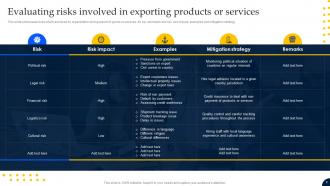
Slide 9: This slide showcases Evaluating risks involved in exporting products or services.
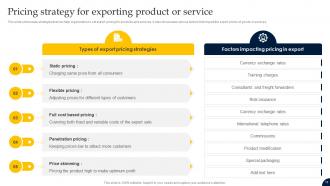
Slide 10: This slide shows Pricing strategy for exporting product or service.
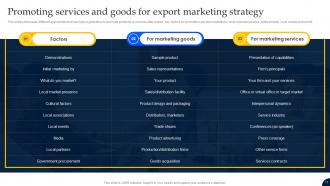
Slide 11: This slide presents Promoting services and goods for export marketing strategy.
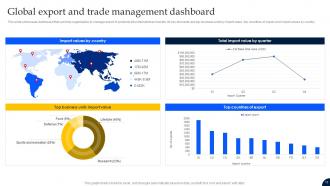
Slide 12: This slide displays Global export and trade management dashboard.
Slide 13: This is a Thank You slide with address, contact numbers and email address.
Export Strategic Guide For Global Market Entry Powerpoint Presentation Slides Strategy MD with all 18 slides:
Use our Export Strategic Guide For Global Market Entry Powerpoint Presentation Slides Strategy MD to effectively help you save your valuable time. They are readymade to fit into any presentation structure.






FAQs for Export Strategic Guide For Global Market Entry Powerpoint Presentation
Honestly, most people screw up the market research part - they think there's demand without actually understanding what locals want or who they're competing against. You've got to nail four things: research your target countries hard, figure out all the regulatory stuff, plan your logistics, and get your finances sorted. Pick just 1-2 markets to test first instead of going everywhere at once. Your logistics needs to cover shipping and warehousing, obviously. Financial planning is trickier though - currency swings will mess with you, plus pricing strategies are different everywhere. Oh, and start building relationships with local partners now, not later.
Honestly, market research is what saves you from making really expensive mistakes when you're trying to export stuff. You need it to figure out which countries actually want what you're selling and how much they'll pay. Plus it shows you who you're competing against and what regulations you'll have to deal with - some places have weird rules you'd never think of. I'd start with just googling around and reading industry reports first. Way cheaper than jumping straight into surveys. Once you narrow it down to maybe 2-3 countries that look promising, then you can do the real research with focus groups or whatever. Trust me, skipping this step because you're eager to get started will bite you later.
Oh man, you've gotta dive deep into the cultural stuff first. I'm talking customs, business etiquette, how people actually communicate there - the whole deal. Seriously, I've watched companies crash and burn because they skipped this part. Your pricing needs to make sense locally, same with packaging and how you sell. Even colors matter more than you'd think! Religious practices can totally derail you if you're not careful. Honestly? Find someone who actually lives there and knows the market inside out.
Start with a risk assessment - political stability, currency stuff, trade rules, local competition. Export credit agencies have amazing country reports (seriously, they're way better than you'd expect). Cultural barriers can totally kill your launch, so factor those in too. Economic risks matter obviously, plus operational challenges like distribution. Honestly, I'd make a simple scoring sheet to compare different markets side by side. Makes it way easier to see which ones are actually worth pursuing vs. the ones that'll just drain your budget.
Okay so first thing - check if your products need export licenses before shipping anything. Some stuff requires government approval. Also watch out for trade sanctions because accidentally doing business with banned countries is a nightmare. Each target market has different customs rules, tariffs, and paperwork requirements too. Your products also have to meet their safety standards, which honestly varies wildly by country. International trade law is seriously complicated - like, way more than you'd expect. I'd definitely get a trade lawyer involved early, especially if you're in regulated industries or dealing with any sensitive tech.
Dude, you gotta check out how much tech can help with exports. Real-time tracking and automated documentation save insane amounts of time - I'm talking like 60% faster processing just from going digital. The customs paperwork basically does itself now, which honestly feels like magic sometimes. Data analytics show you which markets are actually worth your time too. Short sentences work. But finding a platform that connects everything from your initial orders through delivery - that's where it gets really powerful. Companies are scaling internationally way faster because they're not drowning in paperwork anymore. Worth looking into for sure.
So you've got a few main options here - export credit insurance, letters of credit, and export loans through banks or SBA. Insurance protects you when buyers flake on payment. Letters of credit are great because they guarantee you get paid once you ship everything correctly. Your bank can also front you money for production costs before the buyer pays up. Export-Import Bank has decent programs if you're doing bigger deals. Honestly, trade finance seems super complicated at first but those three handle most situations. I'd just call your bank's trade finance people - they know what works best for different markets and deal sizes.
Start by checking their track record - get references from other suppliers and pull their credit reports. Market coverage is huge too. Do they actually reach your customers or just talk a big game? I've seen too many reps who promise the world but can't deliver. Experience with similar products matters because nobody wants to pay for their learning curve. Check out their sales team size and marketing muscle. Most importantly though - find distributors who'll actually invest in pushing your brand, not ones who'll just throw it on a shelf with everything else. You want partners who care about your success.
Track your revenue growth by region obviously, but customer acquisition costs per country matter way more than people think. Export volumes are super easy to monitor and give you quick wins data-wise. Shipping times and return rates by location will make or break your international rep - I learned this the hard way with a client last year. Market penetration rates help too. Customer satisfaction scores split by country are clutch. Honestly just throw it all into a monthly dashboard so you can see which markets are crushing it and which ones... aren't.
Trade agreements are honestly your best bet for cutting tariffs - sometimes down to zero. USMCA, CPTPP, bilateral deals your country signed... they can save you serious money. The catch? You've got to prove your stuff meets "rules of origin" requirements (basically showing enough work happened domestically). Yeah, the paperwork's annoying at first. But once you figure out which agreements cover your target markets, it's pretty straightforward. I'd definitely get a trade specialist to help initially - they'll make sure you're documenting everything right to claim those lower rates.
Look, your supply chain basically controls whether your export business succeeds or fails. When it's running smoothly, you'll see better costs, faster deliveries, and way less stress with inventory. But here's the thing - this is also where everything usually goes wrong! Bad coordination means late shipments and angry customers calling you at weird hours because of time zones (ugh). You need to map out every single step and spot problems before they hit. I'd start by checking which suppliers and shipping partners are your weak links. Trust me, finding those gaps early saves you so much drama later.
Honestly, you've gotta research each market first - figure out what colors and messaging actually work there. Your logo might even need changes. Look at McDonald's doing rice burgers in Asia, that's smart adaptation. But don't lose your core identity completely or people won't recognize you anymore. Local influencers are huge for this stuff - they already get their audience. I'd say test some smaller campaigns before you go all-in on major rebrand changes. It's basically about finding that balance between being authentic to your brand and not accidentally offending anyone, you know?
So there's some pretty big stuff happening in international trade right now. Digital transformation is everywhere - companies are jumping on e-commerce and digital payments to go global. Supply chains are getting shorter too, which honestly makes sense after all the chaos we've seen. Businesses don't want those crazy long global networks anymore, they're going regional for better reliability. Oh, and sustainability is actually becoming a real thing now, not just marketing fluff. Customers genuinely care about ESG compliance in trade deals. My advice? Take a hard look at your export strategy, especially the digital side and sustainability - those are moving super fast right now.
Okay so first figure out your shipping - ocean for heavy/bulk stuff, air if it's urgent or valuable. Get a good freight forwarder who actually knows your target markets, because honestly the paperwork will make you want to scream otherwise. Learn Incoterms so you're not confused about who pays for what when things go wrong. Documentation is huge - invoices, packing lists, origin certificates, maybe export licenses. Oh and start finding customs brokers in your destination countries now, not later. Always pad your delivery timelines though. Delays happen constantly and customers hate surprises.
Honestly, customer feedback is your best friend when you're figuring out exports. People will straight up tell you what's not working - maybe your pricing is way off for that market, or some product feature just doesn't make sense there. Cultural stuff you never even thought about comes up all the time. Set up ways to actually hear from customers early on - surveys work, but sometimes just listening to what people say on social media tells you more. I learned this the hard way once. The feedback can sting, but it's way better than wasting money on an approach that's totally missing the mark.
-
Great product with effective design. Helped a lot in our corporate presentations. Easy to edit and stunning visuals.
-
I downloaded some of the presentations for work. They were simple to modify and saved me a lot of time and effort.