


Facility Management Company Profile Expand Facility Management Offering By 2025




Try Before you Buy Download Free Sample Product
 Impress Your
 Audience
 100%
100% Editable
 Save Hours
 of Time


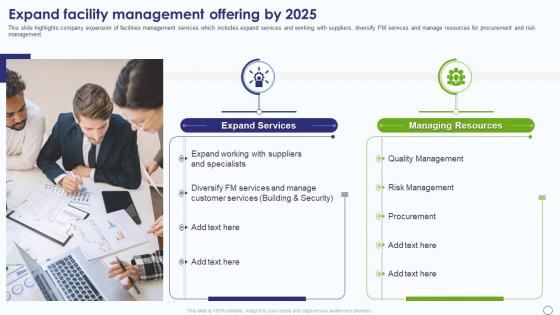
This slide highlights company expansion of facilities management services which includes expand services and working with suppliers, diversify FM services and manage resources for procurement and risk management.
People who downloaded this PowerPoint presentation also viewed the following :
Facility Management Company Profile Expand Facility Management Offering By 2025 with all 6 slides:
Use our Facility Management Company Profile Expand Facility Management Offering By 2025 to effectively help you save your valuable time. They are readymade to fit into any presentation structure.





FAQs for Facility Management Company Profile Expand Facility Management
The expansion of facility management services is driven by increased focus on operational efficiency, cost reduction, regulatory compliance, sustainability initiatives, and technology integration. Organizations across healthcare, manufacturing, and corporate sectors are outsourcing comprehensive facility services to streamline operations, reduce overhead costs, and leverage specialized expertise, ultimately enabling them to focus on core business activities while achieving better workplace experiences.
Technology has revolutionized facility management through IoT sensors, predictive analytics, automated maintenance systems, cloud-based platforms, and mobile applications, enabling real-time monitoring and data-driven decision making. These innovations streamline operations by reducing downtime, optimizing energy consumption, and enhancing space utilization, with many organizations finding that smart building technologies ultimately deliver significant cost savings and improved tenant experiences.
Sustainability drives facility management expansion through energy-efficient systems, waste reduction programs, green building certifications, and resource optimization technologies. These approaches streamline operational costs, enhance corporate reputation, and meet regulatory requirements, with many organizations finding that sustainable facilities deliver significant cost savings, improved employee satisfaction, and competitive advantage in an increasingly environmentally-conscious business landscape.
Facility management enhances operational efficiency by optimizing space utilization, streamlining maintenance processes, implementing smart building technologies, and ensuring regulatory compliance across multiple locations. Through integrated systems and data analytics, large organizations reduce operational costs, minimize equipment downtime, and improve employee productivity, with many enterprises finding that strategic facility management delivers significant cost savings while enhancing workplace experiences.
Facility management professionals can adapt by implementing hybrid workspace solutions, enhancing health and safety protocols, integrating smart building technologies, and redesigning spaces for flexibility and collaboration. These strategic approaches streamline operations while addressing evolving employee expectations, with many organizations finding that adaptive facility management ultimately delivers improved workplace experiences, operational efficiency, and competitive advantage in attracting talent.
Facility management companies face challenges including resource allocation across multiple locations, maintaining consistent service quality standards, integrating different operational systems, and managing increased workforce complexity during expansion phases. These challenges present both operational hurdles and strategic opportunities, with many organizations finding that systematic planning, technology integration, and standardized processes ultimately deliver improved efficiency and competitive advantage in an increasingly complex facilities landscape.
International standards significantly impact facility management expansion by establishing consistent service benchmarks, ensuring regulatory compliance across markets, and building client confidence in service quality. Through ISO certifications and industry frameworks, facility management companies can streamline operations, reduce market entry barriers, and demonstrate proven capabilities to multinational clients, ultimately delivering scalable solutions and competitive advantages in diverse international markets.
Essential skills include strategic planning, technology proficiency, vendor management, financial analysis, sustainability knowledge, and regulatory compliance expertise. These competencies enable professionals to streamline operations, enhance cost efficiency, and leverage emerging technologies like IoT and automation, with many organizations finding that skilled facility managers ultimately deliver significant operational savings and improved workplace experiences in increasingly complex environments.
Customer expectations drive facility management firms toward integrated technology solutions, sustainability initiatives, predictive maintenance capabilities, and enhanced user experiences through digital platforms. These evolving demands push companies to adopt IoT sensors, AI-powered analytics, and mobile applications that streamline operations, with many firms finding that proactive service delivery and data-driven insights ultimately deliver competitive advantage in an increasingly experience-focused marketplace.
Remote and hybrid work models significantly transform facility management strategies by reducing physical space requirements, increasing technology infrastructure demands, and necessitating flexible workspace designs. These shifts enable organizations to optimize real estate costs, enhance employee satisfaction through adaptable environments, and streamline operations with smart building technologies, ultimately delivering competitive advantages in an increasingly flexible work landscape.
Facility management trends differ significantly across industries, with healthcare prioritizing infection control, patient safety compliance, and specialized equipment maintenance, while manufacturing focuses on operational efficiency, predictive maintenance, and safety protocols. These sector-specific approaches enable healthcare facilities to enhance patient outcomes and regulatory adherence, while manufacturing environments streamline production processes, ultimately delivering industry-tailored solutions that optimize both operational performance and strategic competitive advantage.
Organizations should track occupancy rates, space utilization efficiency, operational cost per square foot, tenant satisfaction scores, and maintenance response times during facility management expansion. These metrics enable facilities managers to optimize resource allocation, identify underutilized areas, and streamline operations across multiple locations, with many enterprises finding that comprehensive tracking ultimately delivers cost reductions and enhanced workplace experiences.
Partnerships enhance facility management growth through shared resources, expanded service capabilities, technology integration, market access, and specialized expertise. Strategic collaborations with technology providers, contractors, and industry specialists enable firms to offer comprehensive solutions, reduce operational costs, and penetrate new markets, ultimately delivering enhanced client experiences and competitive advantage in an increasingly complex facilities landscape.
Effective space utilization directly drives facility management expansion by maximizing asset value, reducing operational costs, and enabling data-driven decision making through advanced analytics and IoT monitoring systems. Organizations with optimized space strategies require comprehensive facility services spanning workplace planning, technology integration, and sustainability management, with many enterprises finding that strategic space utilization delivers competitive advantages and scalable operational efficiency.
Emerging facility management technologies include IoT sensors, AI-powered predictive maintenance, cloud-based management platforms, mobile workforce applications, and automated building systems. These technologies streamline operations by enabling real-time monitoring, predictive analytics, and seamless integration across facilities, with many organizations finding that strategic technology adoption delivers significant cost reductions and enhanced operational efficiency.
-
The visual appeal of the templates is just unparalleled! I was so worried about the design of my presentation but SlideTeam made it all so easy.
-
One-stop solution for all presentation needs. Great products with easy customization.