


Feasibility Study Templates For Different Projects Market Segmentation Analysis For Ecommerce Business




Try Before you Buy Download Free Sample Product
 Impress Your
 Audience
 100%
100% Editable
 Save Hours
 of Time


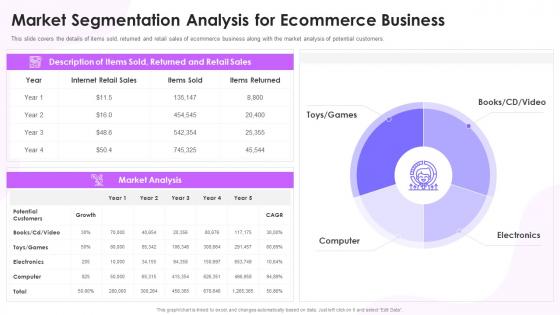
This slide covers the details of items sold, returned and retail sales of ecommerce business along with the market analysis of potential customers.
People who downloaded this PowerPoint presentation also viewed the following :
Feasibility Study Templates For Different Projects Market Segmentation Analysis For Ecommerce Business with all 7 slides:
Use our Feasibility Study Templates For Different Projects Market Segmentation Analysis For Ecommerce Business to effectively help you save your valuable time. They are readymade to fit into any presentation structure.






FAQs for Feasibility Study Templates For Different Projects Market Segmentation Analysis
Essential feasibility study components include market analysis, technical requirements, financial projections, operational assessments, risk evaluations, and implementation timelines. These elements work together by providing comprehensive project viability insights, enabling stakeholders to evaluate market demand, resource allocation, and potential returns, with many organizations finding that structured templates streamline decision-making and minimize investment uncertainties.
Feasibility study templates help businesses streamline project assessment by providing standardized frameworks for evaluating financial viability, market potential, technical requirements, and risk factors consistently across all initiatives. These structured approaches enable organizations to accelerate decision-making timelines, reduce analysis costs, and improve project success rates, with many companies finding that systematic evaluation processes ultimately deliver better resource allocation and competitive advantage.
Visual elements enhance feasibility study presentations by simplifying complex data through charts and graphs, highlighting key findings with infographics, creating clear project timelines, and using professional templates for consistent branding. These visual tools streamline stakeholder comprehension, accelerate decision-making processes, and strengthen credibility, with many organizations finding that well-designed presentations significantly improve project approval rates and investor confidence.
Industries with complex project requirements and high capital investments benefit most from structured feasibility study templates, including healthcare, construction, manufacturing, energy, and financial services. These sectors leverage templates to streamline risk assessment, regulatory compliance, and investment analysis, with many organizations finding that standardized frameworks accelerate decision-making while ensuring comprehensive evaluation of market viability and operational feasibility.
Project size determines template detail through scope complexity, stakeholder requirements, resource allocation, and risk assessment needs. Smaller projects benefit from streamlined templates focusing on core viability factors, while larger initiatives require comprehensive frameworks covering market analysis, technical specifications, and financial projections, with many organizations finding that scalable template structures ultimately deliver faster decision-making and better resource management.
Financial projections serve as the quantitative backbone of feasibility study templates, encompassing revenue forecasts, cost analyses, cash flow projections, break-even calculations, and return on investment metrics. These projections enable stakeholders to assess project viability, secure funding, and make informed strategic decisions, with many organizations finding that comprehensive financial modeling ultimately determines whether initiatives move from concept to implementation.
Customizing feasibility study templates involves modifying sections like market analysis, financial projections, risk assessments, and technical requirements to align with your project's unique scope, industry, and objectives. Organizations across sectors, from manufacturing to healthcare, enhance these templates by incorporating industry-specific metrics, regulatory considerations, and stakeholder requirements, ultimately delivering more accurate assessments and strategic decision-making frameworks.
Common pitfalls include over-relying on generic sections without customization, inadequate market research and financial projections, ignoring regulatory requirements, and insufficient stakeholder input during analysis. These templates work best when tailored to specific industries like healthcare or manufacturing, with many organizations finding that thorough customization and comprehensive data collection ultimately delivers more accurate assessments and strategic decision-making.
Stakeholders can effectively collaborate using a shared feasibility study template by establishing centralized data collection, standardized evaluation criteria, clear role assignments, and structured communication protocols. This approach streamlines decision-making across departments, ensures consistent analysis frameworks, and enables real-time input integration, with many organizations finding that shared templates reduce project timeline conflicts while enhancing strategic alignment.
Feasibility studies focus on viability assessment with sections for market analysis, technical requirements, financial projections, and risk evaluation, while business plans emphasize implementation strategy through executive summaries, marketing plans, operational details, and funding requests. These templates serve different purposes, with feasibility studies helping organizations determine whether to proceed with projects and business plans guiding execution, ultimately delivering strategic decision-making tools for different business phases.
**INPUT**: How can you ensure that a feasibility study template aligns with regulatory requirements in specific industries? **OUTPUT**: Ensuring regulatory alignment requires incorporating industry-specific compliance frameworks, mandatory assessment criteria, and standardized reporting structures directly into your template design. Financial services, healthcare, and manufacturing organizations increasingly customize templates with sector-specific regulatory checkpoints, while collaborating with compliance teams and legal advisors to validate requirements, ultimately delivering streamlined approval processes and reduced regulatory risk. [Word count: 58 words]
Tools that enhance feasibility study templates include Microsoft Excel for financial modeling, PowerPoint for presentations, project management software like Asana or Trello, and specialized platforms such as Smartsheet or Monday.com. These technologies streamline data analysis, automate calculations, and enhance visual presentation, with many organizations finding that integrated platforms deliver more efficient collaboration, faster decision-making, and ultimately stronger stakeholder engagement.
Feasibility study templates should be reviewed annually and updated whenever significant market changes, regulatory shifts, or new industry standards emerge. Organizations in rapidly evolving sectors like technology or healthcare may require more frequent updates, with many companies finding that quarterly reviews ensure their templates capture current market conditions, competitive landscapes, and stakeholder expectations for accurate project assessments.
**INPUT**: What are the best practices for presenting findings from a feasibility study template to potential investors? **OUTPUT**: Best practices include creating executive summaries with clear ROI projections, visual data representations, risk assessments with mitigation strategies, and comprehensive market analysis sections. These elements streamline investor presentations by highlighting financial viability, market opportunities, and strategic advantages, with many organizations finding that structured templates enhance credibility and accelerate funding decisions. [Word count: 53 words]
Cultural factors significantly influence feasibility study templates through varying stakeholder consultation practices, risk assessment frameworks, regulatory compliance requirements, and decision-making hierarchies across regions. For instance, templates in collectivist cultures emphasize community impact and consensus-building sections, while individualistic regions prioritize competitive advantage metrics, with many multinational organizations finding that culturally-adapted templates enhance local acceptance and strategic outcomes.
-
It saves your time and decrease your efforts in half.
-
Qualitative and comprehensive slides.