


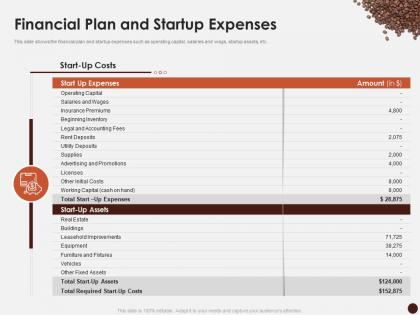
Financial plan and startup expenses master plan kick start coffee house ppt pictures




Try Before you Buy Download Free Sample Product
 Impress Your
 Audience
 100%
100% Editable
 Save Hours
 of Time


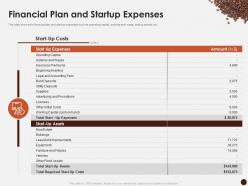
This slide shows the financial plan and startup expenses such as operating capital, salaries and wags, startup assets, etc.
People who downloaded this PowerPoint presentation also viewed the following :
Financial plan and startup expenses master plan kick start coffee house ppt pictures with all 2 slides:
Use our Financial Plan And Startup Expenses Master Plan Kick Start Coffee House Ppt Pictures to effectively help you save your valuable time. They are readymade to fit into any presentation structure.
FAQs for Financial plan and startup expenses master plan kick start coffee
A comprehensive coffee house startup financial plan includes startup costs, revenue projections, operating expenses, cash flow analysis, and break-even calculations. These components work together by establishing initial investment requirements, forecasting daily sales targets, and tracking ongoing costs like rent and inventory, with many coffee entrepreneurs finding that detailed financial planning enables better location decisions, pricing strategies, and ultimately sustainable profitability within the competitive food service market.
Estimate coffee house startup costs by calculating equipment expenses, lease deposits, initial inventory, permits and licensing fees, and renovation costs for your specific location. Through detailed market research, many entrepreneurs find that initial investments typically range from $80,000 to $300,000, with factors like size, location, and concept complexity ultimately determining your total capital requirements.
Market research provides critical insights into customer demographics, local competition, pricing strategies, foot traffic patterns, and revenue potential that directly inform financial projections and budget allocations. Through comprehensive market analysis, coffee house entrepreneurs can accurately forecast sales volumes, optimize location costs, and identify profitable menu pricing, while understanding seasonal fluctuations and consumer preferences, ultimately delivering realistic financial models that enhance investor confidence and operational success.
Project your first-year sales by analyzing local foot traffic patterns, competitor performance, seasonal variations, average transaction values, and customer frequency rates. Start conservatively with 50-100 customers daily in month one, gradually scaling to 200-300 by year-end, while factoring in menu pricing strategies and peak hours, ultimately delivering realistic revenue forecasts between $200,000-400,000 annually.
Fixed costs include rent, insurance, equipment loans, base utilities, and core staff salaries, while variable costs encompass coffee beans, milk, packaging, additional labor during peak hours, and marketing expenses. These cost structures enable coffee house owners to accurately project break-even points, optimize inventory management, and establish pricing strategies, with many successful startups finding that balancing premium ingredients with efficient operations ultimately delivers sustainable profitability and competitive market positioning.
Calculate your break-even point by dividing total fixed costs (rent, salaries, equipment payments) by contribution margin per unit, which equals average sale price minus variable costs per item. Coffee houses typically break even within 12-18 months, with successful locations achieving this through strategic pricing, high-volume products like specialty drinks, and optimizing operational efficiency to minimize waste and labor costs.
Coffee pricing methods include cost-plus pricing, competitive analysis, value-based pricing, psychological pricing strategies, and menu engineering techniques. These approaches work by calculating precise food costs, analyzing local market rates, and strategically positioning premium items alongside affordable options, with many coffee shop owners finding that bundling beverages with pastries and implementing tiered pricing ultimately delivers higher average transactions and sustainable profit margins.
Creating a cash flow statement for your coffee house startup involves tracking operating cash flows like daily sales revenue, inventory purchases, rent, utilities, and payroll, alongside investing activities such as equipment purchases and financing activities including loan proceeds or owner investments. Start with projected monthly sales based on customer traffic estimates, subtract all operating expenses including cost of goods sold, labor, and overhead costs, then factor in one-time startup investments and financing sources, ultimately delivering a clear picture of when your coffee house will achieve positive cash flow and sustainable profitability.
Coffee house entrepreneurs can explore small business loans, SBA financing, angel investors, crowdfunding platforms, equipment financing, and personal investment options. These funding sources enable aspiring owners to secure initial capital, lease prime locations, and purchase essential equipment, with many successful coffee houses combining multiple funding streams to minimize risk while accelerating their path to profitability and market presence.
**INPUT**: How can I forecast customer foot traffic and its impact on sales? **OUTPUT**: Forecasting customer foot traffic involves analyzing location demographics, competitor analysis, seasonal patterns, local events, and peak hour studies to establish baseline projections. Coffee shops typically see 20-30% revenue correlation with foot traffic, with successful establishments using point-of-sale data, weather patterns, and community calendars to refine predictions, ultimately enabling strategic staffing decisions and inventory management. **Word count: 56 words**
Essential financial metrics for coffee house performance include revenue per customer, food cost percentage, labor cost ratio, daily cash flow, and profit margins by product category. These metrics enable owners to optimize pricing strategies, control inventory waste, and manage staffing efficiently, with many successful coffee businesses finding that tracking these indicators weekly delivers improved profitability and sustainable growth.
Marketing and branding typically require 7-15% of projected revenue in your first year, focusing on digital marketing, social media presence, local community engagement, and brand identity development. Coffee startups often find success allocating 60% to digital channels, 25% to local advertising, and 15% to branding materials, ultimately building customer loyalty and competitive differentiation.
Seasonal trends significantly impact coffee house revenue through fluctuating customer traffic, with summer typically seeing decreased hot beverage sales while winter drives higher consumption patterns. These variations affect cash flow projections, inventory planning, and staffing costs, with many coffee houses finding that strategic menu diversification, seasonal promotions, and adjusted operating hours help maintain consistent profitability year-round.
Coffee house contingency planning involves setting aside 10-15% of your total budget for unexpected expenses, creating diversified revenue streams, and establishing emergency credit lines. These strategies enable you to handle equipment breakdowns, supply chain disruptions, and market fluctuations while maintaining operations, with many successful coffee entrepreneurs finding that robust contingency planning ultimately delivers operational resilience and competitive advantage during challenging periods.
Suppliers significantly impact coffee house financial planning through cost structures, payment terms, inventory management, and quality consistency requirements. Strategic supplier relationships enable better cash flow through flexible payment schedules, bulk purchasing discounts, and reliable supply chains, with many coffee businesses finding that diversified supplier networks ultimately deliver cost stability and competitive pricing advantages.
-
Qualitative and comprehensive slides.
-
Appreciate the research and its presentable format.
-
Informative presentations that are easily editable.
-
Excellent template with unique design.
-
Easy to edit slides with easy to understand instructions.