


Financial technology icons
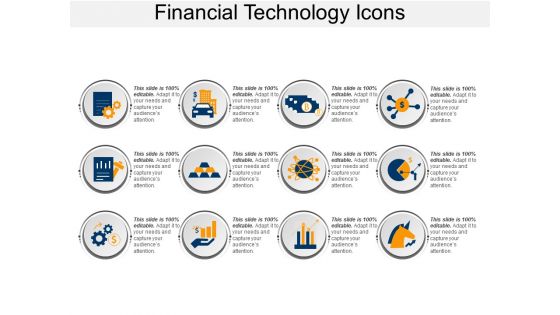





Try Before you Buy Download Free Sample Product
 Impress Your
 Audience
 100%
100% Editable
 Save Hours
 of Time


Our Financial Technology Icons are a fantastic bargain. They come with many extra facilities.
People who downloaded this PowerPoint presentation also viewed the following :
Financial technology icons with all 5 slides:
Initiate the deliberations with our Financial Technology Icons. Give equal consideration to all arguments.




FAQs for
Key drivers include limited traditional banking infrastructure, widespread mobile phone adoption, growing digital literacy, supportive regulatory frameworks, and increasing demand for affordable financial services. These factors enable fintech companies to leapfrog conventional banking systems, with emerging markets like Kenya and India finding that mobile payment platforms and digital lending deliver faster financial inclusion and lower operational costs.
Traditional banks are adapting through digital transformation initiatives, strategic fintech partnerships, mobile-first banking platforms, API integrations, and enhanced customer experience technologies. Through these approaches, banks streamline operations, accelerate service delivery, and offer personalized financial solutions, while leveraging their regulatory expertise and established trust, ultimately delivering competitive digital services that match fintech innovation.
Regulatory frameworks provide essential structure for fintech growth by establishing compliance standards, consumer protection measures, data security requirements, and operational guidelines that build market trust. These frameworks enable fintech companies to scale confidently while fostering innovation through regulatory sandboxes and clear licensing pathways, ultimately delivering sustainable growth and enhanced financial services across banking, payments, and lending sectors.
Artificial intelligence transforms fintech customer service through chatbots, predictive analytics, personalized recommendations, automated fraud detection, and real-time transaction monitoring. These technologies streamline operations by reducing response times, minimizing human errors, and enhancing customer experiences, with many banks and financial institutions finding that AI-powered systems deliver 24/7 support while significantly lowering operational costs.
Fintech cybersecurity risks include data breaches, payment fraud, identity theft, API vulnerabilities, and regulatory compliance failures. These threats present both challenges and opportunities, with many financial institutions finding that robust security frameworks, real-time monitoring, and advanced encryption ultimately deliver enhanced customer trust and competitive advantage in an increasingly digital landscape.
Blockchain technology is revolutionizing finance through decentralized transactions, smart contracts, cross-border payments, digital identity verification, and transparent supply chain financing. Financial institutions increasingly leverage blockchain to reduce settlement times, minimize costs, and enhance security, with banks like JPMorgan and Santander finding that blockchain delivers faster international transfers and improved regulatory compliance.
Fintech companies ensure AML compliance through automated transaction monitoring, customer due diligence protocols, suspicious activity reporting systems, and real-time risk assessment tools. These technologies streamline compliance by flagging unusual patterns, verifying customer identities, and maintaining audit trails, with many financial institutions finding that automated solutions significantly reduce compliance costs while enhancing regulatory transparency.
Integrating fintech solutions delivers enhanced customer experiences, operational efficiency, faster transaction processing, regulatory compliance automation, and competitive differentiation. While implementation presents integration complexity and security considerations, many banks find that strategic partnerships with fintech providers streamline digital transformation, reduce operational costs, and enable innovative services like real-time payments and personalized financial products.
Peer-to-peer lending offers faster approval processes, lower operational costs, and greater accessibility compared to traditional bank lending, which provides regulatory oversight, established credit frameworks, and institutional stability. While P2P platforms enable borrowers with limited credit history to access funds and investors to earn higher returns, traditional methods deliver comprehensive risk assessment and deposit insurance protection, with many financial institutions now integrating both approaches strategically.
Fintech significantly enhances financial inclusion by providing mobile banking, digital wallets, peer-to-peer lending, microfinance platforms, and blockchain-based services to underserved populations. These technologies streamline account opening, reduce transaction costs, and eliminate geographical barriers, with rural communities and small businesses increasingly accessing credit, savings, and payment services that traditional banks couldn't economically deliver.
Fintech innovations address financial literacy through gamified learning apps, AI-powered budgeting tools, automated savings platforms, personalized financial coaching, and interactive educational content that simplifies complex concepts. These technologies enhance financial understanding by delivering real-time spending insights, goal-based learning modules, and micro-investment guidance, with many banks and credit unions finding that digital literacy tools significantly improve customer financial behaviors and long-term engagement.
Mobile-first solutions, blockchain technology, artificial intelligence, biometric authentication, and embedded finance are revolutionizing digital payments. These innovations streamline transactions by reducing friction, enhancing security, and enabling seamless integration across platforms, with retailers and financial institutions finding that contactless payments and real-time processing ultimately deliver faster customer experiences and operational efficiency.
Fintech companies leverage big data analytics through predictive modeling, real-time risk assessment, customer behavior analysis, fraud detection algorithms, and personalized product recommendations. These technologies enable banks and financial institutions to streamline loan approvals, enhance investment strategies, and deliver targeted services, while significantly reducing operational costs and improving customer experiences in an increasingly competitive landscape.
Ethical considerations in fintech include informed consent for data collection, transparent usage policies, secure storage protocols, equitable algorithmic decision-making, and customer control over personal information. While these requirements present compliance challenges, they ultimately build consumer trust and competitive advantage, with many financial institutions finding that robust privacy frameworks enhance customer loyalty and regulatory positioning.
Fintech advancements will reshape finance sector work through automation, artificial intelligence, and digital platforms that streamline operations, enhance customer experiences, and enable remote collaboration. Financial institutions increasingly find that these technologies eliminate routine tasks, create demand for tech-savvy professionals, and deliver faster services, ultimately requiring workforce reskilling while providing competitive advantages.
-
Perfect template with attractive color combination.
-
Helpful product design for delivering presentation.