


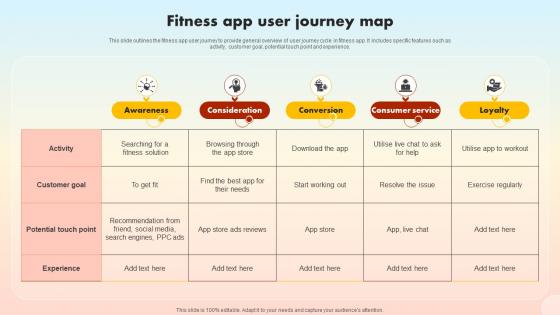
Fitness App User Journey Map




Try Before you Buy Download Free Sample Product
 Impress Your
 Audience
 100%
100% Editable
 Save Hours
 of Time


This slide outlines the fitness app user journey to provide general overview of user journey cycle in fitness app. It includes specific features such as activity, customer goal, potential touch point and experience.
People who downloaded this PowerPoint presentation also viewed the following :
Fitness App User Journey Map with all 9 slides:
Use our Fitness App User Journey Map to effectively help you save your valuable time. They are readymade to fit into any presentation structure.








FAQs for Fitness App
So there are basically five stages users go through with fitness apps. They start by setting up their profile and goals during onboarding. Discovery comes next - exploring workouts and features. Honestly, this is where most apps completely blow it if the interface sucks. Then you've got engagement when people actually start working out regularly. After that they're tracking progress and hitting milestones, which feels pretty good. Finally there's the retention phase where social stuff and challenges keep them hooked. But yeah, focus hard on that discovery-to-engagement jump since that's where you'll lose the most people.
Honestly, onboarding is everything for fitness apps. Most people download them with big plans but quit immediately if they're confused or overwhelmed. You want those first sessions to feel like having a supportive trainer - not like you're drowning in features and menus, you know? Get them to set some personal goals, walk through the basics without being boring about it, and give them those quick wins early. If someone completes even one full workout in their first 48 hours, they're literally 3-4x more likely to still be using your app after a month. That's your magic number right there.
Dude, personalized content is what makes users actually stick around instead of deleting your app after two weeks. When workouts match someone's actual fitness level and goals, they don't feel lost or overwhelmed - which honestly kills most fitness apps before they even get started. Users feel like the app actually gets them, you know? It's not just some cookie-cutter program everyone gets. The retention boost is insane too, like 40% better or something. My advice? Grab those user preferences right away and start customizing their dashboard from day one. Makes all the difference.
Set up feedback collection at different points - post-workout surveys, feature ratings, maybe a feedback tab in settings. Timing matters though! Don't bug people while they're actually exercising (trust me on this one). Test changes with small user groups first before going wide. Here's what really works: tell people when you actually use their ideas. Nothing builds loyalty like that. Sort feedback by what's doable vs pipe dreams, then knock out the easy wins fast. Users notice when you're responsive. Oh and keep it simple - overcomplicated feedback systems just collect dust.
Match your motivation tactics to where users actually are in their journey. Beginners need habit-building stuff - small wins, streaks, basic educational content that won't overwhelm them. Intermediate users want progress tracking and challenges since they're past the "am I even doing this right?" stage. Advanced users crave variety and personalized goals, plus ways to mentor others (they're already self-motivated anyway). What excites a newbie - like their first completed workout - will totally bore someone who's been grinding for months. I'd start by segmenting users by experience level, then A/B test different messages to see what actually works.
Dude, this is huge for keeping people around. Confusing apps get deleted so fast - like within days. I've watched tons of fitness apps crash and burn because they made logging workouts way too complicated. People are already struggling to stick with working out, right? Last thing they need is wrestling with some janky interface that takes forever to load. Make your main features stupidly easy to use. Honestly, the simpler the better. When everything just works smoothly, users actually want to open your app again. Your retention will thank you for it.
Honestly, visual progress tracking is huge - streak counters, before/after pics, those little workout badges people love collecting. Social stuff works too, like competing with friends or sharing wins. But don't go crazy with push notifications or people will just delete the app (learned that the hard way). What really hooks users long-term? Watching their actual numbers improve - faster times, heavier lifts, that kind of thing. Oh, and make sure the dashboard isn't cluttered. People want to see their progress quickly without hunting around for it.
Honestly, gamification works because people are weirdly competitive and love that little dopamine rush from hitting goals. Points, badges for workouts, leaderboards with friends - all solid options. Streak counters are surprisingly addictive too (I've kept my Duolingo streak going for like 2 years just because lol). Progress bars and level-ups give great visual feedback. The trick is making small wins feel meaningful. Different people get motivated by different things, so you'll want multiple ways to "succeed." I'd start simple with maybe points and one other feature, then see what actually gets your users engaged before adding more stuff.
Oh man, social features are a game changer for fitness apps! Friend challenges and workout sharing tap into that competitive side - you know how you always push harder when someone's watching. Community groups are clutch when your motivation tanks (which happens to everyone). Seeing other people hit their goals makes yours feel way more doable too. Progress comparisons can be motivating but honestly sometimes they stress me out lol. I'd focus on features that get people interacting regularly without making it feel like homework. The accountability factor alone keeps users way more engaged.
Honestly, people just get overwhelmed by too many features and bail when they don't see quick wins. I've literally done this with probably four fitness apps now lol. Start simple - pick ONE goal during onboarding instead of trying to do everything. Build in small victories early so people actually feel like they're winning. Push notifications work but don't be that annoying app nobody wants to open. The tracking part needs to be brain-dead easy. If I'm exhausted after a workout and can't figure out how to log it? Yeah, I'm deleting your app. Keep it stupidly simple over flashy features.
Yeah, privacy is huge for fitness apps. People share super personal stuff - health issues, workout routines, body measurements. Apps that are upfront about data use and let you control sharing? They see 40-60% more usage. But one breach and you're toast. I've literally watched people delete apps they loved because they got sketchy about their health data being sold or whatever. So when you're mapping out the user experience, put privacy controls where people can actually find them. Don't bury that stuff three menus deep - nobody has time for that.
Dude, community features are seriously where it's at for fitness apps. Users get hooked when they can share workouts and compete on leaderboards - it's like having gym buddies in your pocket. Social proof works magic too. People see others crushing goals and think "oh snap, I can do that." Short solo tracking? Gets boring fast. But add some challenges where people can hype each other up during rough patches, and suddenly you've got users who actually stick around. I swear, the accountability factor alone makes people way more consistent with their workouts.
Honestly, you've gotta bake this stuff in from the start or you'll regret it later. Let users pick their workout intensity, throw in different styles like yoga or martial arts - whatever fits their vibe. Audio cues are clutch for accessibility too. Oh, and localization isn't just translating text (so many apps mess this up). What motivates a college kid is totally different from what works for busy parents. During onboarding, just ask people what they want instead of guessing based on age or whatever. Survey your current users about what's actually blocking them from using the app more.
Track retention rates first - that's your gold standard since fitness apps bleed users like crazy. Look at 7-day and 30-day marks especially. Session frequency matters too, plus how many people actually complete workouts vs just opening the app. Feature adoption is huge - are they setting goals, tracking progress, using social stuff if you have it? Honestly I'd avoid getting caught up in vanity metrics that look good but don't mean much. Cohort analysis will show you how different user groups behave over time, which is super helpful for tweaking your onboarding flow.
Look, fitness apps live or die by how well they adapt to users. Track everything - workout patterns, where people bail out, completion rates. The smart ones use machine learning to actually predict what workouts you'll stick with (which is honestly kind of scary but whatever). Regular updates matter too based on what people are asking for. I've seen so many apps ignore user feedback and then wonder why downloads tank. Set up analytics from the start and don't be stubborn about pivoting when something isn't working. Quick iteration is key.
-
I was able to find the right choice of PPT template for my thesis with SlideTeam. Thank you for existing.
-
Crisp and neat slides. Makes it fun and easier to curate presentations.