


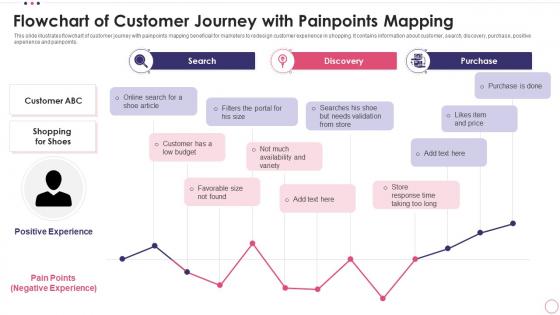
Flowchart Of Customer Journey With Painpoints Mapping




Try Before you Buy Download Free Sample Product
 Impress Your
 Audience
 100%
100% Editable
 Save Hours
 of Time


This slide illustrates flowchart of customer journey with painpoints mapping beneficial for marketers to redesign customer experience in shopping. It contains information about customer, search, discovery, purchase, positive experience and painpoints.
People who downloaded this PowerPoint presentation also viewed the following :
Flowchart Of Customer Journey With Painpoints Mapping with all 7 slides:
Use our Flowchart Of Customer Journey With Painpoints Mapping to effectively help you save your valuable time. They are readymade to fit into any presentation structure.






FAQs for Flowchart Of Customer Journey
So there are usually five main stages: awareness, consideration, purchase, onboarding, and advocacy. Awareness is when people first find out you exist. Then comes consideration - honestly, this part gets chaotic because customers research everything these days. Purchase is obvious, that's the actual buy. Onboarding covers how they first experience your product (super critical but often overlooked). Finally, advocacy is when they're telling others about you. Oh, and some people add retention as its own stage too. Here's the thing though - map what customers actually do, not what you hope they'll do. Makes all the difference.
Mix surveys with actual behavior data - that's where you'll get the real story. Customer interviews are gold, but honestly, watching where people click and bail out tells you way more than what they say sometimes. Sit in on support calls if you can. Those conversations are brutal but super helpful for finding pain points. Your front desk people probably know more about customer frustrations than anyone in leadership does. They deal with complaints all day that never bubble up. Cross-reference everything so you're not just making assumptions about what's actually happening.
Miro and Mural are clutch for team collaboration - everyone can drag sticky notes around together. If you want something more structured, Lucidchart's your bet. UXPressia has ready-made templates which is honestly a lifesaver. Don't sleep on PowerPoint though - I know it sounds basic but it actually works fine when you're starting out. My old boss swore by Google Slides for everything, even journey maps. The real trick? Whatever tool your team will consistently open and not forget about after week one. Nothing worse than switching platforms halfway through a project.
Honestly, you need to trace every single touchpoint - like literally walk through their whole journey from seeing your first ad to calling support months later. Start chronologically and get obsessive about it. Your sales team will catch stuff you'd never think of from your office. Don't skip the weird moments either, like what happens when they open the package (I learned that one the hard way). Talk to actual customers too - surveys, interviews, whatever. Even tiny interactions can totally derail someone's experience. Oh, and your website's probably messier than you think it is from a user perspective.
Track different stuff at each stage - website traffic and social media for awareness, then email opens and downloads when they're considering. For conversions, look at purchase rates and cart abandonment. Most people totally ignore post-purchase metrics which is dumb because that's where the gold is. Satisfaction scores, repeat buys, referrals - all that matters. Map 3-5 key metrics to each touchpoint so you can actually see where people bail. Don't try measuring everything right away though, you'll go crazy.
So journey mapping is basically like having X-ray vision for customer frustration - you'll see exactly where people get stuck instead of just guessing. What's cool is it gets everyone on your team aligned about what customers actually go through (because trust me, everyone has totally different ideas about this). You can spot pain points AND those little moments that make people happy. Then you use all that to figure out what to fix first. Oh, and don't try to map every single customer type right away - just pick one segment to start with or you'll go crazy.
Honestly, empathy is everything when you're mapping customer journeys. You've got to actually feel what they're going through, not just track their clicks. Sure, anyone can write down "visits site → adds item → buys stuff" but that's pretty useless, right? The good stuff happens when you dig into their emotions at each step. Are they confused? Frustrated? Second-guessing themselves? I always try to imagine myself in their situation - like, would this checkout process annoy me too? Focus way more on that emotional layer next time. That's where the real breakthroughs happen.
Honestly? Most companies do it every 6-12 months, but it really depends on your industry. Tech moves fast, so maybe quarterly makes sense there. Big changes are your real trigger though - new products, tons of customer complaints about the same thing, or if your audience shifts completely. Oh, and here's the thing that drives me crazy: teams spend weeks building these gorgeous maps then literally never touch them again. Don't do that! Put a reminder in your calendar and actually assign someone to keep them fresh. Otherwise you'll be making decisions based on customer behavior from 2019 or something ridiculous like that.
Oh man, the classic mistake? Teams map what they *assume* customers do instead of getting real data. Like, actually talk to people! I've watched teams build these crazy complicated maps that are basically useless because nobody can follow them. Focus on the touchpoints that actually matter. Most people only map the perfect scenario too - but customers mess up, get confused, take weird detours. That's the real stuff you need to capture. And honestly, creating it once then forgetting about it is pointless. Keep it simple, test with actual humans, then update it when things change.
Oh man, culture totally changes everything about customer journeys! Some people want you to build a relationship first before they'll buy anything. Others just want to get in and out fast - no small talk. I found this out the hard way working on a project last year, whoops. You really need separate journey maps for different cultural groups because their pain points are gonna be completely different. Like, what feels like great service to one group might annoy another. Best move? Actually talk to customers from each group you're targeting. They'll tell you stuff you'd never guess otherwise.
Honestly, just bake the feedback right into your map as you build it. Grab stuff from surveys, interviews, support tickets - whatever you've got. Then drop those insights onto each stage so you can see what people are actually going through. The negative feedback is pure gold though, seriously - shows you all the spots where things fall apart that you'd totally miss otherwise. Throw in some direct quotes too because stakeholders actually get it when they hear real customer words. Oh and don't treat this like a one-and-done thing - you'll want to keep updating it with fresh feedback or it gets stale fast.
You absolutely need personas before jumping into journey maps - trust me on this one. Each type of customer follows a completely different path through your stuff. A new buyer vs someone who's been around? Night and day difference in what frustrates them and where they interact with you. Without personas, you'll end up creating these bland, generic maps that honestly don't help much. I'd focus on getting your top 2-3 personas solid first. Then map out separate journeys for each. Way more useful that way.
Journey mapping shows you exactly where customers hit walls and want to quit. Map out their experience and you'll catch those annoying friction points - like when your checkout is a mess or onboarding sucks. Fix those before people bail. It's honestly like reading their minds, which sounds creepy but whatever. Look for the biggest drop-off spots first in your most common customer journey. Then you can create those moments that actually make people stick around instead of just... not.
Honestly, color coding saves you so much time - pick different colors for emotions, stages, whatever makes sense for your map. Icons beat text blocks every time, especially for pain points. Your timeline needs clear flow, so arrows or left-to-right layout works well. The emotional highs and lows? Make those pop since they're usually where the good insights live. Don't cram everything together though - white space is clutch. Oh, and start simple with a basic template first. You can always jazz it up later, but I've seen too many maps that are just visual chaos from trying to do too much upfront.
So basically, customer journey mapping forces everyone to see the bigger picture instead of just their own department's stuff. Marketing finally gets what happens to their leads downstream. Support realizes why customers are already pissed off before calling. Sales figures out which touchpoints actually move the needle. Honestly, the best part is watching people have those lightbulb moments when they realize how much their work affects everything else. I'd start small though - just pick one main customer journey and get different teams to map it out together. You'll be surprised how quickly the silos start breaking down once people actually understand what the hell everyone else is doing.
-
Professional and unique presentations.
-
Excellent template with unique design.