


Journey Map To Determine Customer Pain Points Customer Research




Try Before you Buy Download Free Sample Product
 Impress Your
 Audience
 100%
100% Editable
 Save Hours
 of Time


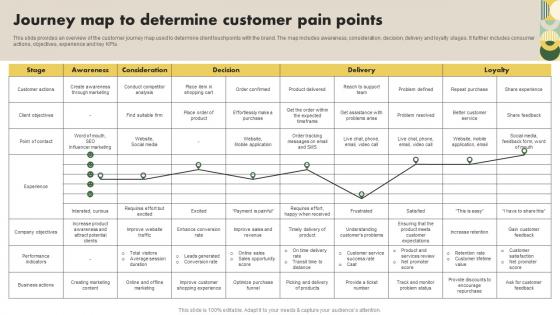
This slide provides an overview of the customer journey map used to determine client touchpoints with the brand. The map includes awareness, consideration, decision, delivery and loyalty stages. It further includes consumer actions, objectives, experience and key KPIs.
People who downloaded this PowerPoint presentation also viewed the following :
Journey Map To Determine Customer Pain Points Customer Research with all 6 slides:
Use our Journey Map To Determine Customer Pain Points Customer Research to effectively help you save your valuable time. They are readymade to fit into any presentation structure.





FAQs for Journey Map To Determine Customer Pain
So customer journey mapping is just tracking every single interaction someone has with your business - like from when they first hear about you all the way through buying and getting support after. Why bother? You'll find the exact spots where people get annoyed and bail. Your team will finally see the disconnect between what you think you're doing vs. what's actually happening. I know one company that realized they were losing a third of buyers at checkout because their form was a total mess. Honestly, just pick one type of customer and map out their whole experience. Start there.
Start by literally writing down every single way customers interact with your business - website, social media, calls, store visits, even random conversations they have about you. Google Analytics and your CRM are super helpful here, but honestly? Just ask people directly. Surveys work great. I'd also try mystery shopping because you'll catch stuff you totally missed from your perspective. Oh, and don't get overwhelmed trying to fix everything at once. Map it all out first, then figure out which touchpoints actually matter for conversions or where people get stuck.
Miro and Mural are probably your best bets - they're like digital whiteboards where everyone can collaborate at once. There's also specialized stuff like Smaply and UXPressia if you want something built just for journey mapping. Some teams still swear by PowerPoint or literal sticky notes on the wall, which honestly works great sometimes. Lucidchart's decent too. Oh, and Figma if you're already using it for design work. I'd start with Miro though - it's got a ton of templates and your team can all edit together without wanting to throw their laptops out the window.
Look, emotional triggers are basically what make or break your customer experience. Every single touchpoint hits differently - your website loads slow? Instant frustration. Checkout feels smooth? They're happy to buy. We've all ditched our carts over some ridiculous form, haven't we? These emotional highs and lows decide if people stick around or bail at each step. Here's the thing though - most businesses just wing it instead of actually mapping where these trigger points happen. Once you figure out the pattern, you can design good feelings into the whole journey. Makes such a difference.
Honestly, the worst thing you can do is just guess what customers want instead of actually asking them. I've seen people try to map out every single interaction right away - total recipe for getting stuck. You really need input from your sales and support teams since they're the ones hearing customer complaints daily. Another trap? Making it look Instagram-perfect before you've figured out what's actually broken. Start with one main customer type and their basic journey. Get real feedback on that first - I'm talking actual conversations, not surveys - then build from there. Don't overthink it initially.
Okay so here's the thing - personas make your customer journey maps way more targeted instead of those boring generic flowcharts nobody uses. Build 2-3 solid personas first, then map journeys around their actual motivations and pain points. Like, busy mom Sarah shops totally different than broke college student Mike, right? Without personas you miss all the specific friction points that matter. Plus honestly? Maps without personas just end up looking nice in meetings but don't help anyone build better products. You'll catch way more useful insights this way.
Honestly, customer feedback is what makes or breaks your journey maps. Without it, you're basically guessing what people actually experience. I've watched teams create these beautiful maps that were totally wrong because they never asked real customers! Their feedback shows you the actual pain points and emotions at each step. Surveys and interviews are gold for this - oh, and don't forget support tickets since people complain there first. Your maps shouldn't be static either. Keep updating them as you learn more. There's always some touchpoint that hits differently than you expected.
Update them every 6-12 months, but honestly depends on how fast things change for you. New products or major customer complaints? Do it sooner. I've watched companies ignore theirs for like 3 years then act shocked when they feel totally out of touch with customers lol. Tech changes or market shifts are obvious reasons to refresh. Don't just create them once and forget - that's pointless. Set a quarterly reminder to at least glance at yours. Even a quick review beats letting them collect digital dust.
Look, customer journey mapping is honestly a game-changer for figuring out where to spend your marketing dollars. It shows you which touchpoints actually matter and where people are bailing out. Way better than just throwing stuff at the wall and hoping something works! You'll spot gaps you didn't even know existed and can finally create content that hits real pain points. The personalization piece is huge too – different messaging for each stage just makes sense. I'd start with one customer segment though, don't try to boil the ocean. You'll immediately see what's working and what's totally missing the mark.
So I'd focus on conversion rates at each step and where people are dropping off - that stuff is gold. Customer satisfaction scores matter too, plus how much effort it takes people to actually buy from you (because seriously, nobody wants to jump through hoops). Track things like email opens and website clicks, but honestly? Start with maybe 3-4 metrics that actually tie to what you're trying to achieve. Oh, and Net Promoter Score is clutch for understanding if people would recommend you. Don't go crazy measuring everything right away - you'll just get overwhelmed with data.
Dude, customer journey maps are game-changers for training. They show you exactly where people get frustrated and what they're thinking at each step. Why waste time on generic "smile more" training when you could tackle the actual problems? Your checkout might be smooth, but maybe your return policy is a nightmare - the map tells you which spots need work. I'd use it to build training scenarios around real customer headaches instead of random fake situations. Way more effective than guessing what your team needs to practice, honestly.
Honestly, B2B journeys are such a nightmare compared to B2C. Multiple people need to sign off on everything, so you're looking at months or even years before they buy anything. Demos, proposals, committee meetings - the whole thing drags on forever. B2C customers just want to know if it's cheap and if other people liked it. They'll buy it today if it feels right. B2B folks stress about ROI calculations and whether their team will actually use the thing. When you're mapping this stuff out, don't just focus on whoever emails you back. There's probably like 5 other people behind the scenes who can kill the deal.
Honestly, visual journey maps are a game-changer because nobody's gonna sit there deciphering paragraphs of customer data. Color-code the emotional highs and lows - red for when people get frustrated, green for happy moments. Icons work great for different touchpoints too. I always create swim lanes so you can see which department owns what (helps avoid those awkward "wait, whose job is this?" meetings). Keep your symbols consistent and don't go crazy with colors - simple palettes work best. The whole point is making problems obvious so your team can actually fix stuff instead of just talking about it.
Get everyone together from day one - sales, marketing, support, product, the whole crew. Someone needs to own this project though, or it'll just become another endless meeting situation. Have each team map out their part of the customer journey in workshops, then piece it all together. Honestly, the best part is watching marketing's faces when they hear what support deals with! Tools like Miro work great so people can add stuff later too. Oh, and don't forget regular check-ins to keep everything current as things change.
Dude, turn your customer journey maps into actual stories! Make your customers the main character dealing with real problems. Like instead of "touchpoint: pricing page," write "Sarah's getting annoyed because she can't find any prices anywhere, but then - boom - she spots the comparison tool and suddenly feels way better." Trust me, stakeholders actually pay attention when you do this vs those dry bullet-point maps. Throw in some dialogue, describe how people feel at each step. Even add those moments where everything goes sideways (we all know they happen). Just pick one section of your current map and rewrite it like a mini story. You'll catch issues you totally missed before.
-
“Thank you to the SlideTeam. Your presentations look really skillful and have made my life so much easier.”
-
Thank you for showering me with discounts every time I was reluctant to make the purchase.