


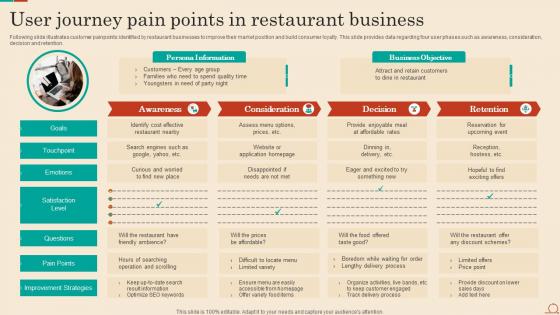
User Journey Pain Points In Restaurant Business




Try Before you Buy Download Free Sample Product
 Impress Your
 Audience
 100%
100% Editable
 Save Hours
 of Time


Following slide illustrates customer painpoints identified by restaurant businesses to improve their market position and build consumer loyalty. This slide provides data regarding four user phases such as awareness, consideration, decision and retention.
People who downloaded this PowerPoint presentation also viewed the following :
User Journey Pain Points In Restaurant Business with all 6 slides:
Use our User Journey Pain Points In Restaurant Business to effectively help you save your valuable time. They are readymade to fit into any presentation structure.





FAQs for User Journey Pain Points
Users commonly encounter obstacles including unclear navigation during discovery, complex registration processes, confusing product information, lengthy checkout procedures, and inadequate post-purchase support. These friction points significantly impact conversion rates and customer satisfaction, with many e-commerce, healthcare, and financial services organizations finding that streamlining these touchpoints enhances user experience, reduces abandonment rates, and ultimately delivers higher retention and competitive advantage.
Understanding user personas helps address journey challenges by providing detailed insights into customer motivations, pain points, preferences, and behavioral patterns at each touchpoint. This deep understanding enables organizations to anticipate friction areas, customize experiences across different user segments, and proactively design solutions that streamline interactions, ultimately delivering more intuitive journeys and higher satisfaction rates.
**INPUT**: What tools or frameworks can help visualize the user journey effectively? **OUTPUT**: User journey visualization tools include customer journey mapping software, service blueprints, experience mapping platforms, touchpoint analysis frameworks, and persona-based journey templates. These methodologies streamline customer experience optimization by identifying pain points, revealing optimization opportunities, and enhancing cross-team collaboration, with many organizations finding that comprehensive journey mapping ultimately delivers improved customer satisfaction and increased conversion rates. [Word count: 60 words]
User feedback plays a crucial role by revealing hidden friction points, emotional responses, and unmet expectations that analytics alone cannot capture. Through surveys, interviews, and behavioral data, organizations can pinpoint specific moments where customers struggle, abandon processes, or experience frustration, ultimately enabling targeted improvements that enhance satisfaction and reduce churn rates.
Critical touchpoints in a typical user journey include awareness discovery, initial engagement, onboarding experience, core product interaction, and support resolution moments. These touchpoints determine customer retention and satisfaction by creating first impressions, establishing trust, and delivering value, with many organizations finding that optimizing these stages significantly reduces churn while enhancing overall customer lifetime value.
Personalization enhances user experience by delivering tailored content, customized product recommendations, and adaptive interface designs based on individual preferences and behaviors. Through machine learning algorithms and data analytics, companies streamline customer interactions, reduce decision fatigue, and accelerate conversion rates, with retail and financial services organizations finding that personalized journeys increase engagement and customer satisfaction significantly.
Mobile responsiveness significantly impacts user journey challenges by affecting navigation ease, loading speeds, and overall user experience across devices. Poor mobile optimization creates friction points, abandoned interactions, and decreased conversion rates, while responsive design streamlines user flows, reduces bounce rates, and enhances customer satisfaction, ultimately delivering competitive advantage in an increasingly mobile-first marketplace.
Cross-functional teams enhance user experience by combining diverse expertise, sharing customer insights across departments, and aligning product development with user needs through regular communication and shared goals. These collaborative approaches streamline decision-making, eliminate silos, and accelerate problem-solving, with many organizations finding that integrated teams deliver more cohesive customer experiences and faster innovation cycles.
Key metrics include conversion rates, bounce rates, time-on-page, drop-off points, customer acquisition costs, and user engagement scores across touchpoints. These analytics enable organizations to identify friction points, optimize customer experiences, and streamline pathways to conversion, with many businesses finding that comprehensive journey mapping ultimately delivers higher retention rates and improved operational efficiency.
Technical issues significantly disrupt user journeys by creating friction points, abandoned transactions, and frustrating experiences that drive customers away. These disruptions lead to immediate drop-offs and long-term retention challenges, with many businesses finding that even minor technical glitches can reduce conversion rates by 20-40%, ultimately impacting revenue and competitive positioning.
Strategies to reduce onboarding drop-offs include progressive profiling, interactive tutorials, personalized welcome sequences, simplified form fields, and real-time support integration. These approaches streamline user experience by minimizing friction, providing immediate value demonstration, and offering contextual guidance, with many organizations finding that strategic onboarding optimization increases completion rates significantly while enhancing long-term customer retention.
Emotional engagement significantly influences user journey outcomes by driving deeper connections, increasing retention rates, and enhancing decision-making processes throughout each touchpoint. When users feel emotionally invested, they demonstrate higher loyalty, spend more time exploring offerings, and become advocates for brands, with many organizations finding that emotionally engaged customers deliver substantially greater lifetime value.
Cognitive biases to consider include confirmation bias, anchoring bias, recency bias, availability heuristic, and assumption bias, which can distort how teams interpret user behavior and pain points. These biases lead organizations to overlook critical touchpoints, misinterpret feedback patterns, and design solutions based on internal perspectives rather than actual user needs, ultimately compromising customer experience optimization.
A/B testing contributes to optimizing user journeys by comparing different interface designs, content variations, and navigation paths to identify what resonates most with users. Through systematic testing of elements like checkout processes, call-to-action buttons, and page layouts, organizations streamline conversion rates, reduce abandonment points, and enhance overall user experiences, ultimately delivering data-driven insights that maximize engagement and business outcomes.
Content quality addresses user journey challenges by providing clear, relevant information that guides users seamlessly through each touchpoint, reducing confusion and friction points. High-quality content enhances user experiences across digital platforms, with many organizations finding that well-crafted messaging, intuitive navigation aids, and targeted communications ultimately streamline customer interactions and improve conversion rates significantly.
-
Placing an order on SlideTeam is very simple and convenient, saves you a lot of your time.
-
I am really satisfied with their XYZ products. Used their slides for my business presentations and now I am taking their help for my son's high-school assignments. Super satisfied!!