


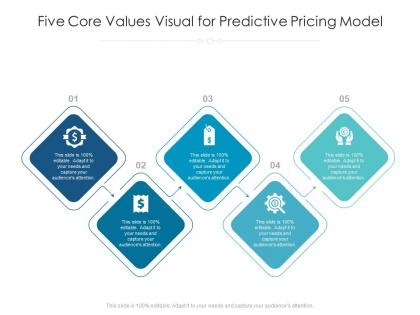
Five core values visual for predictive pricing model infographic template




Try Before you Buy Download Free Sample Product
 Impress Your
 Audience
 100%
100% Editable
 Save Hours
 of Time


Give your usual presentation a brand new look by enhancing its aesthetics using this Five Core Values Visual For Predictive Pricing Model Infographic Template. This PPT slide is drafted using different vector based icons, graphics, and other visual content that can be used by any industry professional. As such, it can be used to display and share information on any topic. With a combination of invaluable information and visual content, this is a great template to use for impressing your viewers, staff, management, or any other individual. This template is designed in such a way that it will not only help you give clarifiers but also reinforce positive actions by your target audience. The feature of in built editable components further adds to the versatility of this slide. Therefore, download it now.
People who downloaded this PowerPoint presentation also viewed the following :
Five core values visual for predictive pricing model infographic template with all 2 slides:
Use our Five Core Values Visual For Predictive Pricing Model Infographic Template to effectively help you save your valuable time. They are readymade to fit into any presentation structure.
FAQs for Five core values visual for predictive pricing
Key components of a predictive pricing model include historical sales data, competitor pricing analysis, demand forecasting algorithms, market trend indicators, and customer behavior patterns. These elements work together by analyzing price elasticity, seasonal fluctuations, and competitive positioning, enabling businesses to optimize revenue strategies and respond dynamically to market conditions, ultimately delivering improved profit margins and competitive advantage.
Historical data trends influence predictive pricing strategies by identifying seasonal patterns, demand fluctuations, competitor responses, and customer behavior cycles that inform future pricing decisions. Through advanced analytics, retailers, airlines, and hospitality businesses can anticipate market shifts, optimize revenue during peak periods, and adjust pricing dynamically, ultimately delivering competitive advantage and maximized profitability.
Machine learning enables predictive pricing models by analyzing vast datasets, identifying complex pricing patterns, recognizing customer behavior trends, and automatically adjusting prices based on market conditions. Through advanced algorithms, retailers and service providers optimize revenue strategies, reduce pricing errors, and respond to competitor changes in real-time, ultimately delivering enhanced profitability and competitive advantage.
Businesses can effectively integrate customer behavior data into pricing predictions by leveraging machine learning algorithms, historical purchase patterns, demographic analysis, and real-time engagement metrics. Through advanced analytics platforms, companies streamline price optimization by analyzing browsing habits, seasonal trends, and competitor responses, while enhancing revenue forecasting and customer segmentation, ultimately delivering personalized pricing strategies and improved profit margins.
Implementing predictive pricing models presents challenges including data quality issues, complex algorithm development, market volatility adaptation, competitive response prediction, and regulatory compliance requirements. While these obstacles require significant technical expertise and resource investment, many retail, hospitality, and e-commerce organizations find that strategic implementation ultimately delivers enhanced profit margins and competitive positioning in increasingly dynamic markets.
External factors significantly influence predictive pricing by providing crucial data inputs that algorithms analyze to determine optimal price points, with market demand patterns, competitor pricing strategies, seasonal fluctuations, and economic indicators serving as key variables. These models continuously process real-time market intelligence, enabling businesses to dynamically adjust pricing strategies, respond to competitive pressures, and capitalize on demand shifts, ultimately delivering enhanced revenue optimization and strategic market positioning.
**INPUT**: What metrics are crucial for evaluating the accuracy of a predictive pricing model? **OUTPUT**: Key accuracy metrics include Mean Absolute Error (MAE), Root Mean Square Error (RMSE), Mean Absolute Percentage Error (MAPE), R-squared values, and directional accuracy measures. These metrics enable businesses to assess pricing precision, forecast reliability, and competitive positioning effectiveness, with many retail and financial services organizations finding that combining multiple metrics delivers comprehensive performance insights and strategic advantage. **Word count: 58**
Companies tailor predictive pricing models through demographic analysis, purchase history segmentation, behavioral pattern recognition, and real-time engagement tracking. By integrating customer data with machine learning algorithms, retailers and service providers can deliver personalized pricing strategies that optimize conversion rates, enhance customer satisfaction, and maximize revenue across diverse market segments.
Retail, airlines, hospitality, and e-commerce have achieved significant success with predictive pricing through their dynamic demand patterns, extensive transaction data, and price-sensitive customer bases. These industries benefit from real-time market responsiveness, optimized revenue streams, and competitive positioning, with many organizations finding that predictive models enhance profit margins while maintaining customer satisfaction in increasingly competitive markets.
Predictive pricing models should typically be updated weekly or monthly, depending on market volatility, seasonal fluctuations, competitor actions, and data availability within your industry. E-commerce retailers often update daily during peak seasons, while manufacturing companies may refresh quarterly, with financial services and hospitality sectors finding that real-time adjustments deliver optimal revenue optimization and competitive positioning.
Seasonality significantly impacts predictive pricing strategies by creating fluctuating demand patterns, inventory challenges, and competitive dynamics that require adaptive algorithms. Through historical data analysis and machine learning, retailers, hospitality businesses, and airlines anticipate seasonal trends, adjusting prices dynamically to optimize revenue while managing supply constraints, ultimately delivering improved profit margins and competitive positioning.
Predictive pricing models enhance customer loyalty by delivering personalized pricing strategies, dynamic discount optimization, behavioral analysis insights, and targeted retention offers that align with individual customer value perceptions. Through machine learning algorithms, companies like subscription services and retail platforms can anticipate price sensitivity patterns, reduce churn rates, and create competitive advantages, ultimately strengthening long-term customer relationships while maximizing revenue potential.
Common tools for predictive pricing models include Python with scikit-learn, R, SAS, Tableau, Microsoft Azure Machine Learning, and specialized platforms like Pricefx and PROS. These technologies streamline data analysis, algorithm development, and real-time implementation, with many retail, hospitality, and e-commerce organizations finding that integrated solutions deliver enhanced revenue optimization and competitive advantage.
Legal and ethical considerations significantly shape predictive pricing practices by requiring transparency, fairness, and compliance with consumer protection laws, anti-discrimination regulations, and data privacy requirements. These frameworks help organizations balance competitive pricing strategies with responsible business practices, with many companies finding that ethical pricing models ultimately enhance customer trust and long-term profitability.
Best practices for presenting predictive pricing model results include creating clear visualizations, providing confidence intervals, explaining model assumptions, offering scenario comparisons, and translating technical metrics into business impact. These presentations should emphasize revenue implications, competitive positioning, and implementation timelines, with many organizations finding that interactive dashboards and executive summaries enhance stakeholder buy-in while ensuring strategic pricing decisions.
-
Graphics are very appealing to eyes.
-
Helpful product design for delivering presentation.
-
Great designs, Easily Editable.