


Five Effective Customer Acquisition Strategy Wheel




Try Before you Buy Download Free Sample Product
 Impress Your
 Audience
 100%
100% Editable
 Save Hours
 of Time


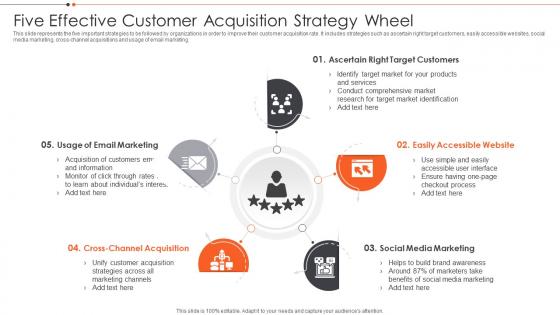
This slide represents the five important strategies to be followed by organizations in order to improve their customer acquisition rate. It includes strategies such as ascertain right target customers, easily accessible websites, social media marketing, cross-channel acquisitions and usage of email marketing.
People who downloaded this PowerPoint presentation also viewed the following :
Five Effective Customer Acquisition Strategy Wheel with all 6 slides:
Use our Five Effective Customer Acquisition Strategy Wheel to effectively help you save your valuable time. They are readymade to fit into any presentation structure.





FAQs for Five Effective Customer
The most effective digital acquisition channels include social media advertising, search engine optimization, content marketing, email campaigns, and influencer partnerships. These strategies work by targeting specific demographics, building organic visibility, and creating authentic engagement, with many businesses finding that combining multiple channels significantly reduces acquisition costs while delivering higher-quality leads and sustainable growth.
Businesses can leverage social media for customer acquisition through targeted advertising, influencer partnerships, content marketing, social listening, and community building. Platforms like LinkedIn enable B2B companies to reach decision-makers, while Instagram and Facebook help retail brands engage younger demographics, ultimately delivering higher conversion rates and lower acquisition costs.
Content marketing attracts potential customers by providing valuable educational resources, addressing pain points, building brand authority, and establishing trust through consistent messaging. Through strategic blog posts, whitepapers, and video content, businesses nurture prospects throughout the buyer's journey, ultimately converting leads into customers while reducing acquisition costs and enhancing long-term loyalty.
Small businesses can optimize customer acquisition costs by leveraging targeted digital marketing, referral programs, content marketing, social media engagement, and strategic partnerships with complementary businesses. Through data-driven audience targeting and cost-effective channels like email campaigns, many small retailers and service providers streamline marketing spend while expanding reach, ultimately delivering higher conversion rates and sustainable customer growth.
Startups can leverage content marketing, influencer partnerships, referral programs, social media engagement, and strategic collaborations to build brand awareness cost-effectively. These techniques work by creating authentic connections, generating word-of-mouth momentum, and maximizing limited resources, with many emerging companies finding that community-building and customer-centric approaches ultimately deliver sustainable growth and competitive advantage.
Customer segmentation proves essential for acquisition strategies by enabling targeted messaging, optimizing resource allocation, and improving conversion rates through personalized approaches. Through detailed demographic and behavioral analysis, companies like retail brands and financial services deliver tailored campaigns that resonate with specific audiences, ultimately reducing acquisition costs while increasing customer lifetime value and competitive advantage.
Key metrics include customer acquisition cost (CAC), lifetime value (CLV), conversion rates, cost per lead, and return on acquisition investment. These measurements enable businesses to optimize marketing spend, identify high-performing channels, and refine targeting strategies, with many organizations finding that tracking CLV-to-CAC ratios ultimately delivers sustainable growth and competitive advantage.
Partnerships and collaborations enhance customer acquisition by expanding market reach, sharing customer bases, and leveraging complementary expertise to create compelling value propositions. Through strategic alliances, businesses access new distribution channels, benefit from partner credibility, and reduce acquisition costs, with many organizations finding that collaborative approaches deliver faster growth and enhanced competitive positioning.
Psychological triggers influencing customer acquisition include social proof, scarcity, reciprocity, authority, and loss aversion. These principles drive decision-making by leveraging testimonials and reviews, creating urgency through limited-time offers, and establishing trust through expert endorsements, with many businesses finding that strategic combinations of these triggers significantly enhance conversion rates and accelerate the customer acquisition process.
B2B customer acquisition focuses on relationship-building, longer sales cycles, and demonstrating ROI through targeted content marketing, industry events, and personalized outreach. B2C strategies emphasize broader reach, emotional engagement, and faster conversions through social media advertising, influencer partnerships, and promotional campaigns, with B2B typically requiring multiple touchpoints while B2C leverages immediate purchase triggers.
Email marketing best practices for customer acquisition include personalized subject lines, segmented audience targeting, compelling call-to-actions, mobile-optimized designs, and automated drip campaigns. These strategies streamline outreach by delivering relevant content, nurturing leads through systematic touchpoints, and tracking engagement metrics, with many businesses finding that targeted email sequences significantly enhance conversion rates while reducing acquisition costs.
Data analytics enables businesses to refine customer acquisition by identifying high-value customer segments, optimizing marketing channel performance, and personalizing outreach campaigns based on behavioral patterns. Through predictive modeling and conversion tracking, companies across retail, financial services, and healthcare can reduce acquisition costs, improve targeting precision, and ultimately deliver higher ROI while enhancing customer experiences.
Referral programs significantly boost customer acquisition rates by leveraging existing customers' networks, reducing acquisition costs, and generating higher-quality leads through trusted recommendations. These programs deliver acquisition rate improvements of 20-50% across industries, with companies like fintech startups and retail brands finding that referred customers demonstrate higher lifetime value and retention rates, ultimately creating sustainable growth momentum.
Companies maintain customer acquisition momentum during economic downturns by focusing on value-driven messaging, optimizing cost-effective digital channels, and strengthening customer retention strategies. Through targeted content marketing, referral programs, and strategic partnerships, businesses streamline acquisition costs while delivering enhanced value propositions, with many organizations finding that economic challenges ultimately accelerate innovation and competitive differentiation.
Businesses must consider transparency in marketing claims, respect for customer privacy and data protection, avoiding manipulative psychological tactics, and ensuring genuine value delivery rather than bait-and-switch approaches. While aggressive strategies can accelerate growth, companies increasingly find that maintaining trust through honest communication, clear pricing, and respectful follow-up practices ultimately delivers stronger customer relationships and sustainable competitive advantage.
-
What an exhaustive collection of templates you guys have there in slideteam. Impressive!!!
-
Awesome use of colors and designs in product templates.