


Five Step Process Of Last Mile Logistics Ideas Graphics Download




Try Before you Buy Download Free Sample Product
 Impress Your
 Audience
 100%
100% Editable
 Save Hours
 of Time


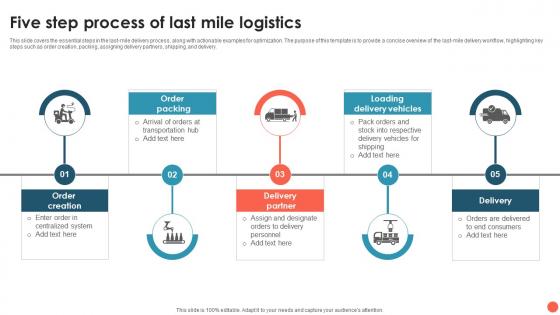
This slide covers the essential steps in the last mile delivery process, along with actionable examples for optimization. The purpose of this template is to provide a concise overview of the last mile delivery workflow, highlighting key steps such as order creation, packing, assigning delivery partners, shipping, and delivery.
People who downloaded this PowerPoint presentation also viewed the following :
Five Step Process Of Last Mile Logistics Ideas Graphics Download with all 9 slides:
Use our Five Step Process Of Last Mile Logistics Ideas Graphics Download to effectively help you save your valuable time. They are readymade to fit into any presentation structure.








FAQs for Five Step Process Of Last Mile Logistics
Key last mile logistics challenges include high delivery costs, traffic congestion, failed delivery attempts, customer demand for faster service, and environmental sustainability pressures. These obstacles significantly impact operational efficiency and customer satisfaction, with many retailers finding that strategic technology adoption, route optimization, and flexible delivery options help streamline operations while reducing costs and enhancing competitive advantage.
Technology like drones and autonomous vehicles revolutionizes last mile delivery by reducing operational costs, accelerating delivery times, and minimizing human error. These innovations enable retailers and logistics companies to streamline urban deliveries, bypass traffic congestion, and reach remote locations more efficiently, ultimately delivering faster customer experiences and significant competitive advantages in increasingly demanding markets.
Customer expectations significantly shape last mile logistics strategies by driving demand for faster delivery windows, real-time tracking capabilities, flexible delivery options, and seamless return processes. These evolving demands push companies to invest in advanced route optimization, automated sorting facilities, and alternative delivery methods like lockers and pickup points, with retailers increasingly finding that meeting these expectations directly correlates with customer retention and competitive advantage.
Urban infrastructure significantly impacts last mile delivery through road quality, traffic congestion patterns, parking availability, building accessibility, and digital connectivity systems. Well-designed infrastructure with dedicated delivery zones, smart traffic management, and accessible loading areas enables logistics companies to reduce delivery times by 30-40%, while poor infrastructure increases costs and delays, ultimately affecting customer satisfaction and competitive positioning.
Data analytics optimizes last mile logistics through route optimization algorithms, predictive demand forecasting, real-time traffic analysis, customer behavior insights, and delivery performance tracking. These technologies streamline operations by reducing fuel costs, minimizing delivery times, and enhancing customer satisfaction, with many logistics companies finding that data-driven approaches deliver significant competitive advantages and operational efficiency.
Last mile logistics significantly impacts the environment through increased carbon emissions, air pollution, packaging waste, and urban congestion from frequent deliveries. Companies can mitigate these effects by implementing electric vehicle fleets, optimizing delivery routes through AI, consolidating shipments at urban hubs, and adopting sustainable packaging, ultimately reducing their environmental footprint while enhancing operational efficiency.
Companies balance cost and speed in last mile delivery through strategic route optimization, flexible delivery options, and technology integration. By leveraging AI-powered logistics platforms, consolidated delivery hubs, and dynamic pricing models, businesses can offer same-day premium services alongside economical standard options, with many retailers finding that customer choice ultimately drives both satisfaction and operational efficiency.
Current last mile logistics innovations include autonomous delivery vehicles, drone technology, smart lockers, route optimization software, and micro-fulfillment centers. These technologies streamline operations by reducing delivery times, minimizing costs, and enhancing customer convenience, with many retailers and logistics companies finding that strategic combinations ultimately deliver competitive advantage in an increasingly demanding e-commerce landscape.
E-commerce significantly transforms last mile logistics by increasing delivery volumes, demanding faster fulfillment, and requiring more flexible delivery options like same-day or scheduled deliveries. This shift drives logistics companies to enhance route optimization, expand warehouse networks, and leverage technologies like automated sorting and real-time tracking, ultimately delivering improved customer experiences while managing operational costs efficiently.
Best practices for managing returns in last mile logistics include streamlined return portals, flexible pickup scheduling, consolidated return centers, automated processing systems, and real-time tracking capabilities. These approaches enhance customer satisfaction by simplifying return processes, reduce operational costs through efficient routing and consolidation, and enable faster refunds, with many retailers finding that optimized reverse logistics ultimately drives customer loyalty and competitive advantage.
Last mile logistics evolves differently across settings, with urban areas emphasizing micro-fulfillment centers, electric vehicles, and drone deliveries for speed and sustainability, while rural regions focus on consolidated delivery hubs, mobile services, and strategic partnerships with local businesses. These approaches enable logistics providers to optimize costs and delivery times in increasingly complex markets, with many companies finding that hybrid models deliver competitive advantage across diverse geographic challenges.
The gig economy revolutionizes last mile delivery through flexible workforce scaling, reduced fixed costs, and expanded service coverage, while presenting challenges in quality control and worker classification. Many logistics companies find that gig workers enable faster deliveries, seasonal adaptability, and cost-effective urban penetration, ultimately delivering enhanced customer experiences and competitive advantage.
Last mile logistics providers can enhance customer satisfaction by offering flexible delivery windows, real-time tracking capabilities, multiple delivery options, proactive communication, and seamless return processes. Through advanced route optimization and mobile technologies, companies like Amazon and FedEx deliver faster services, reduced delivery costs, and personalized experiences, while building customer loyalty, ultimately gaining competitive advantage in an increasingly demanding e-commerce landscape.
Reverse logistics manages product returns, exchanges, and recycling within last mile operations, handling customer-initiated shipments back through the supply chain. This process enhances customer satisfaction by streamlining return experiences, reduces operational costs through efficient resource recovery, and creates competitive advantage, with many retailers finding that seamless reverse logistics significantly improves customer retention and brand loyalty.
Partnerships with local businesses enhance last mile logistics by leveraging existing infrastructure, reducing delivery distances, and providing flexible pickup points for customers. Through strategic collaborations with retailers, cafes, and service centers, companies streamline operations while reducing costs, with many logistics providers finding that local partnerships significantly improve delivery success rates and customer satisfaction in urban markets.
-
Placing an order on SlideTeam is very simple and convenient, saves you a lot of your time.
-
Thanks to SlideTeam, we have an ideal template to present all the info we need to cover. Their slides give our numbers and projections a more clear and enchanting look.