

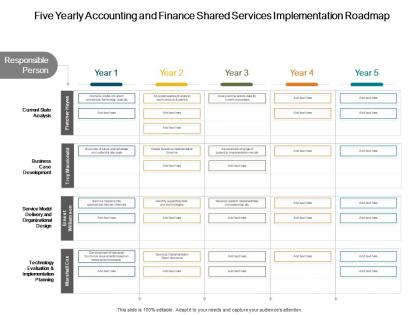
Five yearly accounting and finance shared services implementation roadmap




Try Before you Buy Download Free Sample Product
 Impress Your
 Audience
 100%
100% Editable
 Save Hours
 of Time


Visualize your work plan and communicate your ideas impactfully with our pre designed Five Yearly Accounting And Finance Shared Services Implementation Roadmap. Showcase the detailed overview of the project, the key deliverables, and the milestones to be achieved with the help of our fully customizable PowerPoint layout. You can easily emphasize on the project goals and discuss all the activities involved in an easy to comprehend manner by utilizing our professionally designed PPT theme. This roadmap PowerPoint layout is a perfect strategic planning tool that can help in keeping the project on track. With our attractive PowerPoint theme, you can articulate the workflow, track the work progress, and have a clear vision of the goal to be achieved. Download this versatile Five Yearly Accounting And Finance Shared Services Implementation Roadmap and save your hours of work.
People who downloaded this PowerPoint presentation also viewed the following :
Five yearly accounting and finance shared services implementation roadmap with all 2 slides:
Give your audience a fulfilling experience. They will find our Five Yearly Accounting And Finance Shared Services Implementation Roadmap elevating.
FAQs for Five yearly accounting and finance shared
Key components include service scope definition, technology infrastructure planning, organizational design frameworks, performance metrics establishment, and change management strategies. These elements work together by standardizing processes across business units, centralizing routine operations, and implementing automated workflows, with many organizations finding that this strategic combination delivers significant cost reductions and enhanced operational efficiency.
Organizations assess shared services readiness by evaluating current process standardization, technology infrastructure capabilities, change management capacity, and financial baseline metrics across different locations. Through comprehensive readiness assessments, companies identify integration challenges, resource requirements, and potential cost savings, while determining optimal timing and scope for implementation, ultimately enabling smoother transitions and faster realization of operational efficiencies.
Technology revolutionizes finance shared services by automating routine tasks, enabling real-time data analytics, streamlining invoice processing, and integrating disparate financial systems across multiple locations. These digital solutions deliver faster month-end closes, reduced processing costs, and enhanced accuracy, with many organizations finding that cloud-based platforms and AI-powered tools ultimately provide significant competitive advantages.
Key performance indicators include cost reduction percentages, processing time improvements, error rates, employee productivity metrics, and customer satisfaction scores across finance operations. These metrics enable organizations to track operational efficiency gains, measure service quality improvements, and demonstrate ROI, with many companies finding that comprehensive measurement frameworks ultimately deliver enhanced transparency, streamlined processes, and significant competitive advantages in financial management.
Organizations can identify consolidation-ready functions by evaluating transaction volume, process standardization, cost reduction potential, and regulatory requirements across departments like accounts payable, payroll, and financial reporting. Through detailed analysis of current workflows, resource allocation, and performance metrics, companies streamline operations while maintaining quality, with many finding that high-volume, repeatable processes deliver the greatest efficiency gains and cost savings.
Common challenges include resistance to change, process standardization difficulties, technology integration complexities, talent retention issues, and initial cost increases during implementation phases. These obstacles can be mitigated through comprehensive change management programs, phased rollout approaches, and robust training initiatives, with many organizations finding that early stakeholder engagement and clear communication strategies ultimately deliver smoother transitions and faster achievement of operational efficiencies.
Change management strategies integrate into shared services roadmaps through stakeholder engagement planning, comprehensive communication frameworks, training program development, and resistance mitigation protocols. Organizations like multinational banks and healthcare systems find that embedding change management from initial planning through implementation phases delivers smoother transitions, higher adoption rates, and faster realization of operational efficiencies.
Best practices for finance shared service center workflows include standardizing processes across business units, implementing automated approval hierarchies, establishing clear escalation procedures, and creating real-time reporting dashboards. These approaches streamline operations by reducing manual interventions, minimizing processing errors, and enhancing visibility, with many financial institutions finding that centralized workflows deliver faster month-end closures and improved compliance oversight.
Financial data security and compliance in shared services environments are maintained through robust encryption protocols, multi-factor authentication systems, role-based access controls, regular compliance audits, and automated monitoring tools. These security frameworks enable organizations to streamline operations while meeting regulatory requirements like SOX and GDPR, with many financial institutions finding that centralized governance actually enhances oversight and reduces compliance risks.
Automation transforms accounting and finance shared services by streamlining routine processes, enhancing accuracy through AI-driven analytics, and enabling real-time financial reporting across organizations. These technologies deliver significant cost reductions, faster month-end closes, and improved compliance monitoring, with many financial institutions finding that automated workflows ultimately free up strategic talent for higher-value analysis and decision-making activities.
Organizations foster collaboration within shared services teams by establishing clear communication protocols, implementing cross-functional training programs, creating shared performance metrics, and promoting knowledge-sharing platforms. Through regular team meetings and collaborative technologies, finance teams streamline processes, enhance transparency, and build stronger working relationships, with many organizations finding that integrated approaches ultimately deliver improved efficiency and better stakeholder experiences.
Continuous improvement ensures shared services evolve with changing business needs, regulatory requirements, and technological advances through regular process optimization, performance monitoring, and stakeholder feedback integration. This iterative approach enables finance teams to identify inefficiencies, implement automation enhancements, and adapt service delivery models, with many organizations finding that sustained improvement efforts deliver reduced operational costs, faster processing times, and enhanced service quality that maintains competitive advantage.
Effective SLAs in shared services should include specific performance metrics, clear response timeframes, quality benchmarks, escalation procedures, and regular review mechanisms. These agreements drive accountability by establishing measurable standards for invoice processing, financial reporting accuracy, and query resolution times, with many organizations finding that well-structured SLAs enhance operational efficiency while fostering collaborative partnerships between shared services teams and business units.
Centralized models consolidate all finance functions into a single shared services center with standardized processes, unified reporting, and centralized decision-making, while decentralized models distribute functions across multiple locations with local autonomy. Centralized approaches deliver greater cost efficiency, consistency, and control, whereas decentralized models provide faster local responsiveness and flexibility, with many organizations finding hybrid approaches optimize both operational efficiency and regional adaptability.
Organizations ensure customer service priority within shared services by establishing dedicated service level agreements, implementing robust feedback mechanisms, and maintaining direct communication channels with internal clients. Through centralized support teams and performance dashboards, companies like multinational banks and retail chains streamline responses while enhancing service quality, ultimately delivering faster resolution times and improved stakeholder satisfaction across all business units.
No Reviews