

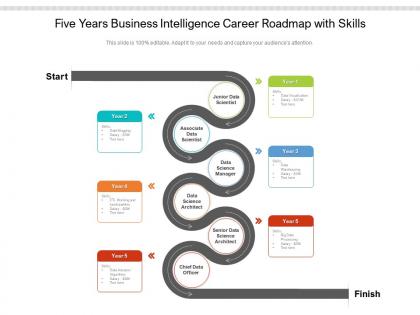
Five years business intelligence career roadmap with skills




Try Before you Buy Download Free Sample Product
 Impress Your
 Audience
 100%
100% Editable
 Save Hours
 of Time


A cohesive work plan is essential for achieving the desired target. Communicate your vision and lay a firm ground in front of your audience with our PowerPoint layout. Align your project milestones, budgets, deliverables, deadlines, and all the requisite information for a dynamic presentation by employing this amazingly designed Five Years Business Intelligence Career Roadmap With Skills. Maximize team efficiency and streamline a work plan efficiently by introducing our ready made roadmap PowerPoint theme. You can quickly establish coordination between different activities across the organization and present an insight to your colleagues by utilizing this useful business tool. Color code specific tasks, prioritize, and keep a close eye on the deadlines with the help of our eye catchy PowerPoint template. Download our Five Years Business Intelligence Career Roadmap With Skills for excelling at productive management.
People who downloaded this PowerPoint presentation also viewed the following :
Five years business intelligence career roadmap with skills with all 2 slides:
Give your audience a fulfilling experience. They will find our Five Years Business Intelligence Career Roadmap With Skills elevating.
FAQs for Five years business intelligence career
Essential business intelligence skills include data analysis and visualization, SQL and database management, statistical knowledge, business acumen, and proficiency in BI tools like Tableau, Power BI, or QlikView. These competencies enable professionals to transform raw data into actionable insights, streamline decision-making processes, and drive strategic initiatives, with many organizations increasingly valuing candidates who combine technical expertise with strong communication skills to bridge data and business strategy.
Transitioning from a technical role to business intelligence requires developing analytical skills, learning BI tools like Tableau or Power BI, and understanding business processes across different departments. Many professionals enhance their transition by pursuing relevant certifications, gaining experience with data visualization projects, and building domain knowledge in specific industries like healthcare or finance, ultimately delivering valuable insights that drive strategic decision-making.
SQL, Python, R, DAX, and M (Power Query) are most beneficial for business intelligence careers, with SQL being fundamental for database querying and Python essential for advanced analytics. These languages enable professionals to extract insights, automate reporting, and build predictive models across industries like retail and finance, ultimately delivering faster decision-making and competitive advantage.
Data visualization is crucial in business intelligence because it transforms complex datasets into clear, actionable insights that drive strategic decision-making, enhances stakeholder communication, and accelerates time-to-insight across organizations. Through interactive dashboards and visual analytics, companies in retail, healthcare, and financial services streamline reporting processes, identify market trends more efficiently, and ultimately deliver faster business responses and competitive advantages.
Business intelligence certifications include Microsoft Power BI Data Analyst, Tableau Desktop Specialist, IBM Cognos Analytics, Oracle Business Intelligence Foundation, and SAS Business Intelligence credentials. These certifications enhance professionals' marketability by demonstrating technical proficiency, analytical expertise, and platform-specific knowledge, with many organizations increasingly prioritizing certified candidates for BI roles, ultimately delivering faster career advancement and higher salary potential.
Industry experience significantly accelerates BI career progression by providing deep domain knowledge, understanding of sector-specific data challenges, and credibility with stakeholders who value practical insights over theoretical expertise. Professionals with banking, healthcare, or retail backgrounds often advance faster into senior analyst and strategic roles, as organizations increasingly prioritize candidates who understand industry nuances, regulatory requirements, and can translate complex data into actionable business recommendations.
Data analysis transforms organizational decision-making by converting raw information into actionable insights, identifying market trends, forecasting outcomes, and measuring performance metrics across departments. Through advanced analytics tools, companies streamline strategic planning, minimize operational risks, and enhance resource allocation, with many financial services and retail organizations finding that data-driven approaches ultimately deliver faster responses to market changes and significant competitive advantages.
Networking enhances BI advancement opportunities by connecting professionals with industry mentors, uncovering hidden job openings, and providing insights into emerging technologies and best practices. Through professional associations, conferences, and online communities, BI professionals gain access to career guidance, collaborative projects, and strategic partnerships, ultimately accelerating skill development and opening doors to senior analytical roles.
Common business intelligence career paths include data analyst, BI developer, data scientist, business analyst, and BI architect roles. These positions enable professionals to advance through technical specializations like data engineering and visualization or strategic tracks toward BI management, with many organizations finding that cross-functional expertise in both analytics and business operations delivers significant competitive advantage.
Professionals can stay updated through online courses, industry certifications, BI conferences, professional networks, and following thought leaders on platforms like LinkedIn and specialized forums. Many analysts also join communities such as TDWI or attend vendor-specific events, while subscribing to publications like Information Week, ultimately building expertise that delivers competitive advantage in an increasingly data-driven marketplace.
Aspiring business intelligence analysts should master SQL for database querying, visualization tools like Tableau and Power BI, programming languages such as Python or R, and cloud platforms including AWS or Azure. These technologies streamline data extraction, analysis, and reporting across industries like healthcare, finance, and retail, with many organizations finding that proficiency in multiple tools delivers faster insights, enhanced decision-making capabilities, and significant competitive advantage.
Soft skills enhance business intelligence success by enabling effective stakeholder communication, translating complex data insights into actionable recommendations, and facilitating cross-functional collaboration between technical and business teams. These capabilities prove essential in organizations where BI professionals must present findings to executives, manage project timelines, and build consensus around data-driven strategies, ultimately delivering greater organizational impact.
**INPUT**: What are the challenges faced by business intelligence professionals today? **OUTPUT**: Business intelligence professionals face data quality issues, integration complexities across multiple systems, skill gaps in emerging technologies, and increasing demand for real-time insights. These challenges create opportunities for career advancement, with many professionals finding that mastering cloud platforms, advanced analytics, and data storytelling ultimately delivers competitive advantage and enhanced organizational value.
Assessing BI job opportunities involves evaluating company data maturity, growth trajectory, technology stack alignment, and team structure within the organization. Industries like healthcare, finance, and retail increasingly demonstrate strong demand, with many professionals finding that companies investing in cloud analytics, automation tools, and data governance offer the most sustainable career advancement and competitive compensation packages.
Artificial intelligence and machine learning are revolutionizing business intelligence careers by automating routine data processing, enhancing predictive analytics capabilities, and requiring professionals to develop advanced technical skills in AI tools and algorithms. This transformation enables BI professionals to focus on strategic analysis and decision-making rather than manual tasks, ultimately delivering greater business value and competitive advantage.
No Reviews