


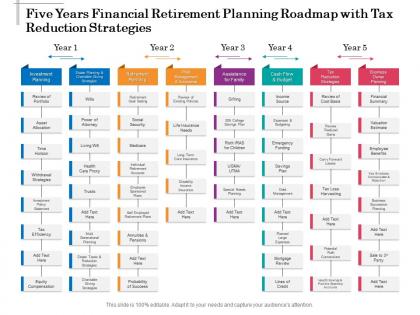
Five years financial retirement planning roadmap with tax reduction strategies




Try Before you Buy Download Free Sample Product
 Impress Your
 Audience
 100%
100% Editable
 Save Hours
 of Time


Visualize your work plan and communicate your ideas impactfully with our pre designed Five Years Financial Retirement Planning Roadmap With Tax Reduction Strategies. Showcase the detailed overview of the project, the key deliverables, and the milestones to be achieved with the help of our fully customizable PowerPoint layout. You can easily emphasize on the project goals and discuss all the activities involved in an easy to comprehend manner by utilizing our professionally designed PPT theme. This roadmap PowerPoint layout is a perfect strategic planning tool that can help in keeping the project on track. With our attractive PowerPoint theme, you can articulate the workflow, track the work progress, and have a clear vision of the goal to be achieved. Download this versatile Five Years Financial Retirement Planning Roadmap With Tax Reduction Strategies and save your hours of work.
People who downloaded this PowerPoint presentation also viewed the following :
Five years financial retirement planning roadmap with tax reduction strategies with all 2 slides:
Give your audience a fulfilling experience. They will find our Five Years Financial Retirement Planning Roadmap With Tax Reduction Strategies elevating.
FAQs for Five years financial retirement planning roadmap with
So you'll need income replacement stuff - 401k, IRA, Social Security. Healthcare's huge since Medicare has gaps. Taxes are tricky too because different accounts hit you differently when withdrawing. Emergency fund should cover like 6-12 months of expenses. Honestly, budgeting for retirement is weird - costs never match what you think they'll be. Estate planning docs are smart to have. Oh, and figure out what kind of lifestyle you actually want first, then work backwards to see how much you need to sock away each month. Makes the whole thing less overwhelming.
Figure out what you actually want your retirement to look like first - housing costs, travel plans, hobbies, healthcare stuff. Most people say you'll need around 70-90% of what you're making now, but honestly that's pretty useless if you're planning to sail around the world versus just chilling at home. Do the math backwards: need $60k a year for 25 years? That's $1.5M total. Don't forget about Social Security though - that helps. Then just plug numbers into those retirement calculators online to see how much you need to save each month. Way easier than doing it by hand.
Look, Social Security will help but don't count on it covering everything. It's maybe 40% of what you made before retiring - which honestly isn't much these days. The whole system's kinda shaky too, so who knows if they'll cut benefits down the road. Max out your 401k and IRA contributions first, that's way more important. I check my Social Security statement every year just to see where I stand, you should too. Think of it like backup money, not your main retirement plan. You'll need those other accounts to actually live comfortably.
So you'll want to start shifting away from growth stocks maybe 5-10 years before you actually retire - don't wait till the last second. More bonds, dividend stocks, that kind of stuff. There's this old rule about having your age in bonds (like 60% bonds at 60) but honestly that seems way too conservative now since we're all living longer. I'd probably go with something like 50-60% stocks and 40-50% bonds once you hit your 60s. You still need growth because retirement could last 30+ years. My dad made this mistake and went too conservative too early.
So basically, traditional 401(k)s and IRAs let you deduct taxes now, but you'll get hit when you withdraw later. Roth is backwards - no deduction upfront, but then it's tax-free when you retire. The usual thinking is go Roth if you expect higher taxes later, traditional if lower. But honestly? Tax rates are gonna change so much over the next few decades, it's kinda impossible to predict. My dad's always complaining about how different everything is from when he started working. If you can swing it, I'd do both types. Gives you options when you actually need the money.
First thing - figure out what you're actually spending right now each month. Then tweak it for retirement life. Work expenses disappear (thank god, no more dry cleaning bills), but healthcare costs can be brutal if you're not ready for them. Most people use that 70-80% rule - you'll need about that much of your current income. Though if you're dreaming of cruises every other month, might as well plan for 100%. Inflation's gonna bite you over the years too. I'd list out monthly costs, multiply by 12, then add extra for random stuff that always pops up.
So it basically comes down to taxes now vs taxes later. Traditional IRA = deduction today, but you'll pay when you withdraw. Roth is flipped - no upfront break, but withdrawals are tax-free. I always lean toward Roth if you're young or think you'll make more money later. Plus Roths don't force you to take money out at 72 like traditional ones do. My financial planner friend swears by running both scenarios with actual numbers - sounds boring but it really helps you see which one wins. What's your current tax situation looking like?
Dude, healthcare costs are gonna hit your retirement hard if you don't prep now. We're talking $300K+ just for basic stuff - and that's before any major issues. Medicare's decent but has tons of gaps, so you'll need extra insurance plus cash on hand. If you've got an HSA, max that thing out - it's like the holy grail of tax breaks for medical expenses. Oh, and here's the kicker: healthcare inflation runs way hotter than regular inflation, usually 2-3% more each year. Honestly makes me wonder how our parents' generation even managed it.
You should totally get one. Retirement planning is honestly such a pain - all those 401k rules, IRA limits, when to take Social Security. It gets messy fast. A good advisor will crunch all that math for you and find tax breaks you'd probably miss. My cousin waited way too long to start and regrets it. They'll also tweak things as your life changes, like if you get promoted or decide you want to retire at 60 instead of 65. The investment allocation stuff alone is worth it. Just make sure you find someone who doesn't charge crazy fees.
Honestly, you gotta spread your money around - dividend stocks, bonds, maybe some REITs. That 4% withdrawal rule everyone talks about? Seems kinda outdated to me, but it's a decent baseline I guess. Tax strategy matters too: hit your regular accounts first, then the tax-deferred stuff, save your Roth for last since it grows without Uncle Sam taking a cut. Oh and if you can wait on Social Security, do it - you get like 8% more each year until 70. Don't just figure this out as you go. Start planning now.
Yeah, start thinking about this stuff in your 50s while you're healthy - that's when long-term care insurance is actually affordable. I get it, nobody wants to plan for potentially needing help with basic things, but here's the thing: about 70% of us will need some kind of care eventually. Medicare won't cover most of it either, which sucks. Look into what care costs where you live first, then figure out your options. Regular LTC insurance, those hybrid life insurance policies with care riders, or just saving more aggressively. Honestly, even if you never use it, at least you'll have peace of mind.
Dude, the worst thing you can do is wait too long to start. Most people barely save anything and then act shocked when Social Security covers like... what, groceries? Maybe half your rent if you're lucky. Don't cash out your 401k every time you switch jobs either - I've seen friends do this and it's painful to watch. Here's the thing though: people plan like they'll die at 75, but you might live to 95. That's a lot of years to fund. Even "safe" investments that barely keep up with inflation will screw you over long-term. Honestly, just start with whatever you can, even $50 monthly adds up thanks to compound interest.
Honestly, I check mine twice a year now - things just change too fast. Big stuff like new jobs, getting married, or having kids definitely means you gotta revisit everything. Market crashes too, obviously. I used to think you could just set it and ignore it but that's terrible advice lol. Even tiny adjustments add up over decades. What works is setting a reminder on your birthday each year to review your contributions and see if your timeline still makes sense. Life's messy and your retirement plan should adapt with it.
Dude, early retirement is tricky because you need WAY more cash saved up. Think about it - you're not working for like 10+ extra years, and you miss those peak earning years in your 50s and 60s. Plus your Social Security gets cut if you take it early, and don't even get me started on health insurance costs without employer coverage. The whole "save 10x your salary" thing? Yeah, that's useless here. Most people going this route shoot for 25-30x their actual yearly expenses instead. Honestly, the math gets pretty intense but it's doable if you're serious about it.
Dude, inflation is basically gonna crush your buying power over time. That 100k you're saving? Could be worth like 50k in 20 years, which is terrifying when you actually do the math. You'll want stuff that beats inflation - stocks, real estate, maybe some I-bonds. Cash under the mattress is pointless. Those "safe" savings accounts paying 1% are honestly a joke. Oh, and if you can swing it, delay Social Security since they adjust those payments for cost of living. Start thinking about what your expenses will actually cost down the road, not what they cost now. It's wild how much prices creep up.
No Reviews