


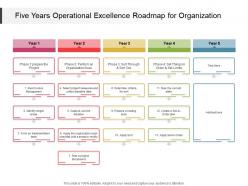
Five years operational excellence roadmap for organization





Try Before you Buy Download Free Sample Product
 Impress Your
 Audience
 100%
100% Editable
 Save Hours
 of Time


A cohesive work plan is essential for achieving the desired target. Communicate your vision and lay a firm ground in front of your audience with our PowerPoint layout. Align your project milestones, budgets, deliverables, deadlines, and all the requisite information for a dynamic presentation by employing this amazingly designed Five Years Operational Excellence Roadmap For Organization. Maximize team efficiency and streamline a work plan efficiently by introducing our ready made roadmap PowerPoint theme. You can quickly establish coordination between different activities across the organization and present an insight to your colleagues by utilizing this useful business tool. Color code specific tasks, prioritize, and keep a close eye on the deadlines with the help of our eye catchy PowerPoint template. Download our Five Years Operational Excellence Roadmap For Organization for excelling at productive management.
People who downloaded this PowerPoint presentation also viewed the following :
Five years operational excellence roadmap for organization with all 2 slides:
Use our Five Years Operational Excellence Roadmap For Organization to effectively help you save your valuable time. They are readymade to fit into any presentation structure.
FAQs for Five years operational excellence
Key components include strategic vision alignment, process standardization frameworks, performance measurement systems, continuous improvement methodologies, and stakeholder engagement protocols. These elements work together by establishing clear objectives, streamlining workflows, and fostering organizational culture change, with many manufacturing and service organizations finding that systematic implementation delivers measurable efficiency gains and sustained competitive advantage.
Organizations measure Operational Excellence success through key performance indicators like cycle time reduction, defect rates, customer satisfaction scores, employee engagement metrics, and cost savings percentages. These measurements enable companies across manufacturing, healthcare, and financial services to track progress systematically, identify improvement opportunities, and demonstrate tangible ROI, ultimately delivering sustained competitive advantage and operational efficiency.
Leadership drives Operational Excellence by setting strategic vision, fostering continuous improvement cultures, allocating resources effectively, and modeling accountability throughout organizations. Through clear communication and commitment, leaders enable cross-functional collaboration, streamline decision-making processes, and empower teams to identify inefficiencies, with many companies finding that engaged leadership ultimately delivers sustainable performance improvements and competitive advantage.
Technology enhances Operational Excellence through automation, real-time analytics, predictive maintenance, process optimization tools, and integrated management systems. These solutions streamline workflows, minimize human error, and accelerate decision-making across manufacturing, healthcare, and financial services, with many organizations finding that strategic technology adoption ultimately delivers measurable cost reductions and improved operational efficiency.
Common pitfalls include setting unrealistic timelines, lack of stakeholder buy-in, insufficient resource allocation, poor change management, and focusing on tools over processes. These challenges can derail initiatives by creating resistance, budget overruns, and implementation delays, with many organizations finding that early stakeholder engagement and phased approaches ultimately deliver sustainable improvements and long-term competitive advantage.
Employee engagement in operational excellence requires clear communication of goals and benefits, regular training on new processes, involving teams in improvement initiatives, and recognizing contributions to efficiency gains. Organizations like Toyota and GE have found that creating cross-functional improvement teams, establishing feedback loops, and celebrating milestone achievements significantly enhances buy-in, ultimately delivering sustained cultural transformation and competitive advantage.
Common frameworks for structuring Operational Excellence Roadmaps include Lean Six Sigma, Total Quality Management (TQM), Kaizen, Business Process Reengineering, and the Balanced Scorecard methodology. These frameworks streamline operations by eliminating waste, standardizing processes, and driving continuous improvement, with many organizations finding that strategic combinations deliver enhanced efficiency, reduced costs, and sustained competitive advantage across their operations.
Organizations align Operational Excellence initiatives with business strategy by establishing clear performance metrics tied to strategic objectives, conducting regular cross-functional alignment reviews, and integrating improvement projects directly into annual planning cycles. Through strategic roadmapping and stakeholder engagement, companies streamline resource allocation, enhance decision-making processes, and accelerate goal achievement, with many finding that this alignment delivers measurable competitive advantage.
Key metrics include cycle time reduction, defect rates, customer satisfaction scores, employee engagement levels, and cost per unit produced. These measurements enable organizations to track efficiency gains, quality improvements, and workforce productivity across manufacturing, healthcare, and service sectors, with many companies finding that balanced scorecards combining financial and operational indicators deliver comprehensive visibility into their transformation progress.
Cross-functional collaboration thrives through shared performance metrics, regular inter-departmental meetings, collaborative project structures, and unified communication platforms that break down organizational silos. These approaches streamline decision-making by aligning diverse expertise, eliminating redundant processes, and accelerating problem-solving, with many organizations finding that integrated teams deliver faster innovation and significantly improved operational efficiency.
Best practices for continuous improvement include implementing lean methodologies, establishing regular process audits, creating cross-functional improvement teams, utilizing data-driven performance metrics, and fostering employee feedback systems. These approaches streamline operations by eliminating waste, identifying bottlenecks, and standardizing workflows, with many organizations finding that consistent application delivers enhanced efficiency, reduced costs, and sustainable competitive advantage.
Organizations ensure sustainability in Operational Excellence by embedding continuous improvement cultures, establishing robust measurement systems, and developing employee capability programs. These approaches streamline long-term success by creating self-reinforcing processes, regular performance monitoring, and skilled workforce development, with many companies finding that sustained excellence ultimately delivers competitive advantage and operational resilience.
Training and development opportunities should include lean methodology workshops, Six Sigma certification programs, process improvement training, leadership development courses, and change management skills development. These programs enhance operational efficiency by building cross-functional expertise, fostering continuous improvement mindsets, and developing internal champions, with many organizations finding that comprehensive skill development ultimately delivers sustained competitive advantage and measurable performance improvements.
Data analytics enhances Operational Excellence decision-making by identifying performance gaps, predicting maintenance needs, optimizing resource allocation, and measuring process efficiency through real-time dashboards and predictive modeling. Manufacturing companies leverage these insights to reduce downtime, healthcare systems streamline patient flow, and retail organizations optimize inventory levels, ultimately delivering faster responses to operational challenges and measurable cost reductions.
Cultural shifts for Operational Excellence include embracing continuous improvement mindsets, fostering employee empowerment and accountability, promoting cross-functional collaboration, and developing data-driven decision-making capabilities. These transformations enable organizations by breaking down silos, encouraging innovation at all levels, and creating transparency in processes, with many manufacturing and healthcare institutions finding that engaged workforces ultimately deliver sustained efficiency gains and competitive advantage.
No Reviews