


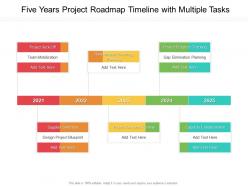
Five years project roadmap timeline with multiple tasks





Try Before you Buy Download Free Sample Product
 Impress Your
 Audience
 100%
100% Editable
 Save Hours
 of Time


Visualize your work plan and communicate your ideas impactfully with our pre designed Five Years Project Roadmap Timeline With Multiple Tasks. Showcase the detailed overview of the project, the key deliverables, and the milestones to be achieved with the help of our fully customizable PowerPoint layout. You can easily emphasize on the project goals and discuss all the activities involved in an easy to comprehend manner by utilizing our professionally designed PPT theme. This roadmap PowerPoint layout is a perfect strategic planning tool that can help in keeping the project on track. With our attractive PowerPoint theme, you can articulate the workflow, track the work progress, and have a clear vision of the goal to be achieved. Download this versatile Five Years Project Roadmap Timeline With Multiple Tasks and save your hours of work.
People who downloaded this PowerPoint presentation also viewed the following :
Five years project roadmap timeline with multiple tasks with all 2 slides:
Give your audience a fulfilling experience. They will find our Five Years Project Roadmap Timeline With Multiple Tasks elevating.
FAQs for Five years project roadmap timeline
Key phases include project initiation, planning and requirements gathering, design and development, testing and quality assurance, and deployment with post-launch support. These phases streamline project execution by establishing clear milestones, allocating resources efficiently, and maintaining stakeholder alignment throughout the process, with many organizations finding that structured timelines ultimately deliver faster project completion and reduced costs.
Determining appropriate phase timelines involves analyzing task complexity, resource availability, dependencies between activities, and stakeholder requirements while building in buffer time for unforeseen challenges. Many organizations use historical data from similar projects, conduct team capacity assessments, and factor in external constraints, ultimately creating realistic schedules that balance ambitious delivery goals with practical execution capabilities.
Effective roadmap tools include Gantt chart software like Microsoft Project, collaborative platforms such as Asana and Trello, specialized solutions like ProductPlan and Roadmunk, and integrated suites including Monday.com and Smartsheet. These platforms streamline project visualization, enable real-time collaboration, and automate timeline adjustments, with many organizations finding that cloud-based solutions deliver enhanced accessibility and scalability across teams.
Stakeholder feedback can be incorporated through regular review cycles, structured feedback sessions, priority workshops, and timeline adjustment processes that maintain project momentum while addressing key concerns. These approaches enable project managers to balance competing priorities, validate assumptions, and refine deliverables, with many organizations finding that systematic feedback integration ultimately delivers stronger stakeholder buy-in and more successful project outcomes.
Common pitfalls include unrealistic timelines, insufficient stakeholder input, lack of flexibility for changes, poor resource allocation, and inadequate risk assessment. These oversights often derail projects by creating bottlenecks, missed deadlines, and budget overruns, with many organizations finding that regular roadmap reviews and adaptive planning ultimately deliver better outcomes and stakeholder alignment.
A project roadmap aligns team efforts with business objectives by establishing clear connections between daily tasks and strategic goals, defining measurable milestones, and ensuring resource allocation supports priority outcomes. Through visual timeline mapping, teams in manufacturing, software development, and consulting can track progress against business targets, adjust workflows when priorities shift, and maintain focus on deliverables that drive competitive advantage and operational efficiency.
Key metrics include milestone completion rates, budget variance, resource utilization, timeline adherence, and deliverable quality scores. These indicators enable project managers to identify bottlenecks, reallocate resources, and maintain stakeholder alignment, with many organizations finding that tracking these metrics simultaneously enhances decision-making speed and ultimately delivers improved project outcomes and competitive advantage.
Project roadmaps should be reviewed monthly and updated quarterly, with additional reviews triggered by significant scope changes, resource shifts, or milestone completions. Many organizations find that regular reviews enable proactive risk management, ensure alignment with business objectives, and maintain stakeholder engagement, while quarterly updates accommodate strategic pivots and evolving market conditions, ultimately delivering improved project success rates.
Visual design significantly enhances project roadmap effectiveness by improving comprehension, facilitating stakeholder alignment, and enabling faster decision-making through clear data visualization, intuitive layouts, and strategic use of color coding. Well-designed roadmaps streamline communication across teams, reduce misunderstandings, and ultimately deliver better project outcomes, with many organizations finding that professional visual presentation increases stakeholder buy-in and project success rates.
**INPUT**: How can you prioritize tasks on a project roadmap timeline? **OUTPUT**: You can prioritize tasks through impact assessment, dependency mapping, resource availability analysis, stakeholder requirements evaluation, and risk consideration approaches. These strategic methods enable project managers to streamline workflows, minimize bottlenecks, and optimize resource allocation, with many organizations finding that systematic prioritization ultimately delivers faster project completion and enhanced competitive advantage.
Scope changes require systematic impact assessment, stakeholder communication, timeline recalculation, and formal change control processes. Project managers evaluate resource implications, dependencies, and critical path adjustments, then communicate revised timelines to all stakeholders while documenting decisions, ultimately maintaining project transparency and delivering realistic expectations that align with new requirements.
Best practices for communicating project roadmaps include regular scheduled updates, visual timeline presentations, role-specific information tailoring, transparent milestone tracking, and proactive risk communication. These approaches streamline project alignment by enhancing team coordination, minimizing miscommunication, and maintaining stakeholder engagement, with many organizations finding that consistent visual roadmaps ultimately deliver improved project outcomes and stronger collaborative relationships.
A project roadmap provides high-level strategic vision and major milestones over extended timeframes, while Gantt charts detail specific tasks, dependencies, and precise scheduling for execution phases. Roadmaps work best for stakeholder communication and long-term planning across organizations, whereas Gantt charts excel in operational project management, with many teams finding that combining both approaches delivers strategic alignment and tactical precision.
Templates that can simplify project roadmap timeline creation include Gantt chart templates, milestone-based roadmaps, agile sprint planners, quarterly planning frameworks, and phase-gate timeline structures. These templates streamline project visualization by providing pre-built frameworks for task sequencing, resource allocation, and deadline tracking, with many project managers finding that standardized templates reduce planning time while enhancing team alignment and stakeholder communication.
Project roadmaps in agile environments provide strategic direction while maintaining flexibility, enabling teams to visualize long-term goals, prioritize features, and communicate progress to stakeholders. These adaptive frameworks help organizations balance sprint-level execution with broader business objectives, with many software development teams finding that roadmaps enhance stakeholder alignment and deliver clearer product vision throughout iterative cycles.
No Reviews