


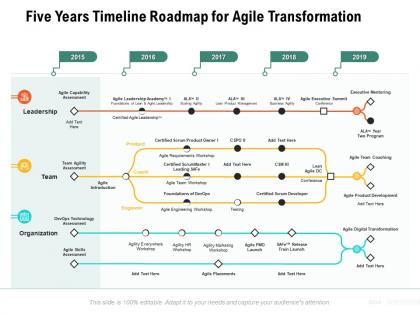
Five years timeline roadmap for agile transformation




Try Before you Buy Download Free Sample Product
 Impress Your
 Audience
 100%
100% Editable
 Save Hours
 of Time


A well thought out action plan makes execution easier and increases the possibility of success significantly. Ensure hitting all the milestones within the deadlines by introducing our fully customizable Five Years Timeline Roadmap For Agile Transformation. Streamline the work related information, budget, timeframe, key deliverable, landmarks, and major steps involved, all in one place to give an organized overview of the project by utilizing our PowerPoint theme. Minimize time lag and increase work efficiency by providing insight into the process with our comprehensively researched roadmap PowerPoint layout. Color coding helps in highlighting the process and grabs the attention of the audience. Download our handy Five Years Timeline Roadmap For Agile Transformation to identify the possible problem areas in a much shorter time and propose solutions. Have a productive brainstorming session with your workforce by utilizing our action plan visualization tool.
People who downloaded this PowerPoint presentation also viewed the following :
Five years timeline roadmap for agile transformation with all 2 slides:
Give your audience a fulfilling experience. They will find our Five Years Timeline Roadmap For Agile Transformation elevating.
FAQs for Five years timeline roadmap
Honestly? Missing deadlines constantly is your first clue. When departments won't talk to each other and customer feedback sits in limbo for months, you've got problems. I've seen this before - everything moves like molasses while competitors ship features you're still "planning." People get burned out from pointless meetings and processes that slow everyone down instead of helping. The dead giveaway though is when your own teams start begging for more autonomy. They want faster decisions, less bureaucracy. Survey them about what's driving them crazy - their answers will tell you everything.
Honestly, you've got to speak their language. Developers want to hear how Agile cuts down technical debt - that's what gets them excited. Executives? They only care about faster time-to-market. Skip the fluffy buzzwords like "collaboration" - I've sat through way too many meetings that felt like corporate bingo night. Town halls work great for Q&A sessions, and definitely share wins from your pilot teams. Each group needs to know what's in it for them specifically. Oh, and keep messaging consistent across everything or people get confused fast.
Honestly, the biggest trap is jumping straight into stand-ups and sprints without actually shifting how people think. You just get waterfall disguised as Agile. Middle managers hate it the most - makes sense since it kinda undermines their whole role. Leadership wants results yesterday but won't let teams actually experiment and mess up. Don't skip retrospectives when things get crazy (I know it's tempting). Most places try transforming everything at once, which is nuts. Pick one eager team first, let them win big where everyone can see it, then expand from there. Trust me on this one.
Honestly, I'd track both the hard numbers and how your team actually feels. Cycle time, sprint predictability, defect rates - that stuff shows if you're shipping faster. But team surveys matter just as much. Are people feeling psychologically safe? Can they actually make decisions without jumping through hoops? Customer satisfaction is obviously huge too. Oh, and stakeholder feedback - sometimes they notice things you miss. Set up a simple dashboard with maybe 3-4 metrics you check monthly. Then do quarterly retrospectives to really dig into what's broken and what's clicking.
Honestly, culture beats any framework or tool every single time. Your transformation will crash and burn if people don't feel safe to experiment and collaborate. I've watched teams go through all the Agile motions, then snap right back to old habits the second things get stressful. Leadership says they want Agile but still freaks out over "failures" and hovers over every decision. Pretty frustrating to watch, actually. You've got to spot those cultural roadblocks early and tackle them directly. Otherwise you're just wasting everyone's time with fancy ceremonies that don't stick.
Honestly, go for the low-hanging fruit first. Find teams that actually want to change and aren't drowning in some massive legacy nightmare. I've watched companies dive headfirst into their most critical systems and it's just... chaos. Pick projects where you can show clear wins - faster deployments, better customer feedback loops, that kind of stuff. You want these early adopters to become your biggest cheerleaders internally. Once the skeptics see real results (and they will), bringing them on board becomes way easier. Trust me on this one.
Okay so first thing - be super upfront about why you're switching and what's actually in it for them. Get the skeptics involved in planning meetings where they can complain openly (trust me on this one). Don't skip training because people hate feeling clueless with new stuff - I've watched so many teams crash and burn here! Pick some easy Agile wins first, then make a big deal celebrating them. Oh and definitely get your influential people bought in early. They'll do half the convincing work for you with the stubborn ones.
Honestly, start with the basics - get everyone on the same definition of done and use one project management tool across all teams. Jira works fine, whatever you pick just stick with it. Set up regular cross-team check-ins, maybe weekly? The hard part is not turning into a micromanager while still keeping things consistent. I'd focus on what teams deliver rather than how they do every little thing. Your Scrum Masters should definitely be talking to each other regularly - they'll figure out what actually works vs what sounds good on paper. Document what each team does now, then fix the biggest mismatches first.
Start with basic Scrum or Kanban certification - seriously, everyone thinks they know Agile until they try running a proper standup meeting. Two-day intensive workshop is perfect to kick things off. User story writing and estimation workshops are clutch for getting the fundamentals down. Soft skills matter way more than people realize though - facilitation and conflict resolution will save your sanity later. Weekly coaching sessions for the first month help tons. Pluralsight's decent for online stuff if your team prefers self-paced learning. Pick one methodology first, don't try to do everything at once.
Look, first thing - map what you're already doing against Agile stuff. You'll find way more overlap than expected. Don't throw out the good parts (quality checks, compliance things that actually matter). The trick is slowly ditching the bureaucratic nonsense that just creates bottlenecks. Most companies screw this up by changing everything overnight - terrible idea. Run a couple pilot teams instead. Let them figure out how your workflows fit into sprints and standups. I've seen this work so much better than the big-bang approach. Keep what delivers results, ditch what doesn't. Test small, scale what sticks.
Track cycle time and velocity for sure, but don't sleep on the team stuff - that's where you'll actually see if people are buying in. Sprint goal achievement and retrospective follow-through are huge tells. I always think deployment frequency shows way more than velocity does, tbh. Cross-functional collaboration is another good one to watch. Team satisfaction scores might sound fluffy but they're not - miserable teams don't deliver. Start small though, maybe 3-4 metrics tops and check them monthly. Otherwise you'll drown in spreadsheets instead of actually improving anything.
Honestly, the right tools can totally speed up your Agile switch. I'd start with Jira or Azure DevOps for tracking sprints - they're solid for managing backlogs too. Slack's great for quick daily standups when you can't meet in person. CI/CD pipelines will blow your mind with how fast deployments become (like, we're talking minutes instead of hours). Miro's clutch for retrospectives since everyone can contribute visually. Oh, and don't just grab whatever tool's popular right now - pick stuff that actually fixes your team's problems. Start with maybe two tools max, then add more once you've got those down. Less overwhelming that way.
So adoption is just copying the surface stuff - standups, sprints, all that. Transformation actually changes how people think and work together. You'll get faster cycles with adoption, sure. But transformation gives you way better results because everyone actually gets it, you know? I swear half the teams I see are just doing "agile theater" - they check all the boxes but miss the point completely. Takes forever to do real transformation, but it sticks. Don't just focus on the ceremonies. Figure out why you're doing them first.
So you'll want feedback happening at different levels - sprint retros for teams, monthly cross-team check-ins, quarterly leadership stuff. Each one needs an actual owner though, or it just becomes venting into the abyss (trust me on this one). People need to feel safe calling out real problems without getting blamed. Collect both the touchy-feely feedback AND hard metrics like cycle time. Here's the thing - if teams never see their input actually change anything, they'll just stop caring. Oh, and don't try to do everything at once. Pick one feedback loop that works well first.
Lots of good examples out there, honestly. The Spotify squad model is probably your best bet to start with - tons of documentation and clear metrics. ING Bank did this crazy overhaul from old-school hierarchy to agile tribes. Netflix is wild about their "freedom and responsibility" thing, but they're kind of intense about firing people so maybe not the best cultural fit for everyone lol. Haier's interesting too - they went from traditional manufacturing to like 4,000 mini teams. Even the UK government pulled it off with their digital services. I'd definitely dig into the Spotify case first though.
No Reviews