

Fixed assets valuation methodology powerpoint presentation slides





Try Before you Buy Download Free Sample Product
 Impress Your
 Audience
 100%
100% Editable
 Save Hours
 of Time


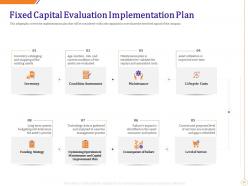
Develop the best capital assets valuation methodology by preparing a presentation with our Fixed Assets Valuation Methodology PowerPoint Presentation Slides. The plant and equipment PPT layout helps you to perform a current situation analysis of the challenges faced by the company, fixed asset turnover ratio, and calculation of depreciation on fixed assets. The business asset PowerPoint Presentation contains slides related to the factors affecting the requirement of fixed capital like the nature of the business, the scale of operations, and diversification. Using our cash flow analysis PowerPoint templates determine the best investment measure technique by comparing methods like net present value, internal rate of return, and payback period. The situation analysis PPT design includes an asset valuation implementation plan showcasing steps starting from inventory, to condition assessment, maintenance, lifecycle cost, funding strategy, capital improvement plan, the consequence of failure, and level of service. Manage depreciation, save time, money, and manpower; create a plant and equipment management software, and an asset management dashboard using this non-liquid asset PPT slideshow.
People who downloaded this PowerPoint presentation also viewed the following :
Content of this Powerpoint Presentation
Slide 1: This title slide introduces Fixed Assets Valuation Methodology. Add the name of your company here.
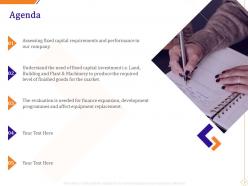
Slide 2: This slide presents the Agenda. It includes Assessing fixed capital requirements and performance in our company, Understand the need for fixed capital investment i.e., Land, Building and Plant & Machinery to produce the required level of finished goods for the market, The evaluation is needed for finance expansion, development programs and affects equipment replacement, etc.
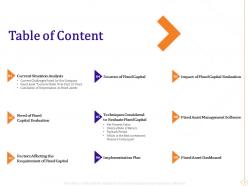
Slide 3: This slide contains the Table of Content. It contains Current Situation Analysis, Need of Fixed Capital Evaluation, Factors Affecting the Requirement of Fixed Capital, Sources of Fixed Capital, Techniques Considered to Evaluate Fixed Capital, Implementation Plan, Impact of Fixed Capital Evaluation, Fixed Asset Management Software, and Fixed Asset Dashboard.
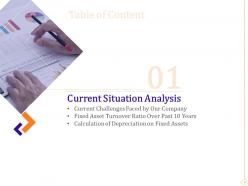
Slide 4: This is a table of content slide showing the Current Situation Analysis. It includes Current Challenges Faced by Our Company, Fixed Asset Turnover Ratio Over Past 10 Years, and Calculation of Depreciation on Fixed Assets.
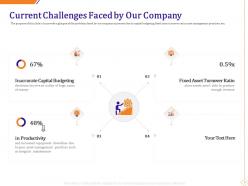
Slide 5: This slide presents the Current Challenges Faced by Our Company. It provides a glimpse of the problems faced by our company at present due to capital budgeting, fixed asset turnover ratio, asset management practices, etc.
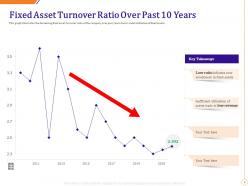
Slide 6: This slide presents the Fixed Asset Turnover Ratio Over the Past 10 Years. It illustrates the decreasing fixed asset turnover ratio of the company over past years due to the underutilization of fixed assets.
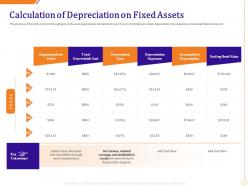
Slide 7: This slide presents the Calculation of Depreciation on Fixed Assets. It provides a glimpse of the asset depreciation calculation for the past 5 years covering book values, depreciation rate, expenses, accumulated depreciation, etc.
Slide 8: This is a table of content slide showing the Need for Fixed Capital Evaluation.
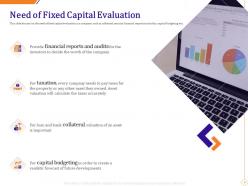
Slide 9: This slide presents the Need for Fixed Capital Evaluation. It focuses on the need for fixed capital evaluation in a company such as collateral security, financial reports, and audits, capital budgeting, etc.
Slide 10: This is a table of content slide showing the Factors Affecting the Requirement of Fixed Capital.
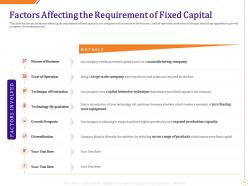
Slide 11: This slide presents the Factors Affecting the Requirement of Fixed Capital. It focuses on the factors affecting the requirement of fixed capital in our company such as nature of the business, the scale of operation, production technique, technology up-gradation, growth prospects, diversification, etc.
Slide 12: This is a table of content slide showing the Sources of Fixed Capital.
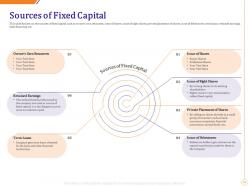
Slide 13: This slide presents the Sources of Fixed Capital. It focuses on the sources of fixed capital such as owner’s own resources, issue of shares, issue of right shares, private placement of shares, issue of debentures, term loans, retained earnings, lease financing, etc
Slide 14: This is a table of content slide showing Techniques Considered to Evaluate Fixed Capital. This includes Net Present Value, Internal Rate of Return, Payback Period, and Which is the Best Investment Measure Technique?
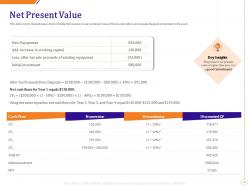
Slide 15: This slide presents the Net Present Value. It covers the technique which will help the business to see its present value of future cash inflow and evaluate the good investment in the asset.
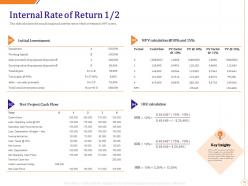
Slide 16: This slide presents part 1 of 2 of the Internal Rate of Return. It calculates the annual compound interest rate at which an investment’s NPV is zero.
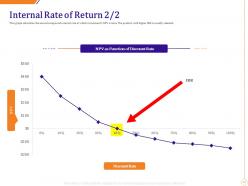
Slide 17: This slide presents part 2 of 2 of the Internal Rate of Return. It calculates the annual compound interest rate at which an investment’s NPV is zero. The product with a higher IRR is usually selected.
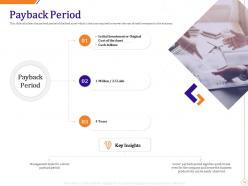
Slide 18: This slide presents the Payback Period. It calculates the payback period of the fixed asset which is the time required to recover the cost of total investment in the business.
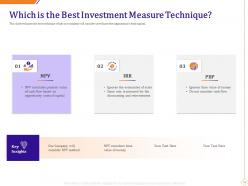
Slide 19: This slide presents Which is the Best Investment Measure Technique? It evaluates the best technique which our company will consider to evaluate the organization’s fixed capital.
Slide 20: This is a table of content slide showing the Implementation Plan.
Slide 21: This slide presents the Fixed Capital Evaluation Implementation Plan. It covers the implementation plan that will be considered within the organization to evaluate the best-fixed capital of the company.
Slide 22: This is a table of content slide showing the Impact of Fixed Capital Evaluation.
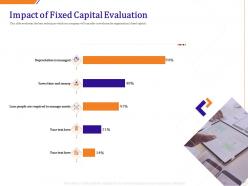
Slide 23: This slide presents the Impact of Fixed Capital Evaluation. It evaluates the best technique which our company will consider to evaluate the organization’s fixed capital.
Slide 24: This is a table of content slide showing Fixed Asset Management Software.
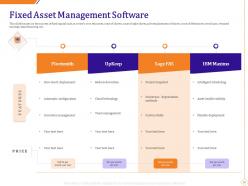
Slide 25: This slide presents the Fixed Asset Management Software. It focuses on the sources of fixed capital such as owner’s own resources, issue of shares, issue of right shares, private placement of shares, issue of debentures, term loans, retained earnings, lease financing, etc.
Slide 26: This is a table of content slide showing the Fixed Asset Dashboard.
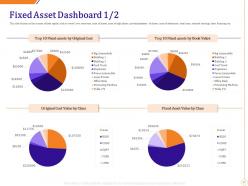
Slide 27: This slide presents part 1 of 2 of the Fixed Asset Dashboard. It focuses on the sources of fixed capital such as owner’s own resources, issue of shares, issue of right shares, private placement of shares, issue of debentures, term loans, retained earnings, lease financing, etc.
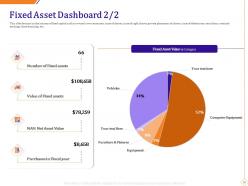
Slide 28: This slide presents part 1 of 2 of the Fixed Asset Dashboard. It focuses on the sources of fixed capital such as owner’s own resources, issue of shares, issue of right shares, private placement of shares, issue of debentures, term loans, retained earnings, lease financing, etc.
Slide 29: This slide contains a number of Fixed Assets Valuation Methodology - Icons for you to choose from.
Slide 30: This slide introduces the Additional Slides.
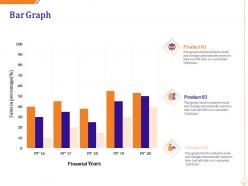
Slide 31: This slide shows a bar graph that compares 3 products’ sales over a timeline of financial years.
Slide 32: This slide provides the Mission for the entire company. This includes the vision, the mission, and the goal.
Slide 33: This slide contains the information about the company aka the ‘About Us’ section. This includes the Value Clients, the Target Audience, and Preferred by Many.
Slide 34: This slide shows the members of the company team with their name, designation, and photo.
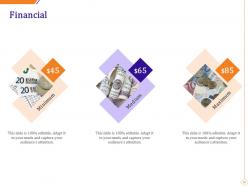
Slide 35: This slide presents the financial status of the company in various currencies.
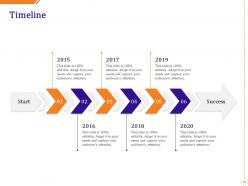
Slide 36: This slide contains a timeline chart that can be used to portray the sequence of events for any project or goal.
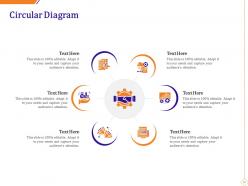
Slide 37: This slide shows a circular diagram to show the elements that make up a concept.
Slide 38: This slide represents Idea Generation. It can be used to brainstorm ideas.
Slide 39: This slide contains Post It Notes that can be used to express any brief thoughts or ideas.
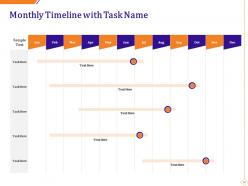
Slide 40: This slide contains a monthly timeline chart that can be used to portray the sequence of events for any project or goal with the name of the tasks.
Slide 41: This is a slide with a 30 60 90 Days Plan to set goals for these important intervals.
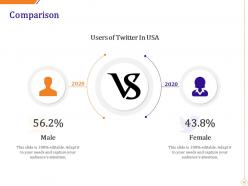
Slide 42: This slide presents a comparison between the male and female percentage of Twitter users in the USA.
Slide 43: This slide is a Roadmap template to showcase the stages of a project, for example.
Slide 44: This is a Thank You slide where details such as the address, contact number, email address are added.
Fixed assets valuation methodology powerpoint presentation slides with all 44 slides:
Use our Fixed Assets Valuation Methodology Powerpoint Presentation Slides to effectively help you save your valuable time. They are readymade to fit into any presentation structure.









FAQs for Fixed assets valuation methodology
Fixed assets valuation methods include historical cost, fair value, replacement cost, net realizable value, and depreciated replacement cost. These approaches enable organizations to accurately assess asset worth by considering original purchase prices, current market conditions, and operational utility, with many companies finding that strategic combinations of these methods deliver enhanced financial transparency and improved investment decisions.
The choice of valuation method significantly impacts balance sheet asset values, depreciation expenses, and overall financial performance metrics. Historical cost methods provide stability and consistency, while fair value approaches offer current market relevance but introduce volatility, with many organizations finding that revaluation methods enhance transparency for stakeholders but require more frequent assessment and professional expertise.
Depreciation reduces fixed asset values over time by systematically allocating asset costs across their useful lives, reflecting wear, obsolescence, and declining economic value. This accounting mechanism enables organizations to accurately represent asset worth on balance sheets, optimize tax planning, and make informed decisions about equipment replacement, ultimately delivering more precise financial reporting and strategic asset management.
External market conditions significantly impact fixed asset valuation through economic volatility, interest rate fluctuations, supply and demand dynamics, and industry-specific trends that influence replacement costs and fair values. These market forces affect asset appraisals by altering comparable sales data, construction costs, and discount rates, with many organizations finding that regular revaluations during volatile periods enhance financial accuracy and strategic decision-making.
Common pitfalls in valuing fixed assets include outdated appraisals, ignoring market depreciation, inadequate documentation, overlooking specialized equipment factors, and failing to account for technological obsolescence. These valuation errors can significantly impact financial reporting accuracy, tax compliance, and insurance coverage, with many organizations finding that regular professional assessments and updated depreciation schedules ultimately deliver more reliable asset management and strategic decision-making capabilities.
Different industries approach fixed asset valuation through sector-specific methodologies, with manufacturing emphasizing equipment depreciation and replacement costs, healthcare focusing on specialized medical technology values, and real estate using market-based appraisals. These tailored approaches enable accurate financial reporting, strategic asset management, and regulatory compliance, while helping organizations optimize resource allocation, minimize tax liabilities, and maintain competitive advantage in their respective markets.
Impairment testing ensures fixed assets are valued accurately by identifying when their carrying value exceeds recoverable amount, preventing overstatement of financial position. This critical process protects investors by requiring write-downs when assets lose value, with many organizations finding that regular impairment assessments enhance financial transparency, support strategic decision-making, and maintain stakeholder confidence in increasingly volatile markets.
Regulatory requirements significantly influence fixed asset valuation through mandated accounting standards like GAAP and IFRS, prescribed depreciation methods, impairment testing protocols, and mandatory disclosure formats. These frameworks ensure consistency and transparency across organizations, with many companies finding that compliance streamlines auditing processes, enhances investor confidence, and ultimately delivers standardized financial reporting that supports strategic decision-making.
Technological advancements can significantly impact fixed asset values through accelerated obsolescence, enhanced operational capabilities, and shifts in market demand for specific equipment types. While newer technologies may decrease values of older assets, they also create opportunities for strategic upgrades and improved efficiency, with many manufacturing and logistics companies finding that timely technology adoption ultimately delivers competitive advantages and higher long-term asset returns.
Intangible assets are typically valued separately from tangible fixed assets, though both contribute to overall enterprise valuation through methods like cost, market, and income approaches. Companies increasingly recognize that intangible assets like patents, trademarks, and software can significantly enhance operational efficiency and competitive positioning, with many organizations finding that strategic integration of both asset categories delivers more comprehensive valuations and better resource allocation decisions.
Businesses can improve fixed asset valuation through regular revaluation schedules, automated tracking systems, professional appraisal services, depreciation method optimization, and comprehensive asset registers. These strategies enhance accuracy by streamlining data collection, minimizing manual errors, and ensuring compliance standards, with many manufacturing and retail organizations finding that systematic approaches deliver better financial reporting and strategic decision-making capabilities.
Owned assets undergo direct revaluation adjustments affecting balance sheet values and equity, while leased assets require separate treatment under lease accounting standards, with right-of-use assets valued differently from underlying asset ownership. Through strategic asset management, organizations streamline financial reporting, enhance transparency in asset utilization, and deliver improved stakeholder confidence, with many companies finding that proper valuation distinctions ultimately strengthen their competitive positioning.
Appraisals provide independent, professional assessments of fixed asset market values, ensuring accurate financial reporting, compliance with accounting standards, and informed decision-making for acquisitions or disposals. Through certified valuation expertise, organizations enhance balance sheet accuracy, support loan collateral requirements, and facilitate strategic asset management, with many companies finding that regular appraisals ultimately deliver improved financial transparency and stakeholder confidence.
Financial modeling forecasts fixed asset values through depreciation analysis, cash flow projections, market comparisons, and scenario planning techniques. These models incorporate factors like asset utilization rates, maintenance costs, and market conditions, enabling organizations across manufacturing, real estate, and infrastructure sectors to optimize capital allocation decisions, ultimately delivering more accurate financial planning and enhanced strategic investment outcomes.
Inflation reduces the real value of fixed assets recorded at historical cost, creating a gap between book value and current market worth through currency devaluation and rising replacement costs. This disconnect affects financial ratios, investment decisions, and asset management strategies, with many organizations finding that regular revaluations enhance accuracy and support strategic planning in inflationary environments.
-
Qualitative and comprehensive slides.
-
Enough space for editing and adding your own content.
-
Awesome presentation, really professional and easy to edit.
-
Easy to edit slides with easy to understand instructions.
-
Innovative and Colorful designs.
-
Topic best represented with attractive design.
-
Nice and innovative design.
-
Unique and attractive product design.
-
Awesome use of colors and designs in product templates.