


Flow diagram of incident response process managing cyber risk in a digital age




Try Before you Buy Download Free Sample Product
 Impress Your
 Audience
 100%
100% Editable
 Save Hours
 of Time


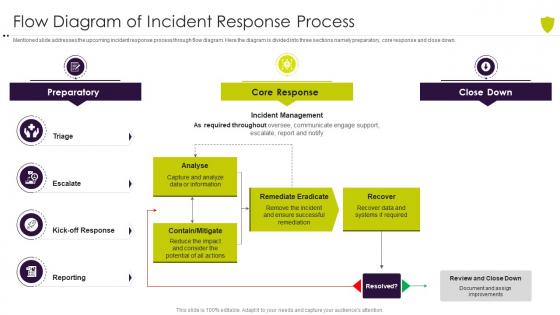
Mentioned slide addresses the upcoming incident response process through flow diagram. Here the diagram is divided into three sections namely preparatory, core response and close down.
People who downloaded this PowerPoint presentation also viewed the following :
Flow diagram of incident response process managing cyber risk in a digital age with all 6 slides:
Use our Flow Diagram Of Incident Response Process Managing Cyber Risk In A Digital Age to effectively help you save your valuable time. They are readymade to fit into any presentation structure.





FAQs for Flow diagram of incident response process managing cyber risk in
The key phases of an effective incident response process include preparation, identification, containment, eradication, recovery, and lessons learned. These phases streamline security operations by establishing clear protocols, minimizing damage through rapid containment, and accelerating system restoration, with many organizations finding that structured incident response ultimately delivers reduced downtime and enhanced operational resilience.
Organizations determine security incident severity by evaluating data sensitivity, system criticality, business impact scope, potential financial losses, and regulatory compliance requirements. Through standardized severity matrices and automated assessment tools, security teams can quickly categorize incidents from low to critical levels, enabling appropriate resource allocation and response timelines, ultimately minimizing operational disruption and protecting organizational assets.
Threat intelligence enhances incident response by providing contextual information about attack patterns, adversary tactics, and emerging vulnerabilities, enabling faster threat identification and attribution. Through real-time intelligence feeds, security teams can prioritize incidents more effectively, understand attack motivations, and implement targeted containment strategies, ultimately reducing response times and preventing similar future attacks.
Organizations prepare their incident response teams through regular tabletop exercises, simulated attack scenarios, cross-functional training sessions, and comprehensive playbook development that covers various threat vectors. These preparation methods enhance team coordination, reduce response times, and improve decision-making under pressure, with many financial services and healthcare organizations finding that consistent simulation training ultimately delivers faster containment and minimizes business disruption during actual security incidents.
Essential incident response tools include SIEM platforms, endpoint detection systems, network monitoring solutions, forensic analysis software, and automated orchestration platforms. These technologies streamline threat detection by correlating security events, isolating affected systems, and accelerating containment processes, with many organizations finding that integrated toolsets reduce response times significantly while enhancing overall security posture.
Measuring incident response effectiveness involves tracking mean time to detection, mean time to resolution, containment speed, recovery duration, and post-incident analysis quality. Organizations across sectors like healthcare, financial services, and retail use these metrics to identify gaps, streamline processes, and reduce business impact, ultimately delivering faster recovery times and enhanced operational resilience.
Proper incident communication requires establishing clear escalation chains, designated communication roles, regular stakeholder updates, standardized messaging templates, and centralized information hubs. Through automated notification systems and predefined protocols, organizations streamline response coordination, minimize confusion, and maintain transparency, with many enterprises finding that structured communication reduces resolution times while enhancing stakeholder confidence and operational resilience.
Organizations should prioritize incidents using severity classifications based on business impact, affected user count, financial implications, regulatory consequences, and operational disruption levels. This strategic approach enables IT teams to allocate resources effectively, minimize downtime costs, and maintain service availability, with many enterprises finding that structured prioritization frameworks reduce response times and enhance overall business resilience.
**INPUT**: What training and simulations are recommended for incident response teams? **OUTPUT**: Recommended training includes tabletop exercises, red team simulations, breach scenario walkthroughs, communication protocols, and technical skill development across cybersecurity frameworks. These approaches enhance preparedness by testing response times, identifying coordination gaps, and refining decision-making processes, with many organizations finding that regular simulations significantly improve incident containment and minimize business disruption. *[Word count: 54 words]*
Documentation from past incidents enhances future response efforts by creating searchable knowledge bases, identifying recurring patterns, and establishing proven remediation procedures. These historical records enable teams to reduce response times, avoid repeated mistakes, and implement preventive measures, with many organizations finding that comprehensive incident documentation delivers faster resolution and significantly improved operational resilience.
Legal considerations during incident response include regulatory compliance requirements, data breach notification laws, evidence preservation protocols, liability management, and cross-jurisdictional regulations. These frameworks streamline legal obligations by ensuring proper documentation, timely stakeholder notifications, and coordinated responses with legal teams, ultimately delivering regulatory compliance and minimized legal exposure across organizations.
Organizations balance transparency with confidentiality by implementing tiered communication strategies, establishing clear stakeholder categories, and using carefully crafted messaging templates that share necessary information without compromising sensitive details. Through strategic disclosure frameworks, companies can maintain customer trust, meet regulatory requirements, and protect ongoing investigations, while ensuring internal teams, affected parties, and the public receive appropriate updates that demonstrate accountability without revealing exploitable vulnerabilities.
Common pitfalls include inadequate preparation and documentation, delayed detection and response times, poor communication protocols, insufficient staff training, and lack of post-incident analysis. These challenges often result from organizations underestimating response complexity, with many financial services and healthcare institutions finding that comprehensive planning, regular simulations, and cross-departmental coordination ultimately deliver faster recovery and stronger security posture.
Integrating incident response with business continuity planning enhances organizational resilience by ensuring coordinated recovery efforts, minimizing downtime, and maintaining critical operations during disruptions. This strategic combination enables faster service restoration, reduces financial losses, and strengthens stakeholder confidence, with many organizations finding that unified planning delivers competitive advantage in an increasingly volatile business environment.
Key incident response metrics include mean time to detection (MTTD), mean time to response (MTTR), incident severity classification accuracy, containment effectiveness, and recovery time objectives. These performance indicators enable organizations to identify bottlenecks, optimize resource allocation, and enhance overall security posture, with many enterprises finding that tracking these metrics reduces response times by 40-60% while improving stakeholder confidence.
-
Good research work and creative work done on every template.
-
Nice and innovative design.