

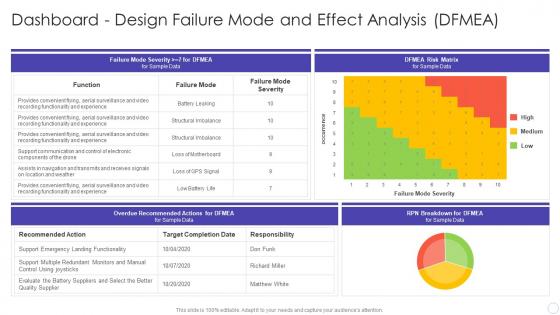
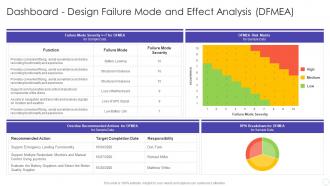
FMEA for Identifying Potential Problems Dashboard Design Failure Mode and Effect Analysis DFMEA




Try Before you Buy Download Free Sample Product
 Impress Your
 Audience
 100%
100% Editable
 Save Hours
 of Time


Our FMEA for Identifying Potential Problems Dashboard Design Failure Mode and Effect Analysis DFMEA are topically designed to provide an attractive backdrop to any subject. Use them to look like a presentation pro.
People who downloaded this PowerPoint presentation also viewed the following :
FMEA for Identifying Potential Problems Dashboard Design Failure Mode and Effect Analysis DFMEA with all 7 slides:
Use our FMEA for Identifying Potential Problems Dashboard Design Failure Mode and Effect Analysis DFMEA to effectively help you save your valuable time. They are readymade to fit into any presentation structure.





FAQs for FMEA for Identifying Potential Problems Dashboard Design Failure Mode and
Key FMEA steps include defining scope and assembling cross-functional teams, identifying potential failure modes, analyzing effects and causes, assessing risk through severity and occurrence ratings, and developing corrective actions. These systematic approaches streamline quality management by prioritizing critical failures, enhancing product reliability, and reducing costs, with manufacturing and healthcare organizations finding significant improvements in operational efficiency.
FMEA enhances risk management by systematically identifying potential failure modes, assessing their severity and likelihood, and prioritizing corrective actions before issues occur. This proactive approach enables development teams to streamline quality control, reduce costly recalls, and accelerate time-to-market, with many manufacturing organizations finding that early risk identification ultimately delivers stronger products and significant competitive advantage.
Design FMEA focuses on potential failures in product design, specifications, and functionality before manufacturing begins, while process FMEA analyzes failures within manufacturing processes, assembly operations, and production workflows. Manufacturing organizations use design FMEA during product development phases and process FMEA during production optimization, with automotive and electronics companies finding that this strategic combination streamlines quality control, reduces costly recalls, and ultimately delivers enhanced product reliability and operational efficiency.
Prioritization enables FMEA teams to systematically focus resources on the highest-risk failure modes by ranking them through Risk Priority Numbers (RPNs), severity scores, and detection capabilities. This strategic approach ensures organizations address critical vulnerabilities first, optimize resource allocation across engineering and quality teams, and deliver faster risk mitigation, ultimately reducing costly failures while enhancing product reliability and customer satisfaction.
FMEA integrates into existing quality management systems through systematic documentation processes, cross-functional team protocols, and regular review cycles that align with ISO 9001 and Six Sigma frameworks. Many manufacturing and healthcare organizations find that embedding FMEA into their design reviews, supplier evaluations, and continuous improvement processes enhances risk visibility, streamlines compliance reporting, and ultimately delivers stronger quality outcomes.
Common FMEA implementation challenges include inadequate cross-functional team collaboration, insufficient historical data for accurate risk assessment, inconsistent severity and occurrence rankings, and resistance to systematic documentation processes. Organizations often struggle with resource allocation and timeline pressures, with many manufacturing and healthcare institutions finding that initial training investments and leadership commitment ultimately streamline implementation and deliver more reliable risk mitigation outcomes.
FMEA ratings are determined through structured evaluation scales, typically 1-10, where severity assesses potential impact on customers or operations, occurrence evaluates failure frequency based on historical data, and detection measures control effectiveness. Cross-functional teams analyze each failure mode systematically, using standardized criteria and organizational experience, ultimately enabling priority-focused risk mitigation and enhanced product reliability across manufacturing and service environments.
Effective FMEA tools include specialized software like Relyence FMEA, APIS IQ-FMEA, PTC Windchill, and integrated quality management platforms. These technologies streamline risk assessment by automating calculations, standardizing documentation, and enabling cross-functional collaboration, with many manufacturing and healthcare organizations finding that digital FMEA platforms reduce analysis time while improving accuracy and regulatory compliance.
FMEA should be revisited at key project milestones, including design reviews, prototype testing, process changes, and post-launch evaluations, with many organizations conducting quarterly assessments during active development phases. This iterative approach enables teams to capture emerging risks, validate mitigation strategies, and incorporate lessons learned, ultimately delivering more robust products and maintaining competitive advantage through proactive quality management.
Best practices for facilitating FMEA team meetings include establishing clear objectives, assembling cross-functional expertise, maintaining structured documentation, encouraging open dialogue, and focusing on data-driven analysis. These approaches streamline the process by ensuring comprehensive risk assessment, promoting collaborative problem-solving, and maintaining meeting momentum, with many organizations finding that skilled facilitation ultimately delivers more thorough failure mode identification and higher-quality mitigation strategies.
FMEA can be effectively applied across diverse non-engineering fields including healthcare, finance, project management, and supply chain operations. Healthcare institutions use FMEA to identify patient safety risks, financial services apply it for fraud detection and compliance failures, while retail organizations leverage it to minimize inventory disruptions and enhance customer experiences, ultimately delivering operational efficiency and competitive advantage.
FMEA contributes to continuous improvement by systematically identifying failure modes, assessing risks, and prioritizing corrective actions based on severity, occurrence, and detection ratings. Through regular FMEA reviews, organizations in manufacturing, healthcare, and automotive sectors enhance product reliability, reduce defect rates, and streamline processes, ultimately delivering improved quality and operational efficiency while minimizing costs.
FMEA success metrics include Risk Priority Number (RPN) reduction, defect rate improvements, customer complaint decreases, cost of quality reductions, and process cycle time enhancements. These measurements enable organizations to track operational efficiency gains, with many manufacturing and automotive companies finding that systematic FMEA implementation delivers measurable improvements in product reliability and customer satisfaction.
Effectively communicating FMEA results involves presenting findings through visual dashboards, executive summaries, risk matrices, and action-prioritized reports that translate technical analysis into business impact. Organizations typically use color-coded risk ratings, clear timelines for corrective actions, and regular stakeholder briefings, with many finding that combining quantitative data with narrative explanations enhances understanding and accelerates decision-making across all organizational levels.
**INPUT**: What training resources are recommended for teams new to FMEA? **OUTPUT**: Recommended FMEA training resources include industry-standard workshops, online certification programs, hands-on simulation exercises, cross-functional mentoring sessions, and sector-specific case studies from automotive, healthcare, and manufacturing organizations. These educational approaches streamline knowledge transfer by combining theoretical foundations with practical applications, ultimately enabling teams to implement effective risk assessment processes while building organizational capability for sustained quality improvement. **Word count: 58 words**
-
I took a chance with SlideTeam. I never looked back. Great products and great service.
-
Well-designed and informative templates. Absolutely brilliant!