


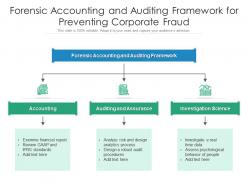
Forensic accounting and auditing framework for preventing corporate fraud





Try Before you Buy Download Free Sample Product
 Impress Your
 Audience
 100%
100% Editable
 Save Hours
 of Time


Our Forensic Accounting And Auditing Framework For Preventing Corporate Fraud are topically designed to provide an attractive backdrop to any subject. Use them to look like a presentation pro.
People who downloaded this PowerPoint presentation also viewed the following :
Forensic accounting and auditing framework for preventing corporate fraud with all 2 slides:
Use our Forensic Accounting And Auditing Framework For Preventing Corporate Fraud to effectively help you save your valuable time. They are readymade to fit into any presentation structure.

FAQs for Forensic accounting and auditing framework for
Forensic accounting combines accounting expertise with investigative skills to examine financial records for legal proceedings, fraud detection, and dispute resolution. Unlike traditional accounting which focuses on recording and reporting financial transactions, forensic accounting analyzes irregularities, traces assets, and provides litigation support, with many law firms and corporations finding it essential for financial crime investigations and regulatory compliance.
Key skills for successful forensic accountants include analytical thinking, attention to detail, investigative expertise, strong communication abilities, and comprehensive understanding of accounting principles and legal procedures. These professionals enhance fraud detection by combining financial analysis, data mining, and interviewing techniques, with many organizations finding that skilled forensic accountants deliver faster case resolution and stronger litigation support.
Forensic accountants detect financial fraud through data analytics, transaction analysis, digital forensics, interviews with stakeholders, and examination of financial records for anomalies or irregularities. These investigative methods enable organizations to uncover embezzlement, asset misappropriation, and accounting manipulation across industries like banking and healthcare, ultimately protecting assets and ensuring regulatory compliance.
Forensic accounting provides critical litigation support by analyzing financial evidence, quantifying damages, tracing assets, and presenting complex financial data in understandable formats for legal proceedings. These specialists work closely with attorneys to strengthen cases through expert witness testimony, detailed financial reconstructions, and comprehensive loss calculations, ultimately delivering credible evidence that can significantly influence case outcomes and settlement negotiations.
Forensic investigations involve systematically collecting financial records, transaction data, bank statements, and digital evidence, followed by detailed analysis using specialized software and accounting techniques. Forensic accountants trace fund flows, identify discrepancies, and reconstruct financial activities through data mining and pattern recognition, ultimately delivering comprehensive reports that support legal proceedings and enable organizations to recover assets while strengthening internal controls.
Forensic accountants identify red flags including unexplained variances in financial records, unusual transactions near period-end, missing documentation, altered documents, and inconsistent employee behavior patterns. These warning signs help detect potential fraud through analytical procedures, data mining, and behavioral analysis, with many financial institutions and corporations finding that early detection significantly reduces losses and enhances regulatory compliance.
Technology has revolutionized forensic accounting by enabling faster data analysis, automated pattern recognition, and enhanced fraud detection capabilities through AI, machine learning, and advanced analytics tools. These innovations streamline investigations, reduce manual review time, and improve accuracy in identifying financial irregularities, with many firms finding that digital forensics delivers more comprehensive evidence and faster case resolution.
Forensic accountants typically handle fraud investigations, divorce proceedings involving complex assets, business valuations during disputes, embezzlement cases, insurance claims, and litigation support matters. These professionals prove invaluable in corporate environments, law firms, and financial institutions, where they uncover financial irregularities, trace hidden assets, and provide expert testimony, ultimately delivering clarity and accountability in complex financial disputes.
Forensic accountants collaborate with law enforcement by providing specialized financial analysis, examining complex transactions, interpreting accounting records, and translating financial evidence into understandable reports for investigations. Through their expertise in fraud detection and financial reconstruction, these professionals enable agencies to build stronger cases in white-collar crime prosecutions, ultimately enhancing investigation outcomes and judicial proceedings.
Forensic accountants must adhere to strict confidentiality, objectivity, professional competence, and independence while maintaining integrity throughout investigations. These ethical standards ensure unbiased reporting, protect sensitive financial information, and uphold court admissibility requirements, with many firms finding that rigorous ethical compliance ultimately delivers credible results and enhanced professional reputation.
High-profile forensic accounting cases include Enron's revenue manipulation, WorldCom's expense capitalization fraud, Bernie Madoff's Ponzi scheme, the Wells Fargo fake accounts scandal, and Volkswagen's emissions deception. These investigations demonstrate how forensic accountants uncover complex financial schemes through data analysis, transaction tracing, and regulatory compliance auditing, ultimately delivering justice and enhanced corporate transparency.
Businesses can implement fraud prevention through strong internal controls, regular audits, employee background checks, segregation of duties, and robust financial monitoring systems. These measures work by creating multiple verification points, enhancing transparency, and establishing clear accountability structures, with many organizations finding that combining technology-driven analytics with comprehensive staff training ultimately delivers significantly reduced fraud risk and enhanced operational integrity.
Certifications for aspiring forensic accountants include the Certified Fraud Examiner (CFE), Certified in Financial Forensics (CFF), Certified Forensic Accountant (Cr.FA), and Master Analyst in Financial Forensics (MAFF). These credentials enhance professional credibility by validating expertise in fraud detection, litigation support, and investigative techniques, with many financial institutions and law firms increasingly seeking certified professionals for complex fraud cases.
Forensic accounting enhances risk management by identifying vulnerabilities, detecting fraudulent activities, and implementing preventive controls through comprehensive financial analysis. These specialized investigations enable organizations to minimize losses, strengthen internal controls, and develop robust compliance frameworks, with many financial institutions and corporations finding that proactive forensic reviews significantly reduce operational risks and protect asset integrity.
**INPUT**: What trends are currently shaping the future of forensic accounting? **OUTPUT**: Current trends shaping forensic accounting's future include advanced data analytics, artificial intelligence integration, cryptocurrency investigations, cybersecurity expertise, and regulatory technology adoption. These developments enhance forensic accountants' capabilities by streamlining complex investigations, automating pattern recognition, and addressing digital fraud schemes, with financial institutions and corporations increasingly finding that technology-enhanced forensic services deliver faster case resolution and more comprehensive risk management. [Word count: 58 words]
-
Great quality product.
-
Enough space for editing and adding your own content.
-
Awesome presentation, really professional and easy to edit.