


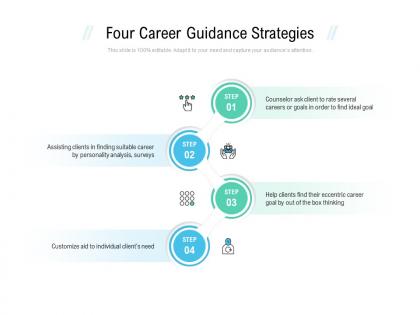
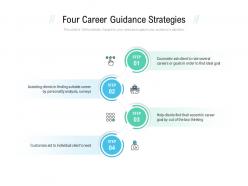
Four career guidance strategies




Try Before you Buy Download Free Sample Product
 Impress Your
 Audience
 100%
100% Editable
 Save Hours
 of Time


Our Four Career Guidance Strategies handle your thoughts with great care. They enable them to endure any hardship.
People who downloaded this PowerPoint presentation also viewed the following :
Four career guidance strategies with all 5 slides:
Endure any hardship with our Four Career Guidance Strategies. They will handle your thoughts with great care.

FAQs for Four
**INPUT**: What are the most effective strategies for identifying a student's career interests? **OUTPUT**: Effective strategies for identifying student career interests include aptitude assessments, personality tests, informational interviews, job shadowing experiences, and skills-based evaluations. These approaches work together by revealing natural talents, preferred work environments, and practical career applications, with many educational institutions finding that combining multiple assessment methods ultimately delivers more accurate career guidance and enhanced student confidence in their professional pathways. [Word count: 60 words]
Educators can incorporate experiential learning into career guidance through job shadowing programs, internships, industry partnerships, hands-on projects, and workplace simulations. These approaches enable students to explore career paths directly, develop practical skills, and build professional networks, while many schools find that such real-world experiences significantly enhance student engagement and career readiness outcomes.
Technology revolutionizes modern career counseling through AI-powered career assessments, virtual reality job simulations, online coaching platforms, data analytics for market trends, and mobile apps for skill tracking. These digital tools enable counselors to deliver personalized guidance at scale, provide real-time labor market insights, and offer immersive career exploration experiences, ultimately enhancing client outcomes while streamlining counseling processes.
Career assessments guide students by evaluating their interests, skills, personality traits, values, and aptitudes through standardized tools and questionnaires. These comprehensive evaluations enable educational institutions to provide personalized career counseling, match students with suitable academic programs, and identify potential career paths across industries like healthcare, technology, and finance, ultimately delivering clearer direction and increased confidence in career decision-making.
Effective strategies include mentorship programs pairing students with industry professionals, culturally responsive career counseling, targeted internship opportunities, skills-based workshops, and partnership networks with diverse employers. These approaches streamline career development by addressing unique cultural perspectives, enhancing professional networks, and building practical competencies, with many educational institutions finding that comprehensive support systems ultimately deliver improved job placement rates and stronger alumni career trajectories.
Mentorship significantly shapes career paths by providing strategic guidance, expanding professional networks, accelerating skill development, and offering insider industry insights. Organizations can facilitate effective mentorship through structured matching programs, cross-departmental partnerships, and digital platforms, with many companies finding that formal mentorship initiatives enhance employee retention, leadership development, and ultimately create stronger talent pipelines.
Best practices for developing a strong resume include tailoring content to specific job descriptions, highlighting relevant skills and achievements, using industry-specific keywords, quantifying accomplishments with metrics, and maintaining clean formatting with clear sections. These strategies enhance visibility in applicant tracking systems while enabling professionals across sectors like healthcare, finance, and technology to showcase targeted expertise, ultimately delivering improved interview rates and stronger competitive positioning in increasingly specialized markets.
Parents can be effectively involved by facilitating open conversations about interests and strengths, providing exposure to diverse career fields through networking and experiences, and offering guidance without imposing personal preferences. This collaborative approach enables students to make informed decisions while maintaining autonomy, with many families finding that balanced support enhances career satisfaction and reduces decision-making stress.
Career workshops should focus on emerging skill requirements, industry-specific certifications, digital literacy training, networking strategies, and market trend analysis. These components enable participants to align their capabilities with current employer needs, while many organizations find that workshops emphasizing adaptability, cross-functional competencies, and continuous learning ultimately deliver better job placement rates and sustained career advancement in an increasingly dynamic employment landscape.
Schools can measure career guidance program effectiveness through student outcome tracking, alumni employment rates, college enrollment statistics, career readiness assessments, and program participation metrics. These evaluation methods enable institutions to analyze post-graduation success, skills development progress, and program engagement levels, while many educational institutions finding that combining quantitative data with qualitative feedback ultimately delivers comprehensive insights for continuous program improvement and strategic resource allocation.
Innovative career exploration tools include virtual reality job simulations, AI-powered career matching platforms, industry-specific assessment tools, interactive skill gap analyzers, and digital mentorship networks. These technologies enhance career guidance by providing immersive experiences, personalized recommendations, and real-time market insights, with many educational institutions finding that students make more informed decisions, ultimately improving career satisfaction and employment outcomes.
Soft skills training can be integrated through interactive workshops, peer mentoring programs, role-playing exercises, industry-specific simulations, and cross-functional project collaborations within career guidance frameworks. These approaches enhance communication abilities, leadership capabilities, and emotional intelligence while providing practical experience, with many organizations finding that structured soft skills development significantly improves employee adaptability and career advancement outcomes.
Career guidance for students with disabilities involves personalized assessments, adaptive technology integration, targeted skill development programs, inclusive workplace preparation, and strategic partnership building with disability-friendly employers. Through individualized planning and accessibility-focused approaches, educational institutions enable these students to identify strengths, develop competitive advantages, and secure meaningful employment opportunities, with many programs finding that comprehensive support systems significantly enhance career outcomes and workplace integration success.
Emerging job market trends include remote work normalization, AI integration across industries, emphasis on digital literacy, growing sustainability sectors, and increased demand for soft skills like adaptability and emotional intelligence. These shifts require students to develop hybrid technical-interpersonal competencies, with many educational institutions finding that combining traditional expertise with digital fluency and collaborative abilities delivers stronger employment outcomes and long-term career resilience.
Alumni networks can be leveraged through mentorship programs, industry-specific career panels, networking events, and one-on-one coaching sessions that connect current students with graduates in their fields. Educational institutions increasingly find that these strategic connections streamline job placement processes, enhance industry insights, and deliver competitive advantages, with many universities reporting significantly improved employment rates and career outcomes.
No Reviews