


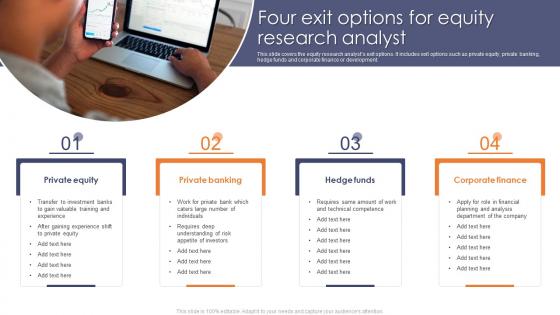
Four Exit Options For Equity Research Analyst




Try Before you Buy Download Free Sample Product
 Impress Your
 Audience
 100%
100% Editable
 Save Hours
 of Time


This slide covers the equity research analysts exit options. It includes exit options such as private equity, private banking, hedge funds and corporate finance or development.
People who downloaded this PowerPoint presentation also viewed the following :
Four Exit Options For Equity Research Analyst with all 6 slides:
Use our Four Exit Options For Equity Research Analyst to effectively help you save your valuable time. They are readymade to fit into any presentation structure.





FAQs for Four Exit Options For
Common exit options for equity research analysts include buy-side roles at hedge funds or asset management firms, investment banking positions, corporate development roles, and portfolio management opportunities. These transitions leverage analytical skills and market expertise, with many analysts finding that hedge funds and private equity firms particularly value their sector knowledge, ultimately delivering enhanced compensation packages and broader strategic responsibilities in an increasingly competitive finance landscape.
Equity research analysts can leverage their financial modeling expertise, industry knowledge, and valuation skills to transition into investment banking roles, particularly in areas like mergers and acquisitions or capital markets. Their deep analytical capabilities, client presentation experience, and understanding of market dynamics translate well to structuring deals and advising corporate clients, with many analysts finding that their research background provides a competitive advantage in evaluating transaction opportunities and delivering strategic recommendations.
Networking opportunities serve as critical pathways for equity research analysts seeking exit options, providing access to hidden job markets, industry insights, and decision-maker relationships. Through professional conferences, alumni networks, and client interactions, analysts often discover roles in investment banking, asset management, and corporate development, with many finding that strong industry connections significantly accelerate career transitions and unlock higher-compensation opportunities.
Equity research analysts possess transferable skills highly valued by hedge funds, including financial modeling, sector expertise, valuation techniques, and market analysis capabilities. These professionals seamlessly transition into hedge fund roles like portfolio management, investment research, and sector specialization, with many funds finding that analysts' disciplined research methodology, risk assessment experience, and deep industry knowledge ultimately deliver enhanced investment decisions and competitive performance advantage.
**INPUT**: Are there specific industries that prefer hiring former equity research analysts? **OUTPUT**: Investment banking, private equity, hedge funds, corporate development, and asset management actively seek former equity research analysts for their analytical expertise and sector knowledge. These industries value analysts' abilities to evaluate financial performance, assess market trends, and conduct due diligence, with many finding that this background delivers enhanced investment decisions and strategic insights. **Word count: 54 words**
Additional qualifications that enhance exit opportunities include the CFA designation, MBA from top-tier schools, sector-specific certifications like FRM for risk management, and specialized training in data analytics or ESG analysis. These credentials significantly broaden career paths into investment banking, portfolio management, hedge funds, and corporate development roles, with many professionals finding that combining technical certifications with industry expertise ultimately delivers enhanced credibility and competitive advantage in increasingly specialized financial markets.
Equity research analysts transition to portfolio management by leveraging their analytical skills, industry expertise, and valuation knowledge while developing portfolio construction and risk management capabilities. Many analysts enhance their credentials through CFA certification, gain client interaction experience, and demonstrate strong stock-picking track records, with investment banks and asset management firms increasingly recognizing that research experience provides excellent preparation for managing institutional portfolios.
**INPUT**: What are the prospects of moving into private equity from equity research? **OUTPUT**: Moving into private equity from equity research offers strong prospects, as the analytical skills, industry expertise, and valuation experience directly translate to PE requirements. Many investment professionals leverage this transition by targeting mid-market firms, sector-focused funds, or growth equity roles, with research analysts finding that their deep industry knowledge and financial modeling capabilities provide significant competitive advantages in deal sourcing and due diligence processes. **Word count**: 60 words
Industry specialization proves crucial for equity research analysts pursuing exit opportunities, as deep sector expertise significantly enhances credibility with potential employers in investment banking, private equity, hedge funds, and corporate strategy roles. Analysts with specialized knowledge in high-demand sectors like technology, healthcare, or financial services often command premium positioning, with many finding that their industry-specific insights directly translate into competitive advantages when transitioning to buy-side roles or corporate development positions.
Former equity research analysts have successfully pursued entrepreneurial paths including independent research boutiques, fintech startups, investment advisory firms, financial technology platforms, and specialized consulting services. Their deep market knowledge, analytical expertise, and industry networks enable them to launch ventures in wealth management, trading platforms, and financial education, with many finding that their sector specialization and client relationships provide significant competitive advantages in increasingly digital financial markets.
Equity research analysts can transition to corporate finance by leveraging their valuation expertise, financial modeling skills, and industry knowledge while developing client relationship management and deal execution capabilities. Many analysts find success moving into investment banking, corporate development, or private equity roles, where their analytical background provides competitive advantage in evaluating transactions, conducting due diligence, and supporting strategic decision-making processes.
**INPUT**: What are the major challenges faced by equity research analysts when exploring new career paths? **OUTPUT**: Major challenges include skill transferability concerns, compensation gaps in alternative roles, limited networking outside finance, and intense work schedules restricting job search time. While analysts possess strong analytical and valuation expertise, transitioning to corporate development, consulting, or portfolio management requires demonstrating broader business acumen, with many finding that proactive skill diversification and strategic networking ultimately deliver enhanced career flexibility and competitive positioning. **Word count**: 60 words
Equity research analysts can effectively communicate their expertise by highlighting their financial modeling skills, industry knowledge, valuation techniques, and client presentation abilities through targeted resumes and portfolio examples. During interviews, demonstrating analytical thinking through case studies, discussing specific stock recommendations with outcomes, and translating complex financial concepts into actionable insights showcases their value to potential employers across investment banking, asset management, or corporate finance roles.
Technology sector exit paths for equity research analysts include corporate development roles at tech companies, venture capital and growth equity positions, technology investment banking, strategic consulting at firms like McKinsey focusing on tech clients, and investor relations roles at major technology corporations. These transitions leverage analysts' deep sector knowledge and financial modeling skills, with many finding that their understanding of technology trends, competitive dynamics, and valuation methodologies provides significant advantages in evaluating tech investments, guiding strategic decisions, and ultimately delivering superior outcomes in an increasingly digital business landscape.
Geographic locations significantly influence exit opportunities through market concentration, regulatory environments, and industry specialization, with major financial hubs like New York, London, and Hong Kong offering broader paths into investment banking, hedge funds, and corporate development roles. Analysts in emerging markets often find opportunities in local asset management and multinational corporations expanding regionally, while those in specialized financial centers can leverage sector expertise for targeted transitions, ultimately delivering enhanced career mobility and compensation potential.
-
Definitely recommend SlideTeam to all who need help with PowerPoint presentations. Their design team can create anything you need.
-
Professional and unique presentations.