


Four Pillars Of Good Agricultural Practices




Try Before you Buy Download Free Sample Product
 Impress Your
 Audience
 100%
100% Editable
 Save Hours
 of Time


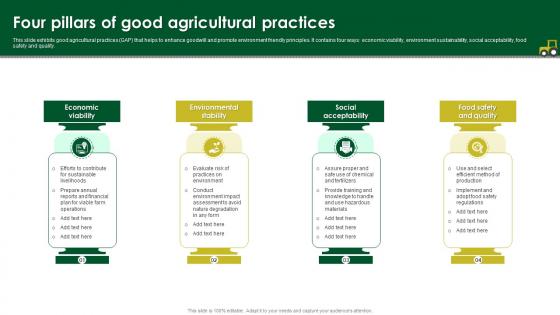
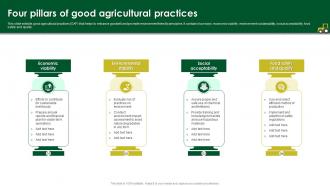
This slide exhibits good agricultural practices GAP that helps to enhance goodwill and promote environment friendly principles. It contains four ways economic viability, environment sustainability, social acceptability, food safety and quality.
People who downloaded this PowerPoint presentation also viewed the following :
Four Pillars Of Good Agricultural Practices with all 6 slides:
Use our Four Pillars Of Good Agricultural Practices to effectively help you save your valuable time. They are readymade to fit into any presentation structure.





FAQs for Four Pillars Of
So there's basically three big things to juggle: keeping the environment healthy, making actual money, and treating workers fairly. Soil health is huge - if you nail that and cut back on chemicals, everything else gets easier. Water conservation and protecting local wildlife matter too, obviously. The social stuff gets forgotten a lot but it shouldn't - fair wages, community relationships, all that. Honestly the whole thing is just farming without totally screwing over the next generation (which sounds simple but... yeah). I'd start with soil first since it affects pretty much everything else.
Dude, the soil thing is wild when you really get into it. Cover crops and rotating what you plant will totally rebuild your dirt from scratch - like, the microorganisms go crazy in a good way. Less tilling means way better water retention too. I've seen soil tests that are honestly night and day different after a few seasons. Your erosion problems basically disappear. Nutrient cycling gets so much more efficient it's not even funny. Oh, and definitely test your soil now before you change anything - you'll want those baseline numbers to compare against later. Trust me on that one.
Dude, cover crops are seriously underrated. They'll prevent erosion and boost your soil health naturally - no synthetic fertilizers needed since they fix nitrogen on their own. Plant them between growing seasons and they keep all those good nutrients from washing away. Plus they add organic matter back into the dirt. Honestly, they're like a natural weed barrier too, which saves you so much work later. Oh, and bugs love them (the good kind). Water retention gets way better too, which you'll definitely notice during those random dry spells we keep getting. I'd start with crimson clover or winter rye - pretty foolproof options.
Dude, the tech stuff happening in farming right now is pretty wild. GPS tractors and soil sensors help you nail exactly where to put water and fertilizer - cuts down waste big time. Drones can monitor your crops too, which honestly sounds like something from a sci-fi movie but it's totally real. Vertical farms are popping up everywhere, and there's AI systems that'll boost your yields without sucking up tons of resources. Scientists are even making crops that don't need as much water. If you're just starting out, grab some soil testing apps or basic moisture sensors - they're cheap and you'll see results right away.
Honestly, the money stuff works out pretty well. You'll slash what you spend on fertilizers and pesticides once your soil gets healthier from things like crop rotation. Takes maybe 2-3 years to see real savings, and yeah there's some upfront costs. But then you can sell into those premium organic markets too - that's where the real money is sometimes. Government throws incentives at this stuff now which helps. My cousin started with just one field to test it out, which was smart. Short-term profits might dip a little during transition but the math adds up.
So basically you want to mess with pest cycles by switching up what you plant. Different crops pull different nutrients from soil and give back different stuff - legumes are actually nitrogen fixers which is pretty neat. Monocultures are just asking for trouble honestly. When you diversify, you're not gambling everything on one crop failing. Plus your soil microbes stay happier since various root systems feed them differently. Even just alternating between two plant families will show results fast. I'd start there and see how it goes - you'll probably notice healthier soil within a season.
So basically, sustainable farming fights climate change by trapping carbon in soil and cutting emissions. Cover crops and rotational grazing actually store tons of carbon underground - which honestly blew my mind when I first learned it. You're also ditching synthetic fertilizers that create massive emissions. Minimal tillage helps too. Diversified systems handle crazy weather way better than monocultures. My cousin started with just cover crops on his farm and now he's obsessed with regenerative practices. Start with one thing and see how it goes - you don't need to overhaul everything at once.
Look, water management can make or break your farm honestly. Drip irrigation and rainwater harvesting are game-changers - they'll cut your costs while boosting yields. Without proper management, you're looking at soil erosion and nutrient runoff, which is a nightmare. Plus depleted aquifers just screw over everyone down the line. Soil moisture monitoring helps you use every drop efficiently. I'd start by checking how much water you're actually using right now - most people are shocked. Then figure out where you can swap in better irrigation systems. It protects the local ecosystem too, which is nice.
So IPM basically means you don't just blast everything with chemicals right away. You rotate crops, bring in beneficial bugs, and only hit pests with targeted stuff when you really need to. Honestly, it's way smarter than the spray-and-pray approach most people use. Your soil stays healthier, water doesn't get contaminated, and you'll save money since those pesticides add up fast. The trick is walking your fields regularly - catch problems early and you can usually fix them without going nuclear. Plus beneficial insects stick around for pollination, which is clutch.
So there's actually a bunch of stuff happening with sustainable ag policies right now. The Conservation Reserve Program pays farmers to basically retire sensitive land, which is cool. Then you've got EQIP - funds conservation improvements on farms that are still operating. Europe's way ahead of us though - their Common Agricultural Policy directly links subsidies to environmental practices. Smart move honestly. Most programs these days use incentives instead of just punishing people, which seems to work better. Oh, and definitely check what's available locally since everything varies by region. The whole landscape changes pretty quickly too.
Look for organic or fair trade labels when you're grocery shopping - they actually mean something. Farmers markets are clutch for seasonal stuff, plus you can ask the actual growers about their practices. I swear the produce just tastes better too. Skip brands that are sketchy about where their food comes from. CSAs are worth checking out if you want local options delivered regularly. Basically, spend your money on farms doing regenerative agriculture instead of the industrial mega-operations that trash soil. Your purchases really do add up to make a difference.
Oh there's so much cool stuff happening! Costa Rica pays farmers to protect forests - literally pays them for biodiversity. Kenya's doing this push-pull thing with companion plants that naturally keeps pests away. Pretty genius honestly. Millions of Indian smallholders are into Zero Budget Natural Farming now, cuts their costs but yields stay solid. Denmark's precision ag tech reduces fertilizer waste by like 30-40% which is huge. Netherlands kills it with vertical farming too, though that's probably overkill for most situations. I'd pick whichever region matches what you're working on and go deep on that first.
Oh totally, sustainable farming is way better for biodiversity than conventional stuff. Crop rotation and cover crops create little habitats everywhere - bugs, birds, soil critters all love it. You're not bombing everything with pesticides either (which honestly makes such a difference). Natural pest control kicks in when you've got that diversity going. Your farm basically becomes this functioning ecosystem instead of just rows of whatever. I'd say start small though - maybe add some pollinator strips to one field first? You'll see the change pretty quick. It's wild how much life shows up when you give it space.
Start with your extension office - they're seriously underrated and do workshops plus demos you can actually walk through. USDA's SARE program has solid case studies too. For online stuff, check out eOrganic and Rodale Institute. But honestly? The farmer networks are where you'll learn the most practical stuff. Your state's sustainable ag association is probably worth joining just for the connections alone. Oh, and they usually do field days where you can see what actually works (and what doesn't, which is just as useful). The farmer-to-farmer conversations end up being way more valuable than most of the formal resources.
Dude, agroforestry is like the Swiss Army knife of farming - you're mixing trees with crops or livestock. The trees prevent soil erosion while their roots add organic matter. Plus you get this cool microclimate thing happening that reduces water stress. Honestly, the biodiversity benefits are kind of wild - more habitats means natural pest control and better pollination. Carbon sequestration is a nice bonus too. Income-wise, you could eventually harvest timber or fruit alongside your regular crops. I'd say start small though, maybe try windbreaks first? See how your specific land responds before going all-in.
-
Mesmerized with the fantastic collection! Super sleek, relevant infographics.
-
Thanks for all your great templates they have saved me lots of time and accelerate my presentations. Great product, keep them up!