


Four Pillars Of Human Development Index





Try Before you Buy Download Free Sample Product
 Impress Your
 Audience
 100%
100% Editable
 Save Hours
 of Time


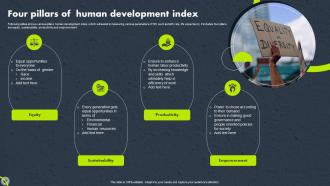
Following slides shows various pillars human development index which will assist in measuring various parameters of HDI such as birth rate, life expectancy. It includes four pillars are equity, sustainability, productivity and empowerment.
People who downloaded this PowerPoint presentation also viewed the following :
Four Pillars Of Human Development Index with all 6 slides:
Use our Four Pillars Of Human Development Index to effectively help you save your valuable time. They are readymade to fit into any presentation structure.





FAQs for Four Pillars Of
So HDI breaks down into three parts: how long people live (life expectancy), education stuff like years in school, and income adjusted for what things actually cost in different countries. It's basically asking - are people living long enough, getting educated, and making decent money? Pretty smart way to measure development if you ask me. When you're comparing countries or tracking progress over time, these three things give you a solid picture. Way better than just looking at GDP alone, which honestly doesn't tell you much about regular people's lives.
HDI is way better than GDP for measuring how people actually live. GDP just tracks economic stuff, but HDI looks at three things: how long people live, education levels, and income. A country could have amazing GDP growth but crappy hospitals and schools - GDP makes it look successful while HDI shows the truth. Honestly, I think more people should pay attention to HDI rankings instead of just economic numbers all the time. Check both when you're comparing countries though. You'll get a much clearer picture of what's actually happening there.
Yeah so regular HDI is basically just national averages, which honestly doesn't tell you much about what's actually happening on the ground. There's this other version called IHDI that factors in inequality - like how spread out the wealth, health, and education really are. When there's a big difference between a country's HDI and IHDI scores, that's your red flag for serious inequality. I mean, you could have a decent average but still have half the population struggling while the other half is doing great. Definitely check both if you're looking into this stuff seriously.
So HDI takes your country's life expectancy and plugs it into this formula against set benchmarks - 20 years minimum, 85 max. Though honestly, 20 as the floor seems depressing lol. They calculate it as (your actual life expectancy - 20) ÷ 65, which spits out a number between 0 and 1. Then it gets averaged with education and income scores for your final HDI. Quick tip: when you're looking at HDI changes over time, check if life expectancy shifts are what's actually moving the needle.
HDI's a solid baseline but don't rely on it for everything. Sure, it covers health, education, and income - the big three. But tons of crucial stuff gets missed. Political freedoms? Environmental issues? How unequal things actually are? None of that shows up. Honestly, some countries look way better on HDI than they actually are once you dig deeper. If you're doing real research, throw in other measures too. Gender Development Index is good, or the Multidimensional Poverty one. HDI's just your starting point, not the whole picture.
So HDI basically makes developing countries look beyond just GDP when they're planning stuff. You can't just chase economic growth anymore - gotta balance education, healthcare, and income all at once. Which is actually pretty brilliant because otherwise governments just throw everything at factories and ignore schools or hospitals. The real benefit? HDI shows you where people actually are quality-of-life wise. Like, you can spot if literacy sucks or if life expectancy is tanking compared to income levels. Then you know exactly what to prioritize in your development plans instead of just guessing.
So HDI measures three things, and education is literally one of them - literacy rates, years of schooling, all that stuff. Norway and Switzerland crush it partly because their schools are incredible. Developing countries get screwed over here though. Even if their economy's growing, bad school access tanks their whole ranking. It's honestly pretty unfair when you think about it. But yeah, if you're trying to figure out why a country ranks where it does, check their education stats first. That'll usually tell you everything you need to know right there.
So HDI is pretty flawed tbh. It only tracks three things - life expectancy, education years, and income - but misses huge stuff like inequality and human rights. A country could have amazing averages while most people are struggling, you know? Plus the education part is kinda shallow since it's just counting school years, not whether kids actually learn anything useful. Most experts say you've got to check other measures too, like gender equality indices and poverty breakdowns. Otherwise you're missing half the story about how people actually live there.
Yeah, they update the HDI every July. Pretty regular schedule. You need fresh data to actually see if countries are getting better at the whole health/education/income thing - though honestly, some places barely budge year to year. But policymakers eat this stuff up when they're deciding where to throw money. Using old HDI data is basically pointless if you're doing any serious country comparisons. I'd always double-check you've got the latest report before diving into research. Three-year-old rankings? Might as well be ancient history at that point.
So the regular HDI doesn't actually look at income inequality at all - just averages for income, education, and life expectancy. There's this other version though called the IHDI that does factor in how evenly things are distributed. What happens is if a country has huge wealth gaps, the IHDI will dock points even if the averages look good. Like, you could have a really high average income but if it's all concentrated among rich people, your IHDI score tanks. Pretty smart way to measure things honestly. I'd check both when you're comparing countries - gives you way better insight.
HDI's pretty useful because it looks at health, education, and income all together instead of just money stuff. So like, you might find a country with okay GDP but people are dying young - that's gonna flip your whole strategy, right? Track the trends over time rather than just taking snapshots. That's where you'll actually see if your development work is making a difference. Plus you can compare what's working between different regions. Honestly, it beats just chasing random targets that don't tell you much about whether people's lives are actually getting better.
Yeah, Cuba and Costa Rica are perfect examples of this! Cuba's got healthcare and education that rivals way richer countries. Costa Rica dumps money into social programs and environmental stuff - honestly, they're doing better than some wealthy nations on quality of life. Sri Lanka used to be amazing at this too before everything went sideways recently. The thing is, these places figured out that smart spending on health, education, and social services works better than just chasing GDP numbers. So don't just look at how much money a country makes - check where they're actually putting it.
Yeah, culture totally affects HDI but it's weird how. Like, it doesn't change the actual numbers for health, education, and income directly. But it shapes how societies go after those things. East Asian countries are obsessed with education so their scores reflect that. Places with strong community health traditions? Better life expectancy. The flip side sucks though - when cultural norms block women from school, you see it in the data. I always think it's fascinating how some countries punch way above their economic weight just because of cultural priorities. Context is everything when you're looking at those rankings.
So GDI is basically HDI but split by gender - same stuff like health, education, income, just broken down to show if women are getting screwed over. A country might look decent on regular HDI but have massive gender gaps that GDI will expose. Perfect score is 1.0 (total equality), anything lower means women are behind men in development. Honestly, some countries surprise you with how bad their gender disparities are even when their overall numbers look fine. You really need both indices to get what's actually happening - HDI alone doesn't tell the whole story.
Okay so HDI is basically a cheat sheet for figuring out where to send money. Low HDI countries get more humanitarian aid because they obviously need help with health, education, basic stuff. Rising HDI scores? That's where development investors want to put their cash since there's actual progress happening. Way better than sifting through like 50 different metrics, right? International orgs use these rankings to decide funding priorities all the time. Honestly, if you're trying to predict aid flows, just watch HDI changes - they're usually a dead giveaway for where the money's headed next.
-
“Superb. What a great finding. Thankful for SlideTeam. We were paying people to make slides which went all in vain. We are so happy to have found you.”
-
Enough space for editing and adding your own content.