

Four Pillars To Overcome Global Procurement Challenges




Try Before you Buy Download Free Sample Product
 Impress Your
 Audience
 100%
100% Editable
 Save Hours
 of Time


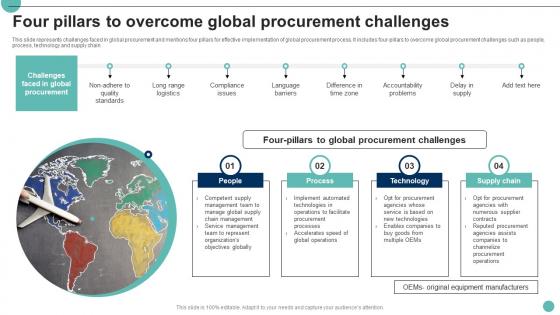
This slide represents challenges faced in global procurement and mentions four pillars for effective implementation of global procurement process. It includes four-pillars to overcome global procurement challenges such as people, process, technology and supply chain
People who downloaded this PowerPoint presentation also viewed the following :
Four Pillars To Overcome Global Procurement Challenges with all 9 slides:
Use our Four Pillars To Overcome Global Procurement Challenges to effectively help you save your valuable time. They are readymade to fit into any presentation structure.








FAQs for Four Pillars To Overcome
Key elements of an effective procurement strategy include supplier relationship management, cost optimization, risk assessment, technology integration, and performance monitoring. These components work together by streamlining vendor selection, enhancing contract negotiations, and automating approval processes, with many organizations finding that strategic procurement delivers significant cost reductions and operational efficiency gains.
Organizations align procurement strategies with business objectives by establishing cross-functional teams, conducting regular strategy reviews, setting KPIs that mirror corporate goals, and implementing integrated planning processes. Through strategic sourcing and supplier partnerships, companies in manufacturing, healthcare, and retail streamline operations, reduce costs, and enhance innovation capabilities, ultimately delivering competitive advantage and sustainable growth in increasingly dynamic markets.
Technology streamlines modern procurement strategies through automated sourcing, AI-driven supplier evaluation, predictive analytics, real-world spend analysis, and digital contract management platforms. These innovations enable organizations to reduce costs, accelerate procurement cycles, and enhance supplier relationships, with many companies finding that strategic technology adoption delivers significant competitive advantages and operational efficiency gains.
Supplier relationship management enhances procurement outcomes by fostering strategic partnerships, improving communication channels, and enabling collaborative problem-solving approaches. Through structured relationship frameworks, organizations streamline negotiation processes, reduce supply chain risks, and achieve better pricing agreements, with many companies finding that strong supplier partnerships ultimately deliver cost savings and operational efficiency.
Key procurement strategy metrics include cost savings percentage, supplier performance ratings, procurement cycle time, contract compliance rates, and spend under management. These metrics enable organizations to track operational efficiency, supplier relationship quality, and strategic value delivery, with many companies finding that comprehensive measurement across cost, quality, and timeline dimensions ultimately drives competitive advantage and informed decision-making.
Sustainable procurement practices influence purchasing decisions by prioritizing environmental impact, social responsibility, and long-term value over lowest initial cost. Organizations increasingly evaluate suppliers based on carbon footprints, ethical labor practices, and circular economy principles, with many companies finding that sustainable sourcing reduces risks, enhances brand reputation, and delivers competitive advantage.
Poor procurement strategies create risks including cost overruns, supply chain disruptions, quality issues, vendor dependency, and compliance failures. These challenges can be mitigated through diversified supplier networks, comprehensive vendor assessments, strategic contract negotiations, and robust risk monitoring systems, with many organizations finding that proactive procurement planning ultimately delivers enhanced operational resilience and competitive advantage.
Cross-departmental collaboration enhances procurement strategies by aligning purchasing decisions with operational needs, budget constraints, and strategic objectives from finance, operations, and management teams. This integrated approach streamlines vendor selection, reduces redundant purchases, and leverages collective negotiating power, with many organizations finding that coordinated procurement delivers significant cost savings and improved supplier relationships.
Globalization significantly impacts procurement strategies by expanding supplier networks across international markets, increasing supply chain complexity, and introducing currency fluctuation risks alongside competitive pricing opportunities. Through strategic global sourcing, organizations access diverse suppliers, reduce costs, and enhance product quality, while many multinational companies find that diversified procurement delivers greater resilience and competitive advantage.
Small and medium-sized enterprises can develop competitive procurement strategies through supplier diversification, strategic partnerships, technology adoption, collaborative purchasing, and data-driven decision making. These approaches enable SMEs to negotiate better terms, reduce costs, and access quality suppliers previously available only to larger organizations, ultimately delivering operational efficiency and competitive advantage in increasingly complex markets.
Procurement strategies incorporate agile methodologies through iterative supplier evaluations, cross-functional collaboration, rapid prototyping of procurement processes, flexible contract structures, and continuous feedback loops. These approaches enable organizations to adapt quickly to market changes, reduce procurement cycle times, and enhance supplier relationships, with many companies finding that agile procurement delivers faster decision-making and improved cost efficiency.
Data analytics transforms procurement decision-making by enabling predictive supplier performance analysis, real-time spend visibility, and risk assessment through historical data patterns. Through advanced analytics platforms, organizations streamline vendor selection, optimize contract negotiations, and identify cost-saving opportunities, with many manufacturing and retail companies finding that data-driven procurement delivers 15-20% cost reductions while enhancing supplier relationships.
Effective contract negotiation strategies include conducting thorough market research, leveraging volume commitments, establishing long-term partnerships, implementing performance-based terms, and utilizing competitive bidding processes. These approaches enable organizations to secure favorable pricing, improved service levels, and risk mitigation clauses, with many procurement teams finding that strategic supplier relationships ultimately deliver cost savings while enhancing operational efficiency and supply chain resilience.
Market research contributes to procurement strategies by identifying supplier capabilities, analyzing market trends, assessing pricing structures, and evaluating competitive landscapes. Through comprehensive market analysis, organizations streamline vendor selection, negotiate better contracts, and minimize supply chain risks, while anticipating demand fluctuations, ultimately delivering cost savings and enhanced operational efficiency.
Transitioning from traditional procurement to strategic sourcing presents challenges including resistance to change, lack of cross-functional collaboration, inadequate supplier data, and insufficient analytical capabilities. Organizations often struggle with breaking down silos between departments, developing supplier relationship management skills, and shifting from transaction-focused to value-driven decision making, ultimately requiring significant process reengineering and cultural transformation.
-
Excellent Designs.
-
“I've always gotten excellent slides from them and the customer service is up to the mark.”