


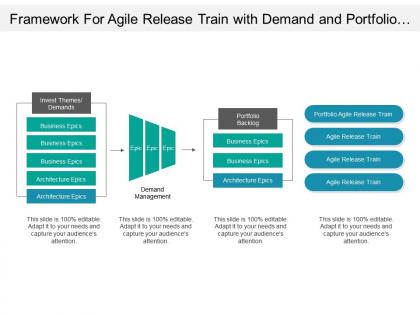
Framework for agile release train with demand and portfolio management




Try Before you Buy Download Free Sample Product
 Impress Your
 Audience
 100%
100% Editable
 Save Hours
 of Time


Ensure folks are not falsely blamed with our Framework For Agile Release Train With Demand And Portfolio Management. Be able to argue for the innocent.
People who downloaded this PowerPoint presentation also viewed the following :
Framework for agile release train with demand and portfolio management with all 5 slides:
Cater for instability with our Framework For Agile Release Train With Demand And Portfolio Management. Allow for the impact of frequent changes.

FAQs for Framework for agile release train with demand
The Agile Release Train framework includes Program Increment planning, cross-functional teams, Release Train Engineer leadership, System Architecture guidance, and continuous delivery pipelines. These components streamline large-scale agile development by synchronizing multiple teams, enhancing collaboration through structured ceremonies, and enabling faster product releases, with many organizations finding that coordinated ARTs deliver predictable outcomes and improved time-to-market.
The Agile Release Train facilitates alignment through synchronized planning events, shared objectives, and regular cadence ceremonies that coordinate multiple teams toward common goals. Through Program Increment planning, daily standups, and system demos, organizations streamline communication, minimize dependencies, and ensure consistent delivery timelines, with many enterprises finding that this structured approach ultimately delivers faster feature releases and enhanced cross-team collaboration.
Essential Agile Release Train roles include Release Train Engineer, Product Manager, System Architect, Business Owners, and Scrum Masters across multiple teams. These roles streamline coordination by aligning cross-functional teams, managing dependencies, and maintaining architectural integrity, while Product Managers prioritize features and Business Owners ensure strategic alignment, ultimately delivering faster value and reducing integration risks.
PI Planning events bring together all teams within an Agile Release Train for intensive two-day collaborative sessions, where they align on objectives, identify dependencies, and create synchronized quarterly plans. These face-to-face gatherings enable cross-functional teams to resolve conflicts, establish clear commitments, and build shared understanding, with many organizations finding that this structured approach delivers faster feature delivery, reduced integration risks, and enhanced team coordination across complex development initiatives.
Managing dependencies between teams in an ART involves establishing clear communication protocols, implementing regular synchronization events like PI Planning and Scrum of Scrums, and creating shared dependency boards for visibility. These practices streamline coordination by enabling proactive identification of blockers, facilitating cross-team collaboration, and maintaining alignment on deliverables, with many organizations finding that structured dependency management ultimately delivers faster release cycles and enhanced predictability.
Organizations effectively measure Agile Release Train performance through predictability metrics, velocity tracking, program increment objectives achievement, and value delivery assessments. These measurements enable teams to evaluate sprint completion rates, feature delivery consistency, and stakeholder satisfaction, with many enterprises finding that combining quantitative data with qualitative feedback ultimately delivers improved planning accuracy and enhanced cross-team collaboration.
Tools supporting Agile Release Trains include Azure DevOps, Jira Align, Rally Software, VersionOne, and ServiceNow for portfolio management, while GitLab, Jenkins, and Bamboo handle continuous integration. These technologies streamline backlog management, sprint planning, and cross-team coordination, with many large organizations finding that integrated toolchains ultimately enhance visibility, reduce cycle times, and deliver faster product releases across multiple development teams.
The Agile Release Train scales Agile practices by synchronizing multiple teams through coordinated planning cycles, shared cadences, and unified delivery objectives across large organizational structures. This framework enables enterprises to maintain Agile flexibility while achieving strategic alignment, with organizations like financial services and technology companies finding that coordinated releases, cross-team collaboration, and systematic integration ultimately deliver faster time-to-market and enhanced operational efficiency.
Common implementation challenges include coordination difficulties across multiple teams, inconsistent sprint cycles, communication gaps between stakeholders, resistance to cultural change, and alignment issues with business objectives. These obstacles can be overcome by establishing clear governance structures, implementing standardized ceremonies and metrics, investing in comprehensive training programs, and fostering transparent communication channels, with many organizations finding that dedicated ART coaches and regular retrospectives ultimately deliver improved collaboration and faster value delivery.
CI/CD practices integrate with Agile Release Trains by enabling automated testing, seamless code integration, and synchronized deployment across all teams within the train. These practices streamline development workflows through shared pipelines, standardized quality gates, and coordinated release schedules, ultimately delivering faster time-to-market and reduced integration risks for large-scale agile organizations.
The Agile Release Train promotes customer collaboration through regular PI planning sessions, continuous demo cycles, customer advisory boards, feedback loops integrated into sprint reviews, and direct stakeholder participation in feature prioritization. This framework enables organizations to gather real-time input, validate product direction early, and incorporate customer insights throughout development, ultimately delivering solutions that align closely with market needs and user expectations.
ARTs can be tailored through customized cadence lengths, industry-specific compliance integration, modified PI planning approaches, and adapted governance structures that reflect regulatory requirements. Organizations in sectors like healthcare, financial services, and manufacturing successfully customize their sprint durations, stakeholder involvement, and delivery milestones, ultimately delivering enhanced operational efficiency while maintaining industry standards and accelerating time-to-market.
Leadership drives Agile Release Train success by establishing clear vision, removing organizational impediments, fostering cross-team collaboration, and ensuring alignment with strategic business objectives. Effective leaders enable servant leadership principles, facilitate continuous improvement through retrospectives and metrics analysis, while empowering teams with decision-making autonomy, ultimately delivering faster product releases and enhanced customer value in increasingly competitive markets.
Agile Release Trains foster continuous improvement through regular retrospectives, cross-team collaboration, shared metrics tracking, and systematic feedback loops that identify bottlenecks and enhancement opportunities. These practices enable teams to streamline processes, accelerate delivery cycles, and enhance product quality, with many organizations finding that this structured approach ultimately delivers increased innovation and competitive advantage.
Agile Release Trains differ from traditional project management through continuous value delivery, cross-functional collaboration, fixed cadences with variable scope, and iterative planning cycles. While traditional approaches emphasize sequential phases, detailed upfront planning, and fixed scope with variable timelines, ARTs enable organizations to respond faster to market changes, reduce risk through frequent releases, and maintain alignment across multiple teams, ultimately delivering more predictable outcomes and enhanced customer satisfaction.
-
Easily Understandable slides.
-
Topic best represented with attractive design.