


Framework Of Wireless Sensor Network Protocols In Iot PPT Example





Try Before you Buy Download Free Sample Product
 Impress Your
 Audience
 100%
100% Editable
 Save Hours
 of Time


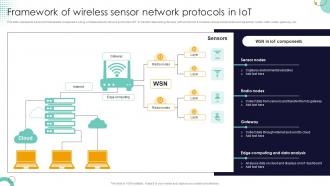
This slide represents framework that assists companies in using wireless security network protocols in IOT to transfer data among devices without internet. It includes various components such as sensor nodes, radio nodes, gateway, etc.
People who downloaded this PowerPoint presentation also viewed the following :
Framework Of Wireless Sensor Network Protocols In Iot PPT Example with all 9 slides:
Use our Framework Of Wireless Sensor Network Protocols In Iot PPT Example to effectively help you save your valuable time. They are readymade to fit into any presentation structure.








FAQs for Framework Of Wireless Sensor Network Protocols In
Wireless sensor networks utilize routing protocols, MAC protocols, transport protocols, network layer protocols, and data aggregation protocols. These protocols work together by optimizing energy consumption, managing data transmission, and ensuring reliable communication across distributed sensor nodes, with many IoT deployments in smart cities, industrial monitoring, and environmental sensing finding that strategic protocol combinations deliver enhanced network performance and extended operational lifespans.
Routing protocols differ through their data transmission strategies, including proactive table-driven approaches, reactive on-demand routing, and hierarchical cluster-based methods. While proactive protocols like DSDV maintain constant routing information, reactive protocols such as AODV discover paths when needed, and hierarchical approaches like LEACH organize nodes into clusters, ultimately delivering optimized energy consumption and network longevity across various sensor deployments.
Energy efficiency serves as the foundational design principle for wireless sensor network protocols, directly influencing data transmission scheduling, routing algorithms, sleep-wake cycles, and communication frequency optimization. These protocols minimize power consumption through adaptive clustering, efficient data aggregation, and intelligent node coordination, with applications in smart agriculture, environmental monitoring, and industrial automation ultimately extending network lifespans from months to years while reducing operational costs.
Mesh and star topologies significantly influence protocol selection by determining data routing complexity, energy consumption patterns, and network scalability requirements. Star topologies favor centralized protocols with direct node-to-coordinator communication, streamlining management for applications like building automation, while mesh networks require distributed routing protocols that enable multi-hop communication, ultimately delivering greater resilience and coverage for industrial monitoring systems.
Wireless sensor networks face reliability challenges including node failures, interference, limited battery life, data packet loss, and environmental disruptions that can compromise network performance. Current protocols address these through redundant routing paths, error correction mechanisms, adaptive transmission power control, and cluster-based architectures, with many industrial and environmental monitoring systems finding that these multi-layered approaches significantly enhance network resilience and data integrity.
Security protocols protect data integrity in wireless sensor networks through encryption algorithms, authentication mechanisms, message authentication codes, and secure key management systems. These protocols enable banks to secure transaction data, hospitals to protect patient monitoring information, and manufacturing facilities to safeguard operational metrics, while detecting tampering attempts and ensuring only authorized nodes access sensitive data, ultimately delivering trusted communication and regulatory compliance.
Contention-based protocols allow multiple nodes to compete for channel access using methods like CSMA/CA, while collision-free protocols prevent conflicts through scheduled transmissions, TDMA slots, or token passing mechanisms. Contention-based approaches offer flexibility and simplicity but may experience delays during high traffic, whereas collision-free methods ensure predictable performance and energy efficiency, with many industrial monitoring and healthcare applications finding that scheduled protocols deliver more reliable data transmission and extended network lifespans.
Quality of Service in wireless sensor networks is managed through adaptive routing protocols, bandwidth allocation mechanisms, priority-based scheduling, energy-aware transmission control, and real-time data prioritization techniques. These protocols enable networks to balance power consumption with performance requirements, ensuring critical data from sectors like healthcare monitoring and industrial automation receives priority transmission, ultimately delivering reliable connectivity and optimized resource utilization.
Recent advancements in low-power WSN protocols include IEEE 802.15.4e for time-synchronized communication, RPL for IPv6 routing, ContikiMAC for duty cycling, and LoRaWAN for long-range connectivity. These protocols enhance network efficiency by reducing energy consumption, extending battery life, and improving data transmission reliability, with smart agriculture and industrial monitoring systems finding significantly lower operational costs and enhanced sensor longevity.
Environmental factors significantly impact wireless sensor network protocols through signal interference, temperature fluctuations, humidity levels, physical obstructions, and electromagnetic noise. These conditions affect transmission range, battery life, and data accuracy, with many industrial and agricultural deployments finding that adaptive protocols and robust sensor placement strategies ultimately deliver more reliable network performance and extended operational lifespans.
IEEE 802.15.4 standard provides the foundational physical and data link layer specifications for low-power, low-data-rate wireless personal area networks, enabling energy-efficient communication in wireless sensor networks. This standard facilitates reliable, short-range connectivity across industrial monitoring, smart agriculture, and healthcare applications, with many organizations finding that its mesh networking capabilities and extended battery life ultimately deliver cost-effective IoT deployments and enhanced operational efficiency.
Network scalability issues significantly influence wireless sensor network protocol development by requiring adaptive routing algorithms, hierarchical network architectures, and energy-efficient communication mechanisms. Protocol designers must address node density variations, data aggregation challenges, and bandwidth limitations, with many industrial IoT implementations finding that scalable protocols ultimately deliver better network performance and longer operational lifespans across diverse deployment scenarios.
Application-specific requirements fundamentally drive WSN protocol design through factors like data transmission frequency, power consumption constraints, network topology needs, and quality-of-service demands. These requirements shape whether protocols prioritize real-time delivery for industrial monitoring, energy efficiency for environmental sensing, or reliability for healthcare applications, with many organizations finding that tailored protocol selection significantly enhances operational performance and system longevity.
Data aggregation in wireless sensor networks combines data from multiple sensors at intermediate nodes through clustering, tree-based hierarchies, and in-network processing techniques. These protocols enable nodes to merge redundant information, compress data streams, and eliminate unnecessary transmissions, with manufacturing facilities and environmental monitoring systems finding that strategic aggregation reduces network traffic by up to 70%, ultimately extending battery life and enhancing operational efficiency.
Emerging trends in wireless sensor network protocols for IoT integration include edge computing integration, AI-driven adaptive protocols, ultra-low power communication standards, mesh networking enhancements, and security-first protocol designs. These advancements streamline device interoperability, minimize energy consumption, and enhance real-time data processing, with smart cities, industrial automation, and healthcare systems finding that modern protocols deliver significantly improved scalability and operational efficiency.
-
Content of slide is easy to understand and edit.
-
Loved the fact that SlideTeam provides clean, high-definition, and professional PowerPoint products.