


Functional Team Structure For Project Management Playbook For App Design And Development




Try Before you Buy Download Free Sample Product
 Impress Your
 Audience
 100%
100% Editable
 Save Hours
 of Time


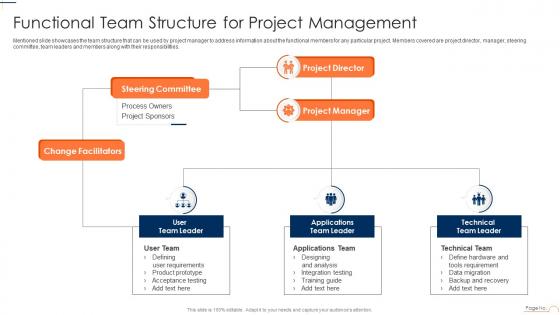
Mentioned slide showcases the team structure that can be used by project manager to address information about the functional members for any particular project. Members covered are project director, manager, steering committee, team leaders and members along with their responsibilities.
People who downloaded this PowerPoint presentation also viewed the following :
Functional Team Structure For Project Management Playbook For App Design And Development with all 6 slides:
Use our Functional Team Structure For Project Management Playbook For App Design And Development to effectively help you save your valuable time. They are readymade to fit into any presentation structure.





FAQs for Functional Team Structure For Project Management Playbook For App
**INPUT**: What are the key characteristics of a successful functional team structure? **OUTPUT**: Successful functional team structures feature clear departmental specialization, defined reporting hierarchies, standardized processes, efficient resource allocation, and strong interdepartmental communication protocols. These characteristics streamline operations by enhancing expertise development, reducing operational costs, and enabling scalable growth, with many organizations finding that specialized teams ultimately deliver improved efficiency and competitive advantage. [Word count: 54 words]
Functional team structure enhances communication by grouping employees with similar skills and expertise together, creating natural knowledge-sharing opportunities, streamlined reporting lines, and specialized channels for technical discussions. This organizational approach enables departments like marketing, finance, and operations to develop deep collaborative relationships, standardize processes more effectively, and leverage collective expertise for problem-solving, ultimately delivering improved efficiency and stronger departmental outcomes.
Organizations implementing functional team structure face challenges including communication barriers between departments, slower decision-making processes, limited cross-functional collaboration, potential silos that hinder information flow, and reduced flexibility in responding to market changes. While these obstacles can impact operational efficiency, many companies successfully address them through strategic coordination mechanisms, regular inter-departmental meetings, and technology platforms that enhance transparency, ultimately delivering streamlined operations and clearer accountability across functions.
Functional team structure impacts employee motivation through specialized skill development, clear career advancement paths, and expertise recognition within departments. While this structure enhances professional growth and creates strong mentorship opportunities, it can also limit cross-functional collaboration, with many organizations finding that balancing specialization with interdepartmental projects ultimately delivers both technical excellence and broader employee engagement.
Functional teams excel in specialized efficiency and deep expertise development, while cross-functional teams deliver faster project completion and enhanced innovation through diverse perspectives. Financial services organizations often find that functional structures streamline routine operations like compliance and auditing, whereas cross-functional approaches accelerate product launches and customer experience initiatives, with many companies strategically combining both structures.
Leadership drives functional team success by establishing clear communication channels across departments, aligning specialized teams with organizational goals, and ensuring efficient resource allocation between functions. Effective leaders facilitate cross-functional collaboration while maintaining departmental expertise, with many organizations finding that strong leadership bridges potential silos, ultimately delivering improved coordination and enhanced operational efficiency.
Organizations measure functional team structure effectiveness through performance metrics like productivity rates, cost per function, and goal achievement timelines, alongside qualitative assessments including employee satisfaction surveys and cross-departmental collaboration evaluations. Many companies find that combining quantitative data with regular team feedback sessions enables strategic adjustments, ultimately delivering improved operational efficiency and enhanced competitive advantage.
Effective onboarding practices include structured role-specific training, mentorship pairing, gradual responsibility integration, clear performance expectations, and comprehensive department knowledge transfer. These approaches streamline new hire adaptation by establishing clear communication channels, providing specialized skill development, and ensuring cultural alignment, with many organizations finding that systematic functional onboarding reduces time-to-productivity and enhances long-term retention.
Functional teams adapt to strategic changes through cross-functional collaboration, skill development programs, flexible resource allocation, and enhanced communication channels with leadership. By implementing agile methodologies and regular strategy alignment sessions, organizations enable departments like marketing, finance, and operations to pivot quickly, ultimately maintaining competitive advantage while preserving specialized expertise during market shifts.
Effective communication tools for functional teams include Slack for instant messaging, Microsoft Teams for integrated collaboration, Asana for project coordination, Zoom for video conferencing, and Confluence for documentation sharing. These platforms streamline workflows by centralizing discussions, automating task updates, and maintaining project visibility, with many organizations finding that strategic tool combinations significantly enhance cross-functional coordination and operational efficiency.
Functional team structure enables specialized skill development by grouping employees with similar expertise together, allowing focused training, mentorship, and knowledge sharing within each department. This concentration creates deep competency pools where team members learn from experienced colleagues, access specialized resources, and develop advanced technical skills, ultimately delivering enhanced operational efficiency and competitive advantage across organizations.
Functional team structures can complicate conflict resolution by creating departmental silos, competing priorities, and limited cross-functional communication channels. However, clear hierarchical lines and specialized expertise within each function can streamline decision-making processes, with many organizations finding that structured escalation paths and regular inter-departmental meetings ultimately enhance collaboration and minimize resource conflicts.
Inter-departmental collaboration is critically important in functional team structures because it breaks down silos, ensures seamless information flow, and aligns diverse expertise toward common objectives. Through strategic cross-functional communication, organizations enhance operational efficiency, accelerate decision-making, and deliver superior customer experiences, with many companies finding that structured collaboration ultimately drives competitive advantage and innovation.
A functional team structure excels when organizations prioritize deep expertise development, standardized processes, and operational efficiency within specialized domains. This approach proves particularly beneficial for manufacturing companies requiring technical precision, financial institutions needing regulatory compliance expertise, and established corporations with stable product lines, ultimately delivering cost-effective resource allocation and streamlined decision-making.
Leaders foster innovation within functional teams by encouraging cross-functional collaboration, implementing regular brainstorming sessions, and creating psychological safety for experimentation and calculated risk-taking. These approaches streamline creative processes by breaking down silos, leveraging diverse expertise, and establishing innovation metrics, with many organizations finding that structured innovation programs ultimately deliver faster product development and enhanced competitive advantage.
-
Wonderful ideas and visuals. I'm really pleased with the templates, which are unique and up to date.
-
Extremely professional slides with attractive designs. I especially appreciate how easily they can be modified and come in different colors, shapes, and sizes!