


Funding Raised By Scale Ai From Investors Scale Ai Data Labeling And Annotation Platform AI SS




Try Before you Buy Download Free Sample Product
 Impress Your
 Audience
 100%
100% Editable
 Save Hours
 of Time


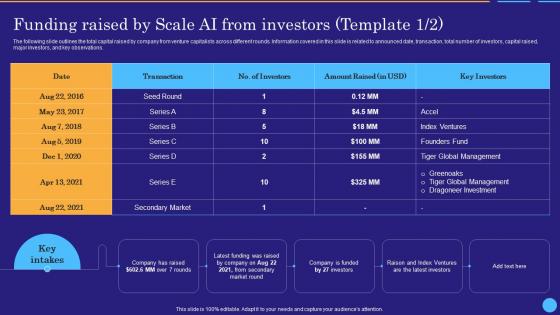
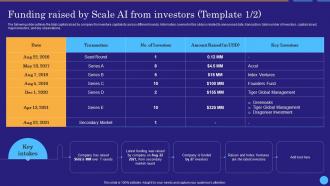
The following slide outlines the total capital raised by company from venture capitalists across different rounds. Information covered in this slide is related to announced date, transaction, total number of investors, capital raised, major investors, and key observations.
People who downloaded this PowerPoint presentation also viewed the following :
Funding Raised By Scale Ai From Investors Scale Ai Data Labeling And Annotation Platform AI SS with all 10 slides:
Use our Funding Raised By Scale Ai From Investors Scale Ai Data Labeling And Annotation Platform AI SS to effectively help you save your valuable time. They are readymade to fit into any presentation structure.









FAQs for Funding Raised By Scale Ai From Investors Scale Ai Data Labeling And Annotation
**INPUT**: What are the key factors driving the recent surge in Scale AI funding? **OUTPUT**: Scale AI funding surges are driven by increasing enterprise demand for data labeling, autonomous vehicle development, government defense contracts, and the critical need for high-quality training datasets. These factors converge as organizations across healthcare, finance, and technology sectors recognize that superior AI models require expertly annotated data, with many finding that investing in data infrastructure delivers significant competitive advantages and faster AI deployment timelines. [Word count: 60 words]
Scale AI startups differentiate themselves by demonstrating proven scalability metrics, showcasing unique data advantages, and presenting clear paths to market dominance across multiple industries. These companies enhance their positioning through proprietary datasets, strategic partnerships with established enterprises, and measurable customer acquisition costs, with many investors finding that demonstrated revenue growth and operational efficiency ultimately deliver the competitive advantage needed in today's funding environment.
Venture capital firms provide essential funding, strategic guidance, and industry connections that enable Scale AI companies to accelerate product development, expand market reach, and build robust infrastructure. Through their networks and expertise, VCs help these companies navigate technical challenges, attract top talent, and scale operations globally, with many AI startups finding that venture backing delivers the resources and credibility needed for rapid growth and competitive positioning.
Scale AI funding has evolved from early-stage venture investments to massive multi-billion dollar rounds, with companies like Scale AI securing $1 billion in Series F funding and OpenAI raising over $13 billion. This transformation reflects growing enterprise demand across sectors like autonomous vehicles, healthcare, and financial services, with investors increasingly recognizing that AI infrastructure companies deliver sustainable competitive advantages and scalable revenue models.
**INPUT**: What are the most promising sectors within Scale AI attracting investor attention? **OUTPUT**: The most promising sectors attracting Scale AI investor attention include autonomous vehicles, healthcare diagnostics, financial services, retail optimization, and manufacturing automation. These sectors deliver significant returns by streamlining operations, reducing costs, and enhancing customer experiences, with many investors finding that companies combining AI scalability with sector-specific expertise ultimately provide the strongest competitive advantages. [Word count: 55 words]
Government initiatives significantly influence Scale AI funding through research grants, tax incentives, public-private partnerships, and regulatory frameworks that encourage innovation investment. These policies create favorable environments where startups access federal funding programs, benefit from R&D tax credits, and attract private investors, with many technology companies finding that government support accelerates their scaling efforts and competitive positioning.
Scale AI startups face challenges including intense competition for limited funding, difficulties demonstrating scalable business models, regulatory uncertainties, and high technical infrastructure costs. These hurdles require strategic positioning and clear value propositions, with many successful startups finding that partnerships with established enterprises, proven customer traction, and demonstrated ROI help overcome investor skepticism while securing growth capital.
Scale AI companies leverage their technology by demonstrating measurable business outcomes, proven scalability across industries, and clear competitive advantages through automated processes and data-driven insights. These companies showcase successful implementations in sectors like healthcare, financial services, and manufacturing, ultimately delivering reduced operational costs, enhanced efficiency, and transformative customer experiences that investors increasingly recognize as sustainable growth drivers.
Scale AI funding in 2023 shows increased focus on enterprise solutions, vertical-specific applications, and AI infrastructure platforms. Investors are prioritizing companies with proven revenue models, regulatory compliance capabilities, and sector expertise in healthcare, finance, and manufacturing, while emphasizing sustainable growth over rapid scaling, ultimately delivering measurable ROI and competitive advantages.
Geographic location significantly influences Scale AI startup funding success, with Silicon Valley, Boston, and major tech hubs offering superior access to specialized investors, AI talent pools, and strategic partnerships. However, remote-first investment trends and emerging AI clusters in Austin, Toronto, and London are increasingly leveling the playing field, with many successful Scale AI companies finding that product-market fit and technical excellence ultimately matter more than zip code for securing growth capital.
The success of Scale AI firms significantly enhances overall tech funding by demonstrating proven business models, attracting institutional investors, and validating AI's commercial viability across sectors. This creates a ripple effect, with venture capitalists increasingly allocating larger portions of portfolios to AI-adjacent startups, while traditional industries like healthcare, finance, and manufacturing accelerate their technology investments, ultimately expanding the entire funding ecosystem.
Scale AI startups should prioritize revenue growth rate, customer acquisition cost, lifetime value ratios, data quality metrics, model accuracy improvements, and operational efficiency indicators. These metrics demonstrate scalability and market viability, with many investors finding that startups showcasing consistent revenue acceleration, strong unit economics, and measurable AI performance gains ultimately deliver the most compelling investment propositions in an increasingly competitive landscape.
Strategic partnerships significantly enhance Scale AI funding opportunities by providing validation from established enterprises, reducing market entry barriers, and demonstrating proven use cases across sectors like healthcare, automotive, and financial services. These collaborations enable investors to see tangible applications and revenue streams, while partners often contribute additional capital or resources, ultimately creating more attractive investment propositions with lower perceived risks.
Ethical considerations significantly influence investor sentiment by creating both due diligence requirements and market opportunities, with concerns about bias, transparency, and regulatory compliance increasingly shaping funding decisions. While these considerations can slow initial investment processes, they ultimately enhance long-term viability, with many institutional investors finding that ethically-grounded AI ventures deliver stronger stakeholder trust and sustainable competitive advantages.
Emerging Scale AI startups can learn to emphasize proven ROI metrics, demonstrate scalable infrastructure capabilities, showcase diverse industry applications, and maintain strong technical talent acquisition strategies from established funding successes. These approaches enable startups to present compelling value propositions across sectors like healthcare, finance, and manufacturing, while highlighting operational efficiency gains and competitive advantages that ultimately deliver sustainable growth and market differentiation.
-
Professionally designed slides with color coordinated themes and icons. Perfect for enhancing the style of the presentations.
-
Unique and attractive product design.