


Future Trends In AI And Machine Learning Implementing Machine Learning For Achieving AI ML SS




Try Before you Buy Download Free Sample Product
 Impress Your
 Audience
 100%
100% Editable
 Save Hours
 of Time


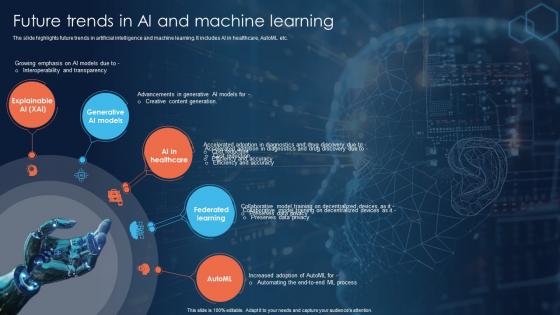
The slide highlights future trends in artificial intelligence and machine learning. It includes AI in healthcare, AutoML etc.
People who downloaded this PowerPoint presentation also viewed the following :
Future Trends In AI And Machine Learning Implementing Machine Learning For Achieving AI ML SS with all 9 slides:
Use our Future Trends In AI And Machine Learning Implementing Machine Learning For Achieving AI ML SS to effectively help you save your valuable time. They are readymade to fit into any presentation structure.








FAQs for Future Trends In AI And Machine Learning Implementing Machine Learning For Achieving
Dude, generative AI is moving so fast right now it's honestly hard to keep up. It's not just chatbots anymore - we're talking autonomous agents handling complex stuff without you babysitting them. Edge AI means you don't need the cloud for real-time processing, which is huge. Code generation tools are getting scary good, and no-code platforms are letting regular people build things that used to need developers. My advice? Look around your company for those tedious, repetitive tasks everyone hates doing. That's your goldmine for automation and quick wins.
So basically AI turns your random hunches into actual data you can trust. These systems catch patterns we'd totally miss and give you real-time suggestions - like how Netflix knows you'll watch another true crime doc at 2am. The cool part? They handle way more variables than your brain ever could. You can test different scenarios, remove bias from hiring decisions, spot problems early. Honestly, the predictive stuff is pretty wild once you see it work. Just don't go crazy right away - pick something repetitive with clear metrics to try first.
Okay so the main stuff to worry about: bias is massive - if your training data sucks, your AI will discriminate like crazy. You really need diverse people building this stuff. Privacy's another big one since these models basically devour personal info. Job displacement freaks people out too, which... fair enough honestly. Oh and transparency matters - people should know they're talking to a bot, not a human. When AI screws up and hurts someone, there's gotta be clear accountability. I'd start by checking your current tools for bias and making sure your team actually gets these risks.
So ML is basically about getting ahead of what your customers want before they know it themselves. Retail nails this with those "people also bought" suggestions that actually make sense. Banks catch fraud instantly now and give you financial tips that don't suck. Healthcare spots problems early instead of waiting for you to get sick. Hotels even predict which room perks you'll use based on your history - kind of stalky but whatever, it works. Honestly, just look at where your customers get frustrated most and figure out how predictive stuff could fix that.
Dude, AI in healthcare is honestly getting crazy good. Doctors are catching cancers way earlier because these systems spot stuff in scans that humans totally miss. The coolest part? It's predicting which patients might have complications before they actually happen - saves tons of readmissions. My cousin's a radiologist and she says the diagnostic accuracy improvements are nuts. Oh, and treatments are getting way more personalized too based on your specific data patterns. If you're in healthcare, you should probably start learning whatever AI tools are popping up in your area. This stuff's becoming the norm faster than anyone expected.
Dude, privacy is literally make-or-break for AI apps now. More GDPR-style laws are coming everywhere, so you've gotta build privacy in from the start - can't just bolt it on later. Those days of grabbing whatever data you want? Yeah, they're done. Users need real control over their info, explicit consent, the whole deal. Companies that figure out good personalization without being creepy will win big. The rest will get destroyed by fines and angry users. Honestly, I'd start cleaning up your data practices yesterday if I were you.
Honestly, yeah you can totally compete with AI tools now. I'd start with something like chatbots for customer service or maybe predictive stuff for inventory - whatever's currently driving you nuts time-wise. The pricing has gotten way better lately, which is nice. You don't need some huge tech team anymore either. HubSpot, Shopify, Google - they all have these ready-to-go AI features now. Pick one annoying process first. Test it out, see how it goes, then maybe add more from there. Way less scary than trying to overhaul everything at once.
Honestly, you don't need to become a programmer or anything, but understanding what AI can and can't do will help you make better calls about when to actually use it. Critical thinking and creativity are going to be huge since AI still sucks at asking the right questions or coming up with truly original ideas. Communication skills matter more than ever too - you'll be working with both people and AI tools. My advice? Start playing around with ChatGPT or whatever AI tools relate to your job right now. Get comfortable with them before everyone else does.
Dude, AI is honestly perfect for environmental stuff. It can predict climate patterns and optimize energy grids way better than doing it manually. Companies use it to monitor deforestation through satellites, cut supply chain waste, find better transport routes. Smart buildings are pretty sick - they learn when you're home and adjust temperature/lighting automatically. Basically these systems crunch tons of data to spot efficiency improvements we'd never catch. Oh and predictive analytics could probably help your company reduce waste too, might be worth checking out what's available.
Honestly, it's pretty intense out there right now. Healthcare's getting flipped with AI diagnosis tools, finance is all algorithmic trading, and don't even get me started on how fast customer service jobs are disappearing. Transportation too - those autonomous vehicles aren't just hype anymore. Manufacturing robots are doing crazy complex stuff now that used to need human hands. Even creative work like marketing and writing is feeling it hard with all the generative AI tools. Oh, and retail's obviously being transformed. If you're doing anything with data patterns or repetitive tasks, might want to start planning ahead.
Dude, AI is totally changing the cybersecurity game right now. These systems can churn through millions of security events instantly and catch stuff that would fly right past human analysts. They're even predicting attacks before they actually happen, which is pretty wild. The systems get better with each attack they see too. But here's the catch - hackers aren't sitting around doing nothing. They're using AI to create nastier attacks than ever before. Honestly, if you're not already looking into AI security tools, you're gonna fall behind fast. Also make sure your team knows what they're up against with these new AI-powered threats.
Honestly, your data's gonna be way messier than you expect - like, budget triple the time for cleaning it. Finding good ML engineers is brutal right now, they're super expensive and everyone wants them. Leadership will probably push back because they don't get why it takes so long to see ROI. Integration with your current systems is another headache nobody thinks about upfront. If you're in something like healthcare or finance, compliance stuff gets crazy complicated. Oh and maintaining models after deployment? That's a whole other beast. Just start with something small to show it actually works first.
Honestly, AI's gonna be more like having a really capable work buddy than some job-stealing robot. It'll handle the boring stuff while you tackle the creative problems and people side of things. I know everyone's freaking out about being replaced, but I think it's more about teamwork? The big change will be AI actually understanding context and having real conversations with you. Short sentences work too. Start playing around with AI tools now so you can figure out what's actually useful versus what still needs your brain. Makes way more sense than waiting around.
Okay so first thing - audit your data sources this week, seriously. Your training data needs to represent different demographics, not just be skewed toward one group. I've watched way too many teams mess this up by rushing through it (honestly makes me cringe). Don't just look at accuracy scores either. Build fairness metrics into your testing from the start. Get diverse people on your development team and do algorithmic auditing. The whole point is making bias detection part of your regular workflow, not something you tack on later when problems show up.
Dude, AI tutoring is going to be insane - imagine having a teacher who actually gets how you learn best and never loses patience with you. Students will get feedback instantly instead of waiting forever for grades back. The coolest part? These systems spot kids who are struggling way before they totally crash and burn. Real-time translation means language won't be this huge barrier anymore either. I've been messing around with ChatGPT for planning lessons (probably spending way too much time on it honestly), and Khan Academy has some solid AI stuff too. It's wild how fast this is all happening.
-
Awesome presentation, really professional and easy to edit.
-
I never had to worry about creating a business presentation from scratch. SlideTeam offered me professional, ready-made, and editable presentations that would have taken ages to design.