

Future Impact Of AI In Corporate Finance AI How Artificial Intelligence AI SS




Try Before you Buy Download Free Sample Product
 Impress Your
Audience
 100%
Editable
 Save Hours
of Time


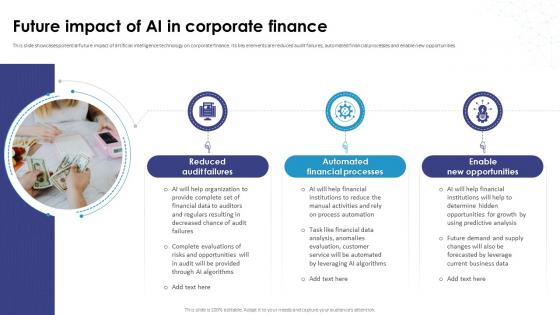
This slide showcases potential future impact of artificial intelligence technology on corporate finance. Its key elements are reduced audit failures, automated financial processes and enable new opportunities
People who downloaded this PowerPoint presentation also viewed the following :
Future Impact Of AI In Corporate Finance AI How Artificial Intelligence AI SS with all 9 slides:
Use our Future Impact Of AI In Corporate Finance AI How Artificial Intelligence AI SS to effectively help you save your valuable time. They are readymade to fit into any presentation structure.








FAQs for Future Impact Of AI In Corporate Finance AI How Artificial
AI is expected to significantly transform risk management, financial forecasting, fraud detection, regulatory compliance, and investment analysis within corporate finance. These technologies streamline operations by automating complex calculations, enhancing predictive accuracy, and enabling real-time decision-making, with many financial institutions finding that AI ultimately delivers faster processing times, reduced operational costs, and improved strategic insights.
Machine learning algorithms enhance risk assessment by analyzing vast datasets, identifying complex patterns, predicting market volatility, automating credit scoring, and detecting anomalies in real-time. Through advanced analytics, financial institutions streamline loan approvals, minimize fraud exposure, and optimize portfolio management, while enabling faster decision-making and more accurate risk modeling, ultimately delivering competitive advantage in increasingly dynamic markets.
AI improves financial forecasting accuracy through machine learning algorithms, predictive analytics, real-time data processing, pattern recognition, and automated scenario modeling. These technologies enable finance teams to analyze vast datasets, identify market trends, and adjust forecasts dynamically, with many corporations finding that AI-driven models reduce forecasting errors by up to 50% while streamlining budget planning processes.
AI streamlines financial reporting and compliance by automating data collection, standardizing report formats, and conducting real-time regulatory checks across multiple frameworks. Through machine learning algorithms, financial institutions and corporations can minimize manual errors, accelerate month-end closing processes, and ensure continuous compliance monitoring, ultimately delivering faster, more accurate reporting while reducing operational costs and regulatory risks.
AI automates routine financial tasks through invoice processing, expense categorization, reconciliation, and compliance reporting, significantly reducing manual workloads and error rates. This automation enables finance teams to shift focus toward strategic analysis, forecasting, and decision-making, with many organizations finding that their teams become more valuable business partners rather than transaction processors, ultimately delivering faster month-end closes and enhanced operational efficiency.
AI-driven analytics enhances strategic decision-making in corporate finance by providing predictive forecasting, real-time risk assessment, scenario modeling, and automated financial reporting. These technologies enable finance teams to identify market opportunities, optimize capital allocation, and streamline budget planning processes, with many organizations finding that AI-powered insights deliver faster strategic responses and competitive advantage.
Companies must address data privacy, algorithmic bias, transparency in decision-making, accountability for automated choices, and fair access to financial services when implementing AI in finance. These considerations become particularly critical in lending decisions, risk assessments, and customer interactions, with many financial institutions finding that proactive ethical frameworks ultimately enhance trust, ensure regulatory compliance, and deliver sustainable competitive advantage.
AI transforms mergers and acquisitions by automating due diligence processes, enhancing valuation accuracy through predictive analytics, and streamlining contract analysis with natural language processing. Through machine learning algorithms, investment banks and private equity firms accelerate deal sourcing, identify strategic synergies more effectively, and minimize regulatory risks, ultimately delivering faster transaction timelines and improved deal outcomes.
Leading AI-enabled corporate finance tools include machine learning platforms for predictive analytics, robotic process automation for transaction processing, natural language processing for document analysis, intelligent dashboards for real-time reporting, and automated reconciliation systems. These technologies streamline financial operations by reducing manual tasks, enhancing accuracy, and accelerating decision-making processes, with many corporations finding that strategic implementation delivers significant cost savings and competitive advantage.
Corporations can leverage AI to enhance capital allocation by utilizing predictive analytics for market forecasting, machine learning algorithms for risk assessment, and automated portfolio optimization tools. These technologies streamline decision-making by analyzing vast datasets, identifying investment opportunities, and minimizing human bias, with many financial institutions finding that AI-driven strategies deliver significantly improved returns and operational efficiency.
AI revolutionizes fraud detection by enabling real-time transaction monitoring, pattern recognition algorithms, behavioral analytics, and predictive modeling that identifies suspicious activities within milliseconds. Through machine learning capabilities, financial institutions can reduce false positives by up to 50%, accelerate investigation processes, and prevent billions in potential losses, while delivering enhanced security and seamless customer experiences.
Organizations balance AI benefits in finance with security risks by implementing robust data governance frameworks, encryption protocols, and access controls while leveraging AI's capabilities for fraud detection and operational efficiency. Through strategic risk management, companies in banking, insurance, and investment sectors enhance decision-making speed and accuracy while maintaining regulatory compliance, ultimately delivering competitive advantage and improved financial outcomes.
Finance professionals will need data analytics expertise, AI tool proficiency, strategic thinking capabilities, cross-functional collaboration skills, and continuous learning adaptability to succeed alongside AI systems. These competencies enable finance teams to interpret AI-generated insights, manage automated processes, and focus on strategic decision-making, with many organizations finding that professionals combining technical literacy with business acumen deliver the greatest competitive advantage.
AI is expected to revolutionize investor relations by enabling real-time data analysis, personalized communication, and automated reporting processes that enhance transparency and engagement. Through predictive analytics and natural language processing, financial institutions can deliver more targeted investor communications, streamline quarterly reporting, and provide data-driven insights that build stronger stakeholder relationships, ultimately improving market confidence.
Companies face challenges including data quality and integration issues, regulatory compliance requirements, legacy system compatibility, staff training needs, and initial implementation costs. While these present hurdles, many financial institutions find that strategic AI integration ultimately delivers enhanced accuracy, streamlined processes, and competitive advantage, with banks and corporations increasingly viewing these investments as essential for operational efficiency.
-
Use of different colors is good. It's simple and attractive.
-
“One of the best experiences with SlideTeam for my presentation.Everything on time, communication is efficient and price is reasonable. All good in one place.”