


Global inequality ppt powerpoint presentation model example introduction cpb




Try Before you Buy Download Free Sample Product
 Impress Your
 Audience
 100%
100% Editable
 Save Hours
 of Time


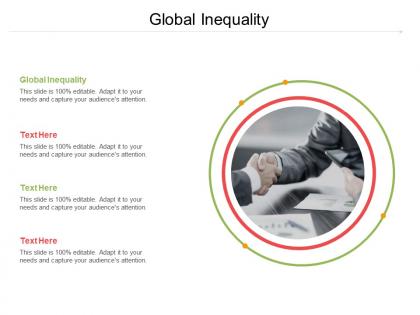
Our Global Inequality Ppt Powerpoint Presentation Model Example Introduction Cpb are topically designed to provide an attractive backdrop to any subject. Use them to look like a presentation pro.
People who downloaded this PowerPoint presentation also viewed the following :
Global inequality ppt powerpoint presentation model example introduction cpb with all 2 slides:
Use our Global Inequality Ppt Powerpoint Presentation Model Example Introduction Cpb to effectively help you save your valuable time. They are readymade to fit into any presentation structure.

FAQs for Global inequality ppt powerpoint presentation model
Global inequality stems from unequal access to education, healthcare, and economic opportunities, systemic discrimination, wealth concentration, technological divides, and governance failures. These interconnected factors create persistent disparities across regions, with developing countries facing additional challenges like limited infrastructure and capital access, while developed nations grapple with income polarization, ultimately requiring comprehensive policy approaches addressing structural barriers.
Income inequality significantly constrains social mobility by limiting access to quality education, healthcare, and economic opportunities, with regions like Sub-Saharan Africa and Latin America experiencing the most pronounced barriers. While Nordic countries demonstrate that strategic social policies and inclusive economic frameworks can enhance upward mobility, developing economies increasingly recognize that reducing inequality through targeted investments in education and infrastructure ultimately delivers stronger economic growth and more resilient societies.
Education significantly influences global inequality through disparities in school quality, teacher training, educational resources, technological access, and higher education opportunities. These gaps perpetuate income differences across regions, with countries investing in comprehensive educational systems finding enhanced workforce capabilities, innovation capacity, and economic competitiveness, ultimately delivering improved social mobility and reduced inequality over generations.
Globalization presents both challenges and opportunities for global inequality, creating wealth through increased trade, technology transfer, and economic integration, while potentially widening gaps between skilled and unskilled workers. With many developing nations finding that strategic participation in global markets delivers enhanced competitiveness and resource allocation, ultimately enabling faster economic growth when coupled with inclusive policies.
Health disparities manifest dramatically between high-income and low-income countries through differences in life expectancy, infant mortality rates, disease burden, healthcare infrastructure, and access to essential medicines and preventive care. These disparities perpetuate global inequality by limiting human capital development, reducing economic productivity, and creating cyclical poverty patterns that prevent sustainable growth and social mobility across populations.
Technology and digital divides significantly amplify global economic disparities by creating barriers to education, employment opportunities, financial services, and market access. While developed nations leverage digital infrastructure for economic growth, developing regions without reliable internet, digital literacy, or technological resources face widening income gaps, with many economists finding that bridging these divides enables substantial poverty reduction and competitive positioning.
The international trade system influences inequality through unequal market access, export dependency on raw materials versus manufactured goods, and varying bargaining power in trade agreements. Developing nations often export commodities while importing higher-value products, creating persistent trade imbalances, with many countries finding that diversifying into manufacturing and services helps reduce these disparities and enhance economic competitiveness.
Effective inequality-reduction policies include progressive taxation, universal healthcare, quality education access, minimum wage increases, and targeted social transfer programs. Countries like Brazil and South Korea have achieved significant reductions through strategic combinations of these approaches, with many finding that comprehensive education reform and conditional cash transfers deliver sustained economic mobility, ultimately creating more competitive economies and stronger consumer bases.
Climate change amplifies global inequality by disproportionately affecting vulnerable populations through extreme weather events, agricultural disruption, water scarcity, and forced displacement. While wealthy nations contribute most emissions, low-income communities and developing countries face the greatest consequences, with many organizations finding that targeted adaptation programs and sustainable development initiatives can help bridge these gaps, ultimately delivering more resilient communities and equitable climate responses.
Political instability often correlates with high inequality, as unequal resource distribution creates social tensions, undermines trust in institutions, and fuels conflict between different economic groups. Countries with more equitable income distribution, like those in Scandinavia and parts of Western Europe, typically maintain stronger democratic governance and social cohesion, ultimately delivering sustained economic growth and competitive advantage in global markets.
Historical colonialism continues shaping global inequality through persistent structural disadvantages, including disrupted economic systems, extracted resources, weakened institutions, and imposed trade relationships that favor former colonial powers. These colonial legacies manifest today in debt burdens, limited industrial capacity, and dependency on raw material exports, with many developing nations finding that breaking these entrenched patterns requires significant international cooperation and strategic economic restructuring.
Tax policies significantly influence wealth distribution through progressive taxation, capital gains rates, inheritance taxes, and corporate tax structures, affecting income mobility and economic equality. While higher progressive rates can reduce local inequality, global tax competition often enables wealthy individuals and corporations to minimize obligations through offshore strategies, ultimately creating disparities between nations and limiting redistribution effectiveness.
Gender inequality amplifies global economic disparities through unequal access to education, employment opportunities, financial services, and leadership positions, creating compounding disadvantages across generations. Women in developing economies face systemic barriers that limit productivity and economic participation, with many organizations finding that addressing gender gaps through inclusive policies, microfinance initiatives, and educational investments ultimately delivers broader economic growth and competitive advantage.
Migration patterns significantly impact global inequality through labor market dynamics, remittance flows, brain drain effects, and uneven demographic distributions across regions. While migration can reduce inequality by enabling workers to access higher wages and send money home, it also presents challenges including skills shortages in origin countries and integration pressures in destination areas, with many policymakers finding that coordinated international frameworks ultimately deliver more balanced outcomes.
International organizations can collaborate through coordinated funding initiatives, standardized data sharing systems, joint policy frameworks, and synchronized development programs targeting education, healthcare, and infrastructure. Through strategic partnerships, entities like the World Bank, UN agencies, and regional bodies streamline resource allocation, minimize program duplication, and enhance cross-border impact, ultimately delivering more comprehensive solutions and measurable progress in reducing economic disparities.
-
Nice and innovative design.
-
Illustrative design with editable content. Exceptional value for money. Highly pleased with the product.
-
Awesomely designed templates, Easy to understand.
-
Commendable slides with attractive designs. Extremely pleased with the fact that they are easy to modify. Great work!
-
Content of slide is easy to understand and edit.