


Goals And Objectives Of E Commerce Website Development Comprehensive E Commerce Website




Try Before you Buy Download Free Sample Product
 Impress Your
 Audience
 100%
100% Editable
 Save Hours
 of Time


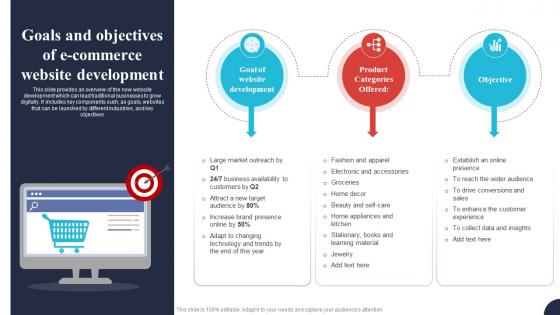
This slide provides an overview of the new website development which can lead traditional businesses to grow digitally. It includes key components such, as goals, websites that can be launched by different industries, and key objectives
People who downloaded this PowerPoint presentation also viewed the following :
Goals And Objectives Of E Commerce Website Development Comprehensive E Commerce Website with all 9 slides:
Use our Goals And Objectives Of E Commerce Website Development Comprehensive E Commerce Website to effectively help you save your valuable time. They are readymade to fit into any presentation structure.









FAQs for Goals And Objectives Of E Commerce Website Development Comprehensive
Critical e-commerce features include intuitive navigation, fast loading speeds, mobile responsiveness, secure payment gateways, detailed product descriptions with high-quality images, customer reviews, and streamlined checkout processes. These elements work together by reducing friction, building trust, and enhancing user experience, with many online retailers finding that strategic implementation ultimately delivers higher conversion rates and sustained customer loyalty.
SEO strategies integrate into e-commerce development through optimized site architecture, mobile-responsive design, fast loading speeds, clean URL structures, and strategic keyword implementation. These technical foundations enable search engines to crawl efficiently while enhancing user experience, with many online retailers finding that early SEO integration delivers higher organic traffic and sustained competitive advantage.
User experience (UX) serves as the foundation for successful e-commerce platforms, directly influencing conversion rates, customer retention, and revenue generation through intuitive navigation, streamlined checkout processes, and responsive design. Strategic UX design enables retailers to reduce cart abandonment, enhance customer satisfaction, and build competitive advantage, with many leading platforms finding that optimized user journeys deliver significantly higher sales and long-term customer loyalty.
Mobile responsiveness is critically important in e-commerce development, as over 60% of online shopping occurs on mobile devices, directly impacting conversion rates, search rankings, and customer retention. Through responsive design, businesses streamline checkout processes, enhance user experiences, and capture mobile-first consumers, with many retailers finding that mobile-optimized sites deliver significantly higher sales and competitive advantage.
Best practices for incorporating payment gateways include implementing multiple payment options, ensuring PCI DSS compliance, optimizing checkout flows, integrating fraud detection systems, and providing mobile-responsive interfaces. These security and usability measures streamline transactions by reducing cart abandonment, enhancing customer trust, and enabling seamless processing across devices, ultimately delivering faster checkout experiences and increased conversion rates for online retailers.
E-commerce websites leverage data analytics through customer behavior tracking, sales pattern analysis, personalization algorithms, inventory optimization, and conversion funnel assessment to drive strategic business decisions. These analytics enable retailers to enhance customer experiences by delivering targeted product recommendations, optimizing pricing strategies, and streamlining checkout processes, ultimately increasing sales conversion rates and customer retention.
**INPUT**: What security measures should be prioritized when developing an e-commerce website to protect customer information? **OUTPUT**: Essential security measures include SSL encryption, secure payment gateways, two-factor authentication, regular security audits, and PCI DSS compliance. These technologies streamline protection by safeguarding transactions, preventing data breaches, and building customer trust, with many retailers finding that robust security ultimately delivers competitive advantage and enhanced customer loyalty.
Social media integration enhances e-commerce performance by enabling seamless social login, facilitating user-generated content sharing, and driving referral traffic through integrated marketing campaigns. These features streamline customer acquisition, boost brand visibility, and create authentic social proof, with many retail businesses finding that social integration increases conversion rates and customer engagement significantly.
Ensuring a seamless checkout process involves minimizing form fields, offering guest checkout options, displaying security badges, providing multiple payment methods, and implementing progress indicators. These optimization strategies streamline customer experiences by reducing cart abandonment, accelerating transaction completion, and building purchase confidence, with many retailers finding that simplified checkouts increase conversion rates by up to 35%.
Personalization tactics in e-commerce include dynamic product recommendations, customized landing pages, targeted email campaigns, personalized search results, and behavioral-triggered content based on browsing history and purchase patterns. These strategies enhance customer experiences by delivering relevant content, streamlining navigation, and anticipating needs, with many retailers finding that personalized approaches increase repeat purchases and customer lifetime value significantly.
Site speed significantly impacts user experience and sales conversions, with slow-loading pages leading to increased bounce rates, abandoned shopping carts, and reduced customer satisfaction. Research consistently shows that even one-second delays can decrease conversions by up to 7%, while faster sites enhance user engagement, improve search rankings, and ultimately deliver higher revenue, with many e-commerce businesses finding that optimized loading times directly correlate with competitive advantage.
E-commerce websites should integrate real-time inventory tracking systems, automated reorder points, multi-warehouse management capabilities, and seamless logistics partnerships directly into their development architecture. These strategic combinations streamline operations by reducing stockouts, minimizing carrying costs, and accelerating fulfillment processes, with many retailers finding that unified inventory-logistics platforms ultimately deliver faster customer experiences and significant competitive advantages.
**INPUT**: What design elements contribute to building trust with users on e-commerce websites? **OUTPUT**: Trust-building design elements include SSL certificates, customer reviews, clear contact information, professional product photography, and transparent return policies. These elements enhance credibility by displaying security badges, showcasing authentic testimonials, and providing accessible customer service channels, with many e-commerce businesses finding that combining visual professionalism with transparent communication ultimately delivers higher conversion rates and customer loyalty. [Word count: 58 words]
A/B testing optimizes e-commerce conversions by systematically comparing different versions of key website elements like checkout flows, product pages, call-to-action buttons, pricing displays, and navigation structures. Through controlled experiments, online retailers can identify which design variations, content approaches, and user experience features drive higher purchase rates, reduce cart abandonment, and increase average order values, ultimately delivering data-driven improvements that enhance customer engagement and maximize revenue performance.
Content management systems enable e-commerce businesses to efficiently update product catalogs, manage inventory, modify pricing, and maintain website content without requiring technical expertise. Through intuitive dashboards and automated workflows, retailers streamline daily operations like promotional campaigns and inventory tracking, while restaurants and fashion brands leverage CMS platforms to deliver faster updates and enhanced customer experiences, ultimately reducing operational costs.
-
These stunning templates can help you create a presentation like a pro.
-
Editable templates with innovative design and color combination.