


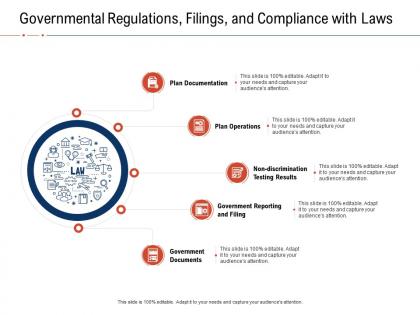
Governmental regulations filings and compliance with laws fraud investigation ppt format




Try Before you Buy Download Free Sample Product
 Impress Your
 Audience
 100%
100% Editable
 Save Hours
 of Time


Our Governmental Regulations Filings And Compliance With Laws Fraud Investigation Ppt Format are topically designed to provide an attractive backdrop to any subject. Use them to look like a presentation pro.
People who downloaded this PowerPoint presentation also viewed the following :
Governmental regulations filings and compliance with laws fraud investigation ppt format with all 2 slides:
Use our Governmental Regulations Filings And Compliance With Laws Fraud Investigation Ppt Format to effectively help you save your valuable time. They are readymade to fit into any presentation structure.

FAQs for Governmental regulations filings and compliance with laws fraud
Key components include risk assessment frameworks, detection systems, investigation protocols, reporting mechanisms, and staff training programs. These elements work together by identifying vulnerabilities, monitoring transactions, standardizing response procedures, and ensuring regulatory adherence, with many financial institutions finding that integrated compliance programs significantly reduce fraud losses while maintaining customer trust.
Organizations can assess their fraud detection capabilities by evaluating their monitoring systems, data analytics tools, detection algorithms, response protocols, and compliance frameworks. Through comprehensive audits and benchmarking exercises, companies can identify gaps in real-time detection, investigate weaknesses in cross-channel monitoring, and enhance their investigative processes, ultimately strengthening their fraud prevention strategies and regulatory compliance.
Employee training serves as a critical frontline defense against fraud by educating staff on recognizing suspicious activities, understanding compliance protocols, proper reporting procedures, and emerging fraud schemes. Through comprehensive programs, organizations enhance detection capabilities, reduce human error vulnerabilities, and create accountability cultures, with many financial institutions and healthcare companies finding that well-trained employees identify fraud attempts significantly faster.
Legal requirements for fraud investigation compliance vary significantly across jurisdictions, including mandatory reporting timelines, evidence preservation standards, regulatory notification protocols, data protection measures, and cross-border cooperation frameworks. While financial institutions in the EU must comply with GDPR and PCI DSS standards, banks in the US navigate SOX requirements and state-specific regulations, ultimately delivering standardized investigation processes and enhanced regulatory transparency.
Data analytics enhances fraud detection by identifying unusual patterns, analyzing transaction behaviors, and flagging suspicious activities in real-time through machine learning algorithms. Financial institutions and insurance companies leverage predictive modeling, anomaly detection, and behavioral analytics to reduce false positives, accelerate investigation timelines, and ultimately deliver more accurate fraud prevention while minimizing operational costs.
Common red flags include unexplained financial discrepancies, unusual vendor relationships, employee lifestyle changes beyond income levels, altered documentation, and inconsistent accounting records. These warning signs often manifest through duplicate payments, unauthorized transactions, or resistance to audits, with many organizations finding that combining automated monitoring systems with regular compliance reviews enables early detection and significantly reduces potential losses.
Organizations should document fraud investigation processes through detailed procedural manuals, evidence collection protocols, interview documentation standards, chain of custody requirements, and regular compliance audits. These comprehensive frameworks enable financial institutions, healthcare organizations, and insurance companies to maintain regulatory transparency, ensure consistent investigative approaches, and demonstrate due diligence, ultimately delivering legal protection and enhanced stakeholder confidence.
Strategies include establishing clear ethical guidelines, implementing regular compliance training, creating anonymous reporting channels, conducting transparent investigations, and recognizing ethical behavior publicly. These approaches enhance organizational integrity by promoting accountability, building employee trust, and ensuring consistent adherence to standards, with many financial institutions finding that transparent communication and leadership commitment ultimately deliver stronger compliance outcomes and competitive advantage.
Whistleblower programs significantly enhance fraud investigation compliance by providing anonymous reporting channels, early detection mechanisms, and insider insights that external audits might miss. These programs enable organizations to identify compliance violations, financial irregularities, and regulatory breaches more quickly, while fostering a culture of transparency and accountability, ultimately strengthening overall fraud prevention frameworks.
Organizations face challenges including evidence preservation across digital and physical formats, maintaining confidentiality while gathering witness testimony, balancing legal compliance with operational continuity, managing resource allocation during lengthy investigations, and coordinating between internal teams and external counsel. These complexities are heightened in regulated industries like banking and healthcare, where investigators must navigate strict privacy requirements while ensuring thorough documentation, ultimately requiring specialized expertise and structured protocols.
External audits complement internal fraud investigations by providing independent verification, specialized expertise, and objective assessment of fraud controls and detection mechanisms. These audits enhance investigation credibility through third-party validation, identify gaps in internal processes, and ensure regulatory compliance, with many financial institutions and corporations finding that external oversight strengthens overall fraud prevention frameworks and stakeholder confidence.
Organizations should establish clear communication protocols, maintain detailed documentation chains, ensure data privacy compliance, designate trained liaison personnel, and implement secure information-sharing procedures when collaborating with law enforcement. Financial institutions and healthcare organizations increasingly find that these structured approaches streamline investigations, reduce legal risks, and enhance case outcomes while maintaining regulatory compliance and protecting sensitive information.
Technology streamlines fraud investigation through automated transaction monitoring, AI-powered pattern recognition, digital forensics platforms, blockchain audit trails, and real-time alert systems. These tools enable investigators to process vast datasets quickly, identify suspicious activities automatically, and maintain comprehensive documentation, ultimately reducing investigation time while enhancing accuracy and regulatory compliance.
Risk assessment serves as the foundation for fraud investigation compliance frameworks by identifying vulnerabilities, evaluating potential impact scenarios, and prioritizing resource allocation across different risk categories. This systematic approach enables organizations to develop targeted controls, establish appropriate monitoring thresholds, and create response protocols that align with regulatory requirements, ultimately delivering more effective fraud prevention and faster incident resolution while ensuring compliance consistency.
Organizations leverage case studies by analyzing successful detection methods, identifying common fraud patterns, and adapting proven investigative techniques to their specific contexts. These real-world examples enable financial institutions, healthcare organizations, and retail companies to enhance their prevention frameworks, streamline investigation protocols, and reduce response times, ultimately delivering more robust compliance programs and stronger fraud deterrence.
-
Attractive design and informative presentation.